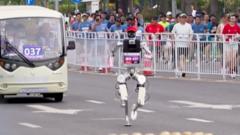
Robotic Sprinter ‘Lightning’ Shatters Human Half-Marathon Records in Beijing
A significant technological milestone was reached at the Beijing Half Marathon, where a robotic competitor named ‘Lightning’ outperformed elite human athletes. The machine completed the 13.1-mile course in just 50 minutes and 26 seconds, a time that comfortably surpasses the current men’s world record of 57 minutes and 20 seconds. This feat highlights a major advancement in autonomous mobility and mechanical efficiency.
Developed by the smartphone manufacturer Honor, Lightning navigated the urban race course with high precision and agility. The event featured a diverse field of robotic participants, with organizers reporting that approximately 40% of the machines functioned with full autonomy. The remaining robots utilized remote human guidance, illustrating the current transitional phase of robotic development where hybrid systems are still common.
The success of Lightning serves as a clear indicator of how rapidly autonomous systems are evolving to handle complex, real-world environments. While human athletes remain the benchmark for competitive sports, the ability of a machine to maintain such high speeds over long distances demonstrates that the gap between human physical endurance and mechanical capability is closing faster than previously anticipated.
Key Takeaways
- The robot 'Lightning' completed a half marathon in 50 minutes and 26 seconds, beating the human world record by nearly seven minutes.
- The robotic field consisted of a mix of fully autonomous systems and remotely operated units.
- Developed by Honor, the performance highlights significant breakthroughs in robotic mobility and real-world navigation.
Editor’s Analysis & Impact
The performance of ‘Lightning’ at the Beijing Half Marathon represents a pivotal moment in the integration of robotics into public, real-world spaces. Beyond the novelty of the event, this achievement underscores the rapid maturation of bipedal and wheeled mobility technologies. For the robotics industry, this serves as a proof-of-concept for high-speed navigation in unpredictable environments, which has massive implications for logistics, search-and-rescue operations, and personal assistance hardware. While we are unlikely to see robots replacing human athletes in professional sports anytime soon, the ability to maintain such speeds over long distances suggests that the mechanical limitations that once hindered robotic mobility are being systematically dismantled. As these technologies continue to scale, we can expect to see increased pressure on regulatory bodies to define the role of autonomous machines in public infrastructure and competitive arenas.
Frequently Asked Questions
Q: How fast did the robot 'Lightning' run the half marathon?
A: The robot completed the 13.1-mile course in 50 minutes and 26 seconds.
Q: Were the robots fully autonomous during the race?
A: Only about 40% of the robotic participants were fully autonomous, while the rest were operated remotely by humans.
AI Disclosure: This article is based on verified data and official reports. Our Team and AI have cross-referenced every financial detail with primary sources to ensure total accuracy.
More from this Category