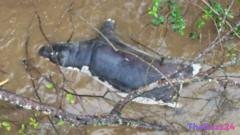
Zambia Issues Urgent Health Warning Amid Deadly Anthrax Outbreak Affecting Wildlife and Humans
Zambian authorities have issued a critical public health warning following a significant anthrax outbreak that has claimed the lives of dozens of wild animals, including hippos, elephants, buffalo, and a crocodile. The alarming situation has led to at least 12 human infections in the Munyamadzi River area, where individuals reportedly consumed meat from the deceased wildlife. Officials are strongly advising the public against consuming any meat from animals that have died from natural causes or unknown illnesses and are urging immediate reporting of such incidents.
The latest outbreak, concentrated within the Munyamadzi Game Management Area in Muchinga province, has seen a devastating toll on wildlife since July. The Disaster Management and Mitigation Unit (DMMU) has confirmed the deaths of 46 hippos, eight elephants, five buffaloes, and one crocodile. Norman Chipakupaku, the DMMU’s national coordinator, highlighted the unfortunate reality that local communities often rely on these carcasses for sustenance, contributing to the human infection rate. While no human fatalities have been reported in this specific outbreak, the 12 infected individuals are currently undergoing treatment.
In response to the escalating crisis, a temporary suspension of hunting activities has been imposed in the affected region. This measure aims to allow authorities to fully assess the geographical spread of the disease and the associated risks before further action. Surveillance efforts and laboratory investigations are actively underway to determine the full extent of the current outbreak.
Anthrax, caused by the bacterium Bacillus anthracis, is endemic to Zambia, with its spores capable of surviving in soil for years. The disease primarily affects grazing animals, often leading to sudden death, and can be transmitted to humans through contact with contaminated animal products or consumption of infected meat. Zambia has a history of significant outbreaks, including an “unprecedented” event in 2023 that resulted in four human deaths and spread across nine of the country’s ten provinces. A large-scale outbreak in 2011 also saw over 500 cases and five fatalities linked to consuming infected hippo meat, underscoring the persistent public health challenge posed by the disease.
Key Takeaways
- An anthrax outbreak in Zambia has led to the deaths of dozens of wild animals, including hippos, elephants, and buffalo.
- At least 12 people have been infected after consuming meat from deceased wildlife in the Munyamadzi River area.
- Zambian authorities have issued urgent warnings against consuming dead animals and have suspended hunting in affected regions to prevent further spread.
Editor’s Analysis & Impact
This anthrax outbreak in Zambia underscores the critical intersection of public health, wildlife conservation, and community livelihoods. The immediate market impact is localized, primarily affecting communities reliant on bushmeat, potentially disrupting local economies and traditional food sources. The suspension of hunting, while necessary, could further strain these communities.
Looking ahead, the endemic nature of anthrax in Zambia suggests a recurring challenge. Effective public health campaigns, robust surveillance, and rapid response mechanisms are crucial. There’s a broader implication for wildlife management, as repeated outbreaks can significantly impact vulnerable populations of large mammals. This situation highlights the ongoing need for integrated “One Health” approaches, addressing human, animal, and environmental health collaboratively to mitigate future risks and protect both biodiversity and human well-being.
Frequently Asked Questions
Q: What is anthrax and how is it transmitted?
A: Anthrax is a serious infectious disease caused by the bacterium Bacillus anthracis. It primarily affects grazing animals but can be transmitted to humans through contact with infected animals or their products, such as consuming contaminated meat or handling carcasses. The bacteria's spores can survive in soil for many years.
Q: Why are Zambian authorities warning against eating dead wildlife?
A: Authorities are warning against consuming dead wildlife because animals that die from unknown causes, especially in an outbreak area, are highly likely to be infected with anthrax. Eating such meat can directly transmit the deadly bacteria to humans, as evidenced by the 12 reported infections in the current outbreak.
Q: How common are anthrax outbreaks in Zambia?
A: Anthrax is endemic to Zambia, meaning it is regularly found in the region. The country has experienced several significant outbreaks, including an "unprecedented" one in 2023 that spread across nine provinces and a large-scale event in 2011, indicating that outbreaks are a recurring public health and wildlife management challenge.
AI Disclosure: This article is based on verified data and official reports. Our Team and AI have cross-referenced every financial detail with primary sources to ensure total accuracy.
More from this Category