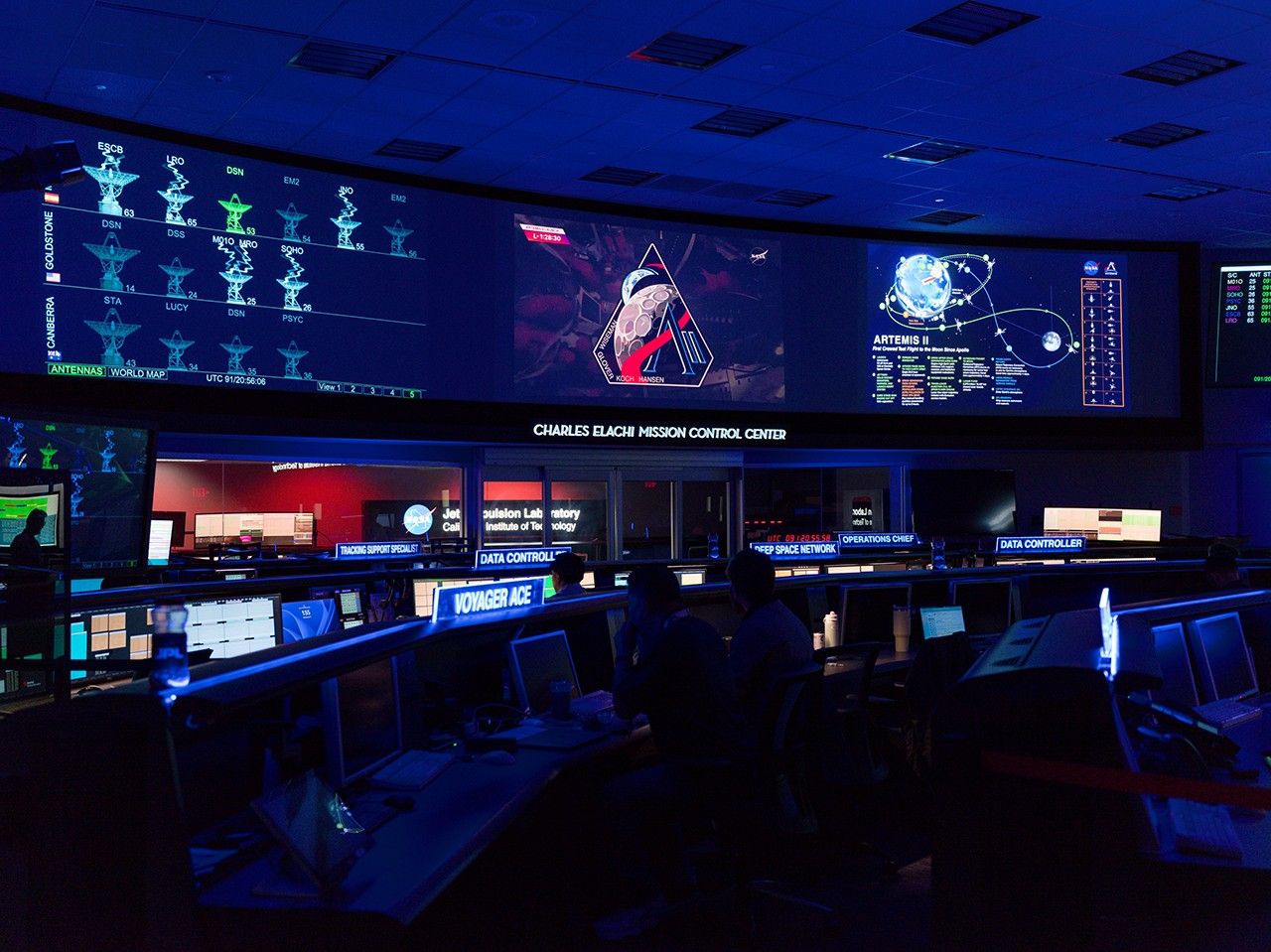
NASA’s Deep Space Network Assumes Command of Artemis II Lunar Mission
The Jet Propulsion Laboratory has officially taken the helm of mission communications for the Artemis II lunar expedition. Operating from the Space Flight Operations Facility in Southern California, mission controllers are now utilizing the Deep Space Network (DSN) to manage tracking and data relay for the crewed spacecraft as it ventures further into the cosmos. This transition marks a historic moment, as it is the first time in over 50 years that the DSN has been tasked with supporting a crewed vessel on a deep-space journey.
To ensure an unbroken connection, the DSN relies on a sophisticated global array of high-precision radio antennas strategically positioned in Goldstone, California; Madrid, Spain; and Canberra, Australia. This geographic distribution allows mission control to maintain a seamless link with the spacecraft regardless of Earth’s rotation, facilitating the constant transfer of critical telemetry, scientific data, and direct commands to the astronauts on board.
The shift to the Deep Space Network follows the initial launch phase, which was supported by the Near Space Network. This transition was a vital operational requirement to maintain signal integrity as the Artemis II craft moves beyond Earth’s immediate vicinity. Managed by the Space Communications and Navigation program, the DSN acts as the primary lifeline for the mission, allowing ground crews to monitor the health and safety of the astronauts in real-time as they navigate the complexities of lunar exploration.
Key Takeaways
- The Jet Propulsion Laboratory has transitioned Artemis II communications to the Deep Space Network for the duration of the lunar voyage.
- The DSN utilizes a global network of antennas in California, Spain, and Australia to ensure constant, uninterrupted contact with the crew.
- This mission represents the first time in over five decades that the DSN has been used to support a crewed deep-space flight.
Editor’s Analysis & Impact
The successful handover of the Artemis II mission to the Deep Space Network underscores the critical importance of robust, global infrastructure in the new era of lunar exploration. As humanity shifts from low-Earth orbit missions to sustained deep-space presence, the reliability of communication networks becomes the single point of failure for mission success. The DSN’s ability to handle the high-bandwidth requirements of modern telemetry while maintaining low-latency links is a technological feat that sets the stage for future Mars missions. Looking ahead, the integration of these ground-based assets with emerging lunar relay satellites will likely create a more resilient ‘lunar internet,’ essential for the safety of long-term crewed operations and the commercialization of the cislunar economy.
Frequently Asked Questions
Q: Why is the Deep Space Network necessary for the Artemis II mission?
A: As the spacecraft travels further away from Earth, the Near Space Network is no longer sufficient to maintain a strong signal. The DSN provides the high-precision, long-range communication capabilities required for deep-space missions.
Q: Where are the Deep Space Network antennas located?
A: The DSN consists of three primary antenna complexes located in Goldstone, California; Madrid, Spain; and Canberra, Australia, ensuring that at least one station has a clear line of sight to the spacecraft at all times.
AI Disclosure: This article is based on verified data and official reports. Our Team and AI have cross-referenced every financial detail with primary sources to ensure total accuracy.
More from this Category