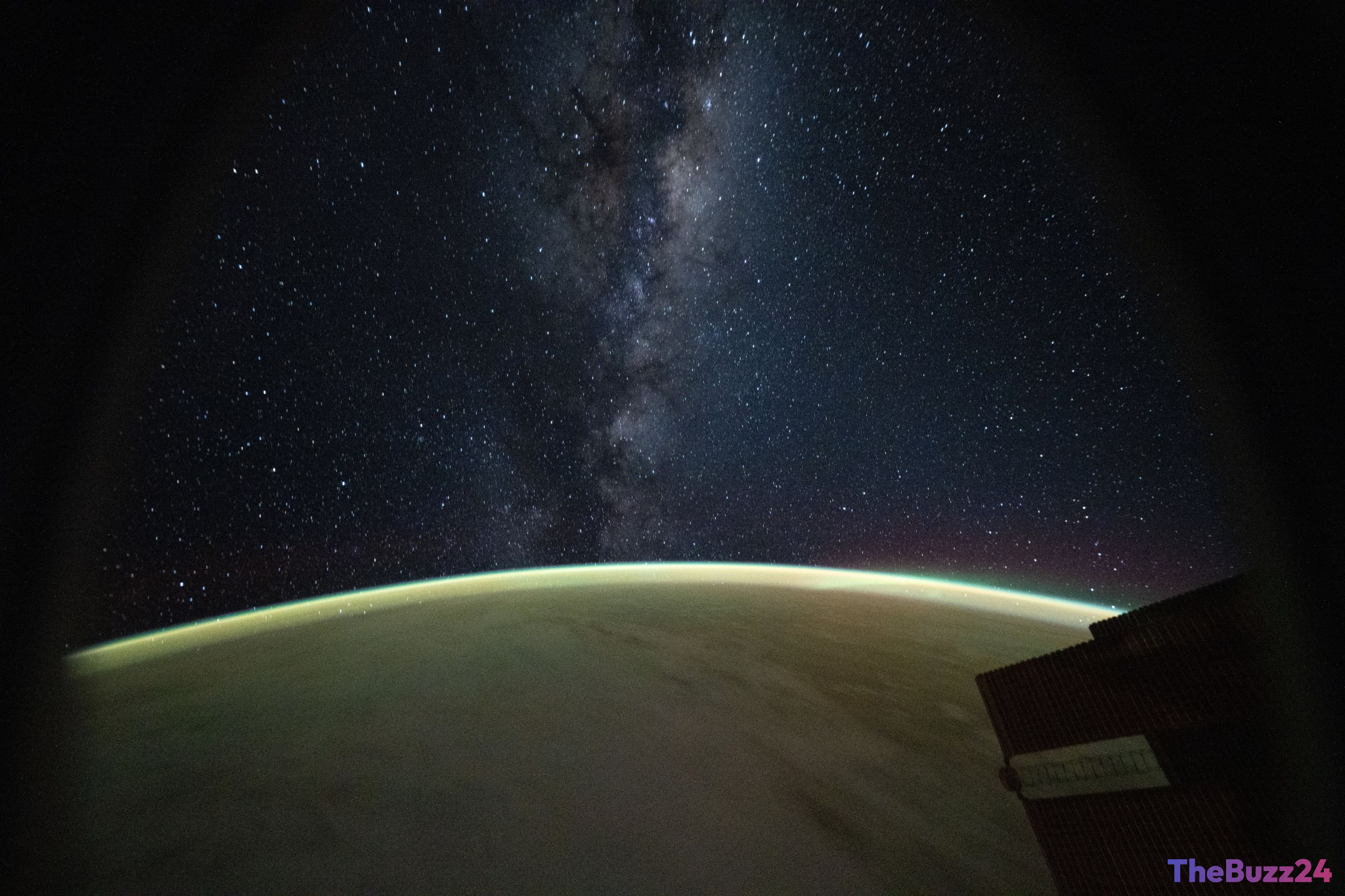
Cosmic Radiance: Astronaut Captures Stunning View of Earth’s Airglow and the Milky Way
In a breathtaking display of cosmic beauty, astronaut Chris Williams recently captured a stunning photograph showcasing the Milky Way rising gracefully above the Earth’s atmospheric glow. Taken on April 13, 2026, the image was captured from a unique vantage point aboard a SpaceX Dragon spacecraft, which was docked at the International Space Station (ISS). The photograph highlights the delicate boundary between our planet’s atmosphere and the vast expanse of space.
The luminous band hugging the Earth’s curve in the photograph is a phenomenon known as airglow. This atmospheric glow occurs in the upper atmosphere when atoms and molecules, energized by daytime sunlight, release light to shed their excess energy. It can also happen when solar-ionized atoms and molecules collide with and capture free electrons, emitting photons as they return to a relaxed state. This continuous emission of light wraps the planet in a subtle, colorful envelope that is visible from orbit.
While airglow may appear similar to the famous auroras, the two phenomena have distinct origins. Auroras are triggered by high-energy particles from solar winds colliding with Earth’s magnetic field, typically concentrating near the poles. In contrast, airglow is powered by everyday solar radiation and occurs globally across the atmosphere. Observing these emissions helps scientists study the temperature, composition, and dynamics of the upper atmosphere, providing crucial data on how solar energy interacts with our planet’s protective layers.
Key Takeaways
- Astronaut Chris Williams photographed the Milky Way and Earth's airglow from a SpaceX Dragon docked at the ISS on April 13, 2026.
- Airglow is caused by atmospheric atoms and molecules releasing excess energy absorbed from daytime solar radiation.
- Unlike auroras, which are driven by solar winds, airglow is a global phenomenon powered by ordinary daily sunlight.
Editor’s Analysis & Impact
The stunning imagery captured by astronauts aboard the ISS does more than just inspire awe; it plays a vital role in advancing public engagement and scientific understanding of near-Earth space environments. As commercial spaceflight becomes more integrated with scientific missions—exemplified by the use of the SpaceX Dragon capsule—the opportunities for high-resolution Earth observation are expanding. Monitoring atmospheric phenomena like airglow is essential for understanding upper-atmosphere dynamics, which directly impact satellite communications, GPS signals, and orbital decay predictions. This intersection of commercial space infrastructure and scientific observation underscores the growing synergy in modern space exploration, where private vessels serve as critical platforms for both human spaceflight and planetary science.
Frequently Asked Questions
Q: What is the difference between airglow and auroras?
A: While both are atmospheric light displays, auroras are caused by high-energy particles from solar winds interacting with Earth's magnetic field, whereas airglow is caused by ordinary daily solar radiation exciting atoms in the upper atmosphere globally.
Q: Where was this photograph taken from?
A: The photograph was taken by astronaut Chris Williams from a SpaceX Dragon spacecraft docked to the International Space Station (ISS).
Q: Why do scientists study airglow?
A: Scientists study airglow to gain insights into the temperature, density, and chemical composition of the Earth's upper atmosphere, which helps in monitoring space weather and its effects on satellite technology.
AI Disclosure: This article is based on verified data and official reports. Our Team and AI have cross-referenced every financial detail with primary sources to ensure total accuracy.
More from this Category