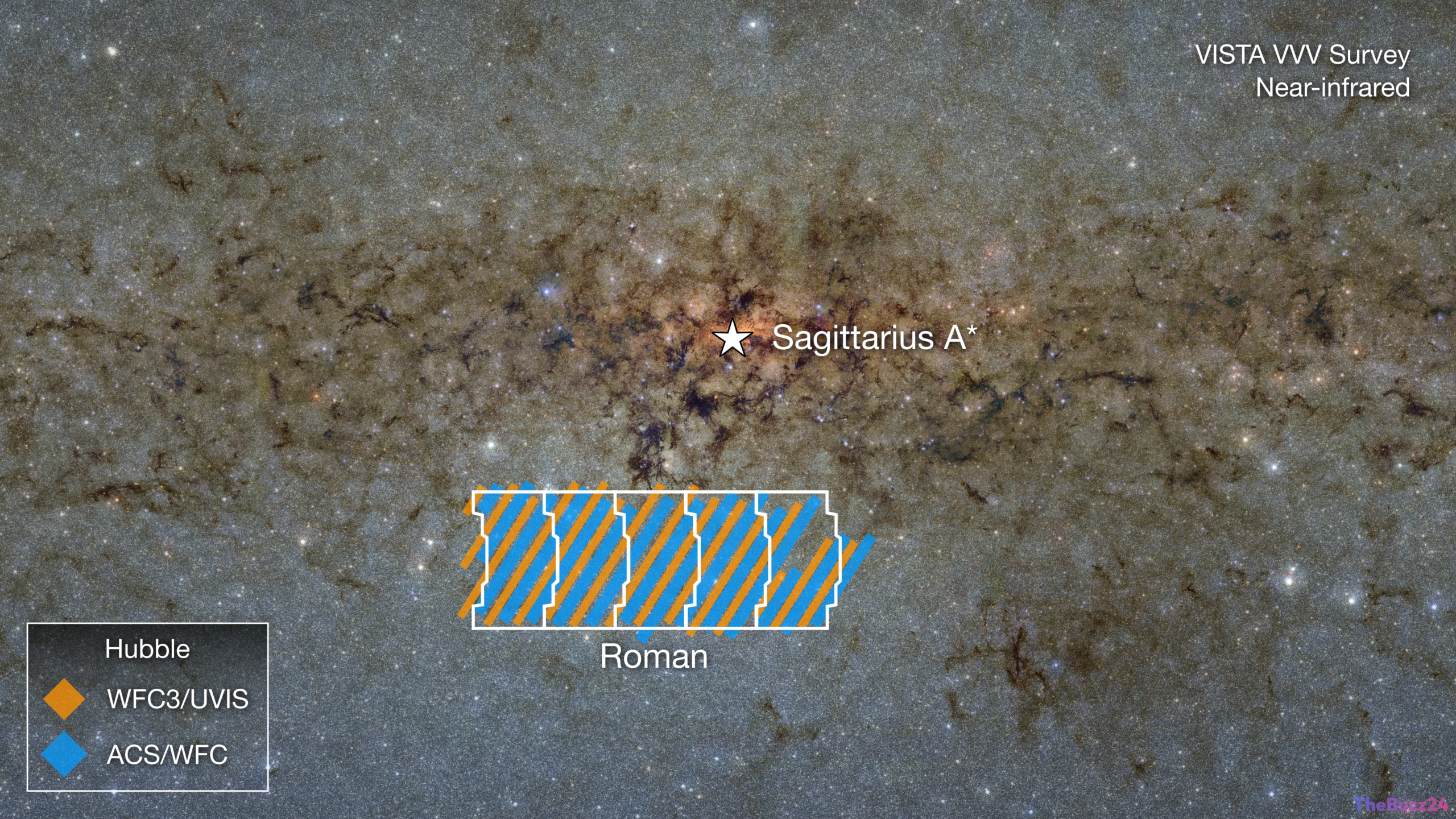
Mapping the Milky Way: Hubble Data Paves the Way for Roman Space Telescope Mission
The dense and enigmatic heart of the Milky Way, known as the galactic bulge, is set to undergo its most detailed examination to date. As the scientific community prepares for the deployment of the Nancy Grace Roman Space Telescope, researchers are utilizing existing data from the Hubble Space Telescope to create a foundational map of this complex region. This strategic preparation ensures that the Roman telescope can begin its mission with a high-resolution baseline, effectively transforming a massive survey into a precise window into the galaxy’s core.
The upcoming mission is designed to catalog millions of stars and thousands of exoplanets, taking advantage of the Roman telescope’s expansive field of view and high-frequency observation capabilities. A primary objective is the study of gravitational microlensing—a phenomenon where a foreground object magnifies the light of a distant star as it passes by. By integrating Hubble’s historical records with the real-time, high-cadence data from the new telescope, scientists expect to identify and measure the masses of elusive objects such as rogue planets, black holes, and isolated neutron stars with unprecedented accuracy.
This collaborative data approach is already proving successful, offering a clearer understanding of the distribution of interstellar dust, gas, and stellar density within the galactic bulge. As the launch of the Roman telescope approaches, this preparatory work acts as a vital bridge, streamlining future data interpretation. The resulting stellar catalog is expected to be one of the most comprehensive in history, fundamentally reshaping our understanding of the inner mechanics of our galaxy.
Key Takeaways
- Hubble Space Telescope data is being used to establish a foundational baseline for the upcoming Nancy Grace Roman Space Telescope mission.
- The mission will utilize gravitational microlensing to detect and measure dark objects like rogue planets, black holes, and neutron stars.
- The integration of legacy and new data will produce one of the most detailed stellar catalogs of the Milky Way's core ever created.
Editor’s Analysis & Impact
The synergy between the Hubble and Roman space telescopes represents a paradigm shift in how astronomical missions are planned and executed. By utilizing ‘legacy’ data to calibrate future instruments, the scientific community is maximizing the return on investment for multi-billion dollar hardware. This approach significantly reduces the ‘learning curve’ for the Roman telescope, allowing it to transition immediately from commissioning to high-impact science. From a broader industry perspective, this methodology highlights the growing importance of data integration in space exploration. As we move toward an era of massive, automated sky surveys, the ability to synthesize data across different generations of telescopes will be the primary driver of discovery. This project not only enhances our map of the Milky Way but also sets a blueprint for future deep-space missions, where archival data serves as the bedrock for next-generation observation.
Frequently Asked Questions
Q: Why is the galactic bulge a primary focus for the Roman Space Telescope?
A: The galactic bulge is a dense, complex region of the Milky Way that contains a high concentration of stars and planetary systems, making it an ideal laboratory for studying stellar evolution and detecting rare objects through microlensing.
Q: What is gravitational microlensing and why is it important?
A: Gravitational microlensing occurs when a foreground object's gravity bends the light of a more distant star. It is a vital tool for detecting 'dark' objects that do not emit light, such as rogue planets, black holes, and neutron stars.
AI Disclosure: This article is based on verified data and official reports. Our Team and AI have cross-referenced every financial detail with primary sources to ensure total accuracy.
More from this Category