Hubble Telescope Reveals Stunning New View of Distant Galaxy Cluster
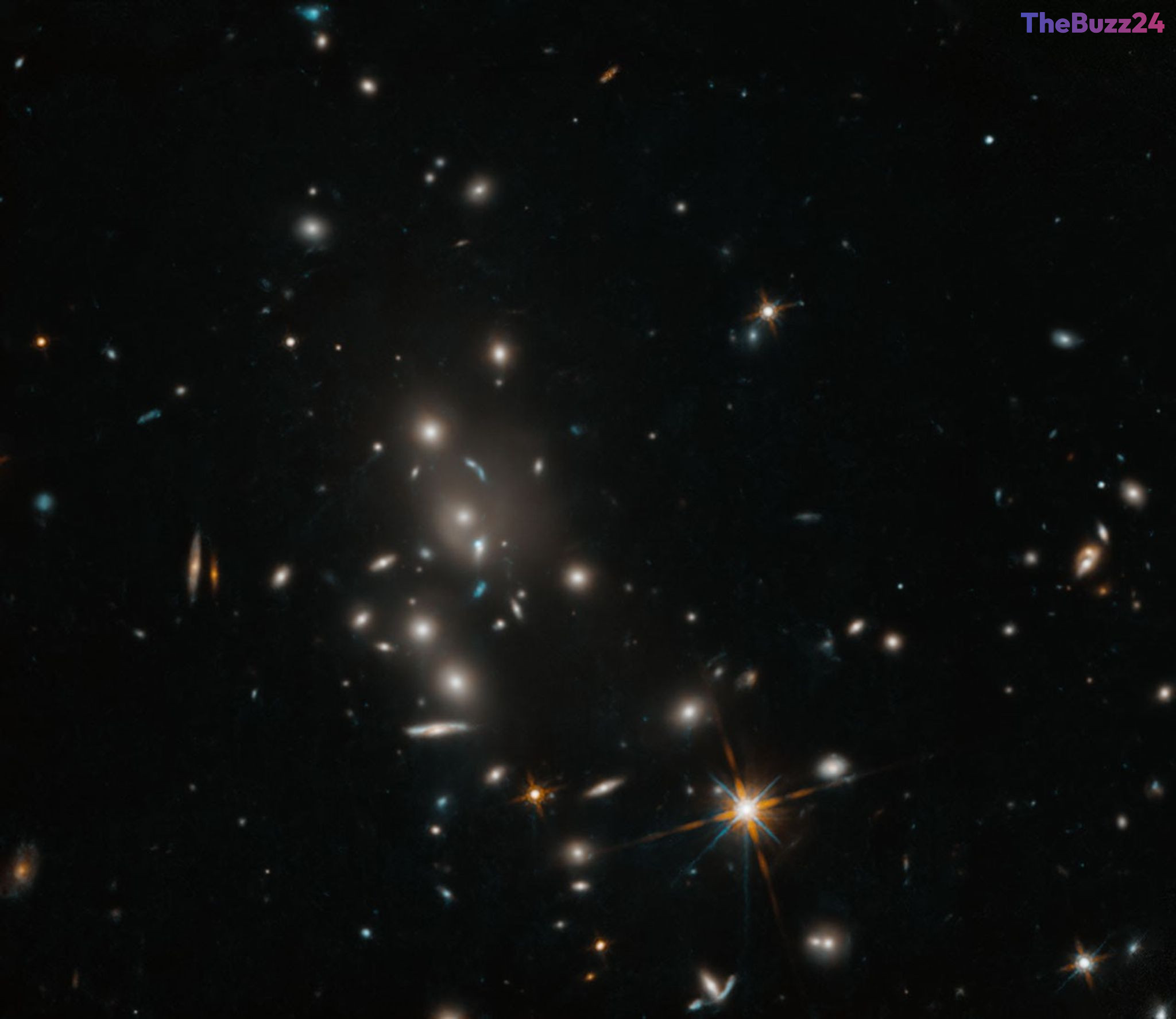
The Hubble Space Telescope has successfully captured a high-resolution image of the galaxy cluster MACS J1141.6-1905. Situated approximately four billion light-years away in the constellation Crater, this dense collection of galaxies was imaged using a combination of visible and infrared light. The resulting visual provides a clear look at the cluster’s structure, punctuated by foreground stars that display the iconic diffraction spikes characteristic of the telescope’s mirror design.
This observation is part of a broader scientific initiative aimed at studying massive, X-ray-bright galaxy clusters. By utilizing the principle of gravitational lensing, researchers are effectively using the cluster as a natural cosmic magnifying glass. This technique allows astronomers to peer at much more distant galaxies that are hidden behind the cluster, while simultaneously gathering data on the internal dynamics and evolutionary processes of MACS J1141.6-1905 itself.
Even after more than three decades in orbit, the Hubble Space Telescope remains an essential tool for modern astrophysics. With an archive containing over 1.7 million observations, the mission continues to provide invaluable data. Scientists are increasingly applying modern analytical techniques to this legacy information, ensuring that the telescope remains at the cutting edge of space exploration and discovery.
Key Takeaways
- The Hubble Space Telescope captured a detailed image of the galaxy cluster MACS J1141.6-1905, located four billion light-years away.
- Researchers are using gravitational lensing within the cluster to observe even more distant galaxies located behind it.
- The telescope's extensive 36-year archive continues to be a primary resource for astronomers applying new technology to historical data.
Editor’s Analysis & Impact
The continued productivity of the Hubble Space Telescope underscores a significant trend in modern astronomy: the immense value of long-term data archives. As analytical software and machine learning algorithms improve, scientists are increasingly able to extract new discoveries from existing datasets without needing new observations. This efficiency is critical for the future of space research, as it maximizes the return on investment for legacy hardware. The study of galaxy clusters like MACS J1141.6-1905 is essential for understanding dark matter distribution and the large-scale structure of the universe. Moving forward, the integration of Hubble’s historical data with newer instruments like the James Webb Space Telescope will likely lead to a more comprehensive understanding of galactic evolution and the expansion rate of the cosmos.
Frequently Asked Questions
Q: What is gravitational lensing?
A: Gravitational lensing occurs when a massive object, such as a galaxy cluster, bends the light from a more distant object behind it, acting like a natural magnifying glass for astronomers.
Q: Why do stars in Hubble images have 'spikes'?
A: The diffraction spikes seen on stars in Hubble images are caused by the light interacting with the telescope's secondary mirror support structures, creating a distinct visual pattern.
AI Disclosure: This article is based on verified data and official reports. Our Team and AI have cross-referenced every financial detail with primary sources to ensure total accuracy.
More from this Category