James Webb Telescope Observations Challenge Origins of Early Universe Black Holes
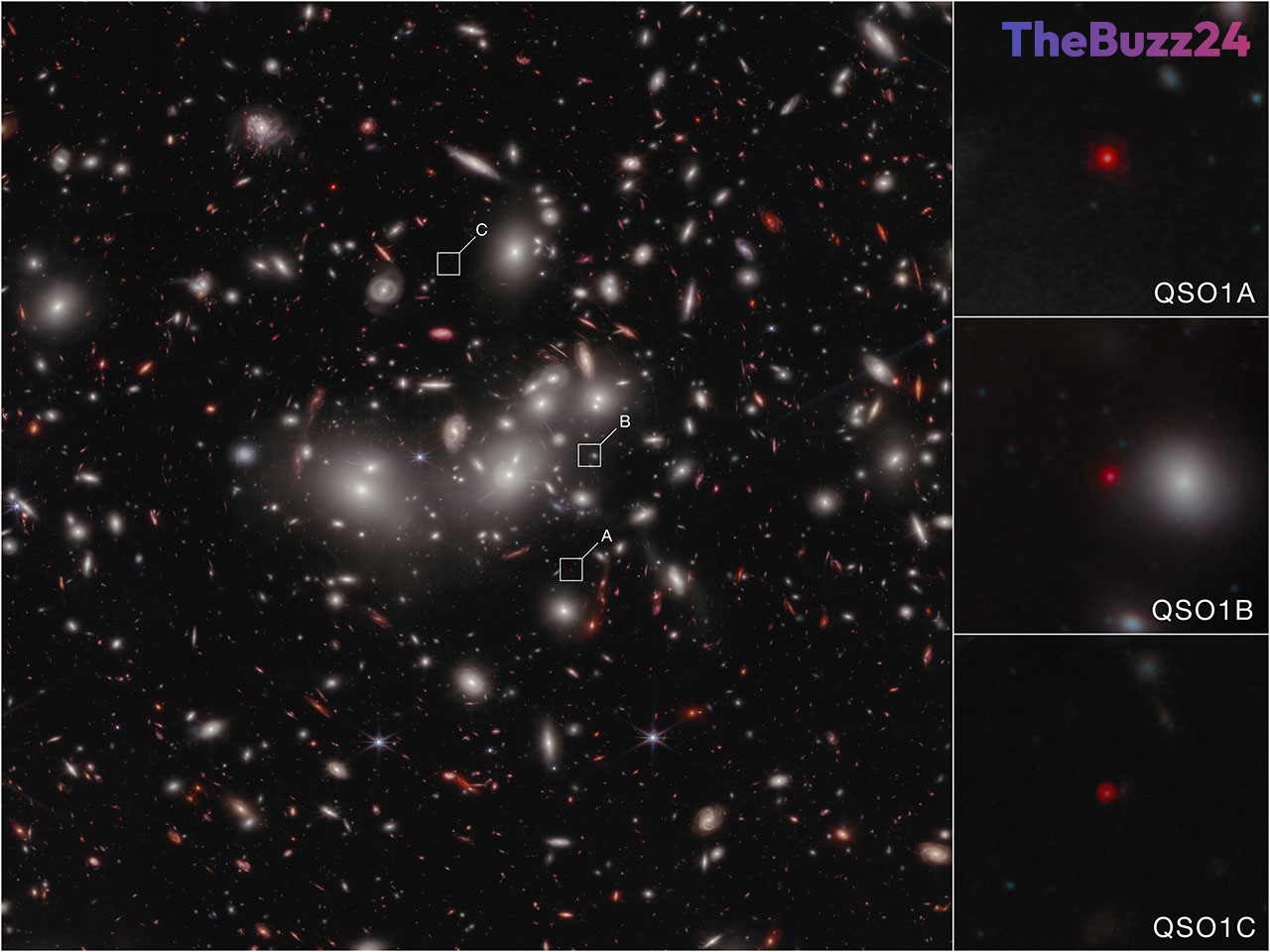
New data provided by the James Webb Space Telescope is prompting a significant reassessment of how the early universe evolved. By examining a celestial object known as Abell2744-QSO1, often described as a ‘Little Red Dot,’ researchers have uncovered evidence that supermassive black holes may have emerged well before the galaxies that currently host them. This finding contradicts long-standing scientific models, which previously suggested that galaxies acted as the necessary foundation for black hole development through the slow accumulation of matter and stellar evolution.
Using the telescope’s sophisticated Near Infrared Spectrograph, the research team analyzed the velocity of hydrogen gas orbiting the central object. The resulting data confirmed Keplerian motion, indicating that the system’s mass is concentrated in a singular, dense point. Estimates reveal that this black hole possesses approximately 50 million solar masses, accounting for at least two-thirds of the entire system’s mass. This proportion is drastically higher than what is observed in modern galaxies, where black holes typically represent a much smaller fraction of the total galactic mass.
Furthermore, the chemical analysis of the region surrounding Abell2744-QSO1 revealed a lack of heavy elements, suggesting a pristine environment devoid of previous stellar generations. This observation provides strong support for the ‘direct collapse’ theory, which proposes that these massive entities formed through the immediate gravitational collapse of enormous gas clouds. As investigation into these early cosmic structures continues, the findings indicate that the foundational architecture of the universe may have been established through much more rapid and aggressive processes than previously theorized.
Key Takeaways
- The discovery of Abell2744-QSO1 indicates that supermassive black holes may have formed independently and prior to their host galaxies.
- The black hole constitutes roughly two-thirds of its system's total mass, challenging existing models of galactic evolution.
- Findings support the 'direct collapse' theory, suggesting black holes formed from massive gas clouds rather than the gradual death of stars.
Editor’s Analysis & Impact
The data provided by the James Webb Space Telescope marks a fundamental shift in astrophysics, potentially rendering decades of galaxy formation models obsolete. By demonstrating that black holes could reach massive proportions in the infancy of the universe, this research suggests that the ‘seeds’ of cosmic structure were significantly more potent than previously understood. This discovery is expected to catalyze a new wave of observational research aimed at identifying similar ‘Little Red Dots’ to determine if Abell2744-QSO1 is a unique outlier or a representative example of early cosmic development. The broader implication is that our current framework for understanding the universe’s history is incomplete, requiring a new model that accounts for rapid, high-mass gravitational collapse occurring shortly after the Big Bang.
Frequently Asked Questions
Q: What is the 'direct collapse' theory?
A: The direct collapse theory posits that supermassive black holes formed from the immediate gravitational collapse of massive gas clouds, rather than growing slowly over billions of years through stellar death and mergers.
Q: Why is the mass ratio of Abell2744-QSO1 significant?
A: In modern galaxies, the central black hole typically accounts for a very small fraction of the total mass. Finding a black hole that comprises two-thirds of its system's mass suggests these objects grew much faster than the galaxies surrounding them, defying traditional evolutionary timelines.
AI Disclosure: This article is based on verified data and official reports. Our Team and AI have cross-referenced every financial detail with primary sources to ensure total accuracy.
More from this Category