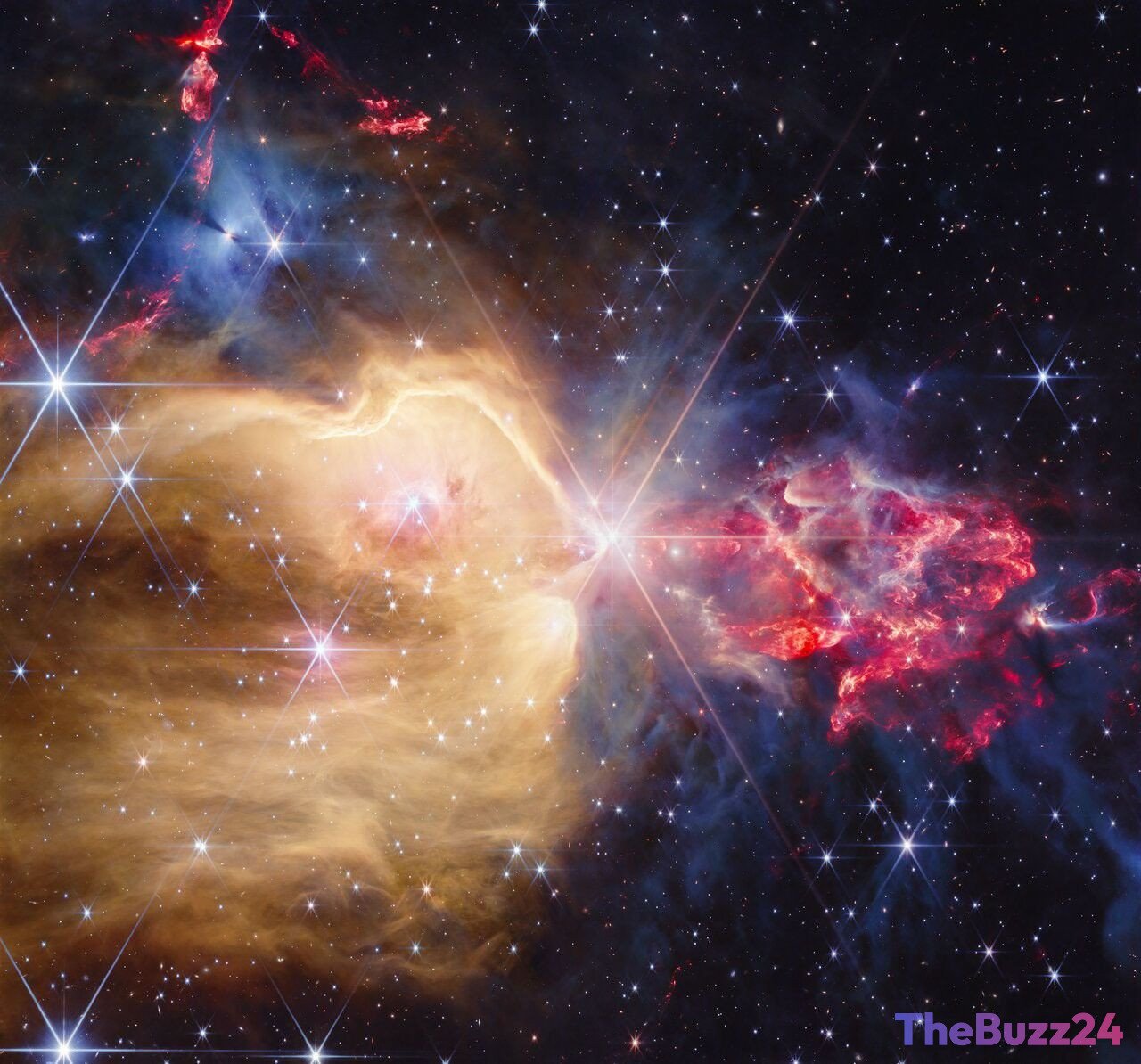
Webb Telescope Captures Dazzling Stellar Nursery in NGC 7129
The James Webb Space Telescope has provided an unprecedented infrared view of NGC 7129, a dynamic star-forming region, offering new insights into the complex processes of stellar birth. This detailed image highlights how gravity initiates star formation by drawing together vast clouds of gas and dust.
However, the process is far from simple. As stars begin to form, previously born stars can emit powerful jets and winds, influencing the surrounding environment and sometimes leading to explosive events. The presence of opaque dust, which can form in stellar atmospheres and disperse, often obscures visible-light observations, making infrared imaging crucial for understanding these regions. The Webb telescope’s capabilities allow astronomers to peer through this dust and witness the intricate details of star formation.
In the captured image, young stars are visible in various stages of development. Those situated in the gold-colored gas on the left appear to be more mature compared to the stars in the red region on the right. The filamentary structure observed in the red gas is likely a result of the energetic jets and winds emanating from these nascent stars. By studying stars at these different developmental phases, scientists can better ascertain the most critical physical processes and their timing in the lifecycle of stars.
Key Takeaways
- The James Webb Space Telescope has captured a detailed infrared image of the star-forming region NGC 7129.
- The image reveals young stars in different stages of development, with more mature stars on the left and younger ones on the right.
- Powerful jets and winds from young stars influence the surrounding gas and dust, creating the observed filamentary structures.
Editor’s Analysis & Impact
This new imagery from the Webb telescope underscores its transformative power in astronomical research, particularly in understanding star formation. By observing NGC 7129 in infrared, astronomers can bypass the obscuring effects of dust, revealing crucial details about the early stages of stellar evolution. The ability to differentiate between stars at various developmental phases within the same region provides invaluable data for refining models of star birth. This research has broader implications for understanding galactic evolution and the conditions necessary for planet formation, potentially impacting fields from astrophysics to astrobiology.
Frequently Asked Questions
Q: What is NGC 7129?
A: NGC 7129 is a star-forming region located in the constellation Cepheus, known for its intricate clouds of gas and dust where new stars are being born.
Q: Why is infrared light important for studying star formation?
A: Infrared light can penetrate the dense clouds of dust that often surround young stars and obscure visible light. This allows telescopes like the James Webb Space Telescope to observe the processes of star birth and early development in greater detail.
Q: What are the 'jets' mentioned in the article?
A: The jets are streams of gas and particles ejected from young stars as they form. These outflows can significantly impact the surrounding interstellar medium and play a role in regulating the growth of the star and the formation of planetary systems.
AI Disclosure: This article is based on verified data and official reports. Our Team and AI have cross-referenced every financial detail with primary sources to ensure total accuracy.
More from this Category