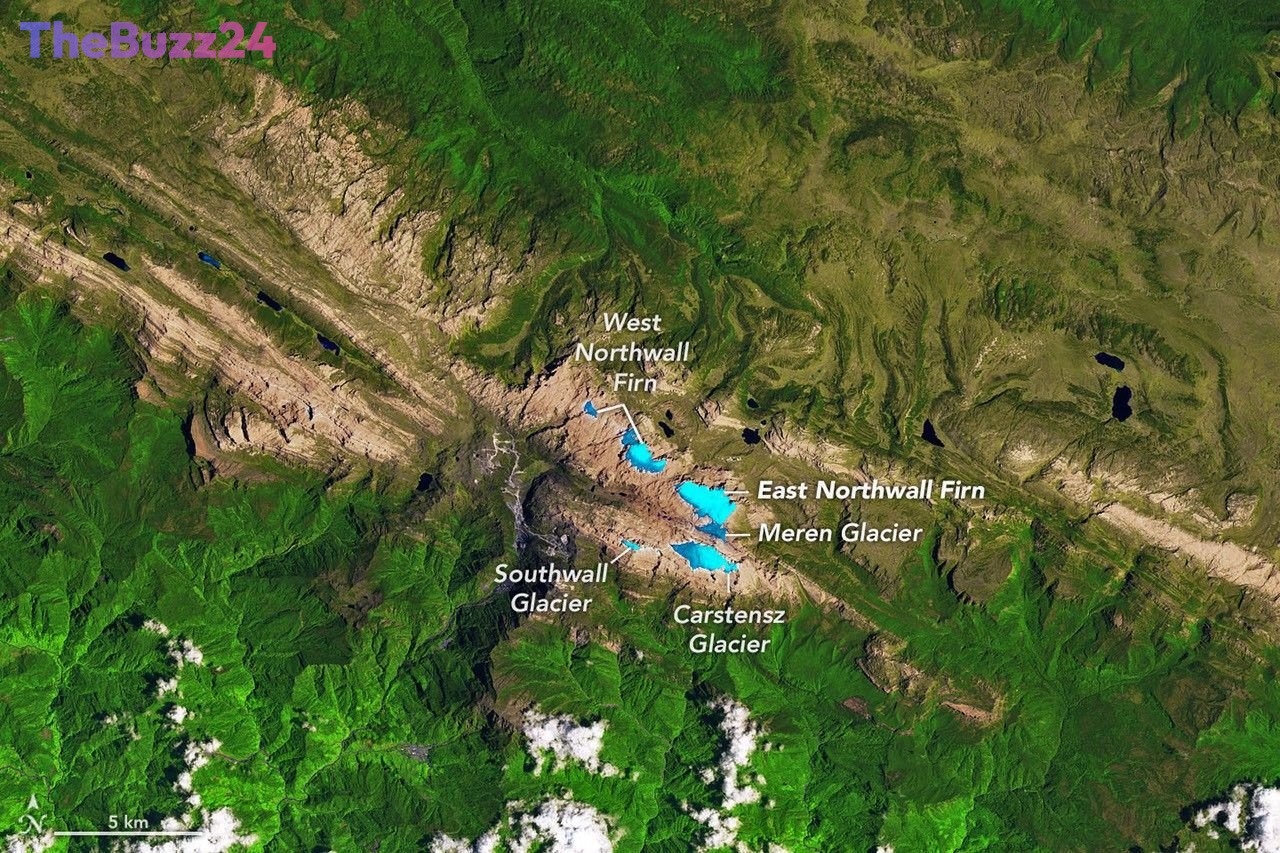
Indonesia’s Puncak Jaya Glaciers Vanish, Signaling Climate Crisis
The iconic glaciers atop Puncak Jaya in Indonesia’s Sudirman Range, once a significant tropical ice mass, are rapidly disappearing, with satellite imagery revealing a dramatic reduction in ice cover. Once spanning approximately 4.31 square kilometers in 1988, the ice has shrunk to a mere 0.09 square kilometers by September 2025, a stark 98% decrease. This dramatic decline, equivalent to about a dozen soccer fields, highlights the extreme vulnerability of tropical glaciers to rising global temperatures.
Scientists have long monitored these high-altitude ice formations as critical indicators of climate change, often referring to them as “canaries in the coal mine.” The ice on Puncak Jaya, situated near the equator and surrounded by vast warm oceans, exists under some of the most marginal conditions for year-round ice survival. Recent data indicates not only a significant reduction in area but also in thickness, with a primary monitoring site losing 28 meters of ice between 2010 and 2023, and becoming completely ice-free by November 2024.
The phenomenon is exacerbated by the glaciers’ fragmentation. As the ice thins and breaks into smaller pieces, more exposed rock surfaces emerge. These darker surfaces absorb more solar radiation, accelerating melting and creating a feedback loop where ice loss becomes increasingly rapid. This process, described by experts as a “house of cards problem,” means that once initiated, the retreat is virtually irreversible. The remaining ice patches are too small and stagnant to flow, signifying the functional end of Puncak Jaya’s glaciers.
El Niño events have historically intensified the melting process. During these periods, warmer air causes the freezing level to rise, leading to precipitation falling as rain rather than snow. This reduces the reflective white snow cover that typically shields the ice, exposing darker surfaces to absorb more heat. The 2015-2016 El Niño, for instance, caused ice to thin five times faster than normal, and the recent 2023-2024 El Niño has continued this trend of rapid ice loss. Projections suggest the complete disappearance of the main glacial ice areas could occur around 2030, or potentially even sooner.
Key Takeaways
- Glacial ice on Indonesia's Puncak Jaya has diminished by 98% since 1988, shrinking from 4.31 sq km to just 0.09 sq km.
- The remaining ice is too thin and fragmented to function as active glaciers, signaling a critical climate change impact.
- El Niño events significantly accelerate melting, and projections indicate the complete disappearance of these tropical glaciers by 2030.
Editor’s Analysis & Impact
The rapid vanishing of Puncak Jaya’s glaciers serves as a stark, tangible warning of the accelerating climate crisis. These tropical ice formations, acting as sensitive barometers, demonstrate how even remote ecosystems are succumbing to global warming. The economic and ecological implications are significant, potentially impacting local water resources and biodiversity. Furthermore, the loss of these glaciers underscores the urgency for global climate action and policy shifts. The ‘house of cards’ effect observed here is a potent metaphor for the cascading environmental consequences that await if emissions are not drastically curbed, impacting everything from sea levels to weather patterns worldwide.
Frequently Asked Questions
Q: Why are tropical glaciers like those on Puncak Jaya particularly sensitive to climate change?
A: Tropical glaciers are located near the equator and exist in some of the warmest conditions where ice can survive year-round. This marginal existence means they have very little buffer against rising global temperatures, making them highly susceptible to melting.
Q: What is the significance of Puncak Jaya's glaciers being called 'canaries in the coal mine'?
A: The term 'canary in the coal mine' is used because these glaciers are early indicators of environmental distress. Their rapid decline signals broader climate change impacts that will eventually affect other regions and ecosystems, much like a canary's sensitivity to toxic gases in a mine warned miners of danger.
Q: How do El Niño events affect tropical glaciers?
A: During El Niño events, warmer air causes the freezing level to rise above the glaciers. This results in precipitation falling as rain instead of snow, and reduces the amount of reflective white snow cover. The exposed darker ice and rock absorb more heat, leading to accelerated melting.
AI Disclosure: This article is based on verified data and official reports. Our Team and AI have cross-referenced every financial detail with primary sources to ensure total accuracy.
More from this Category