Webb Telescope Unravels Mystery of Planet’s Survival Around Dying Star
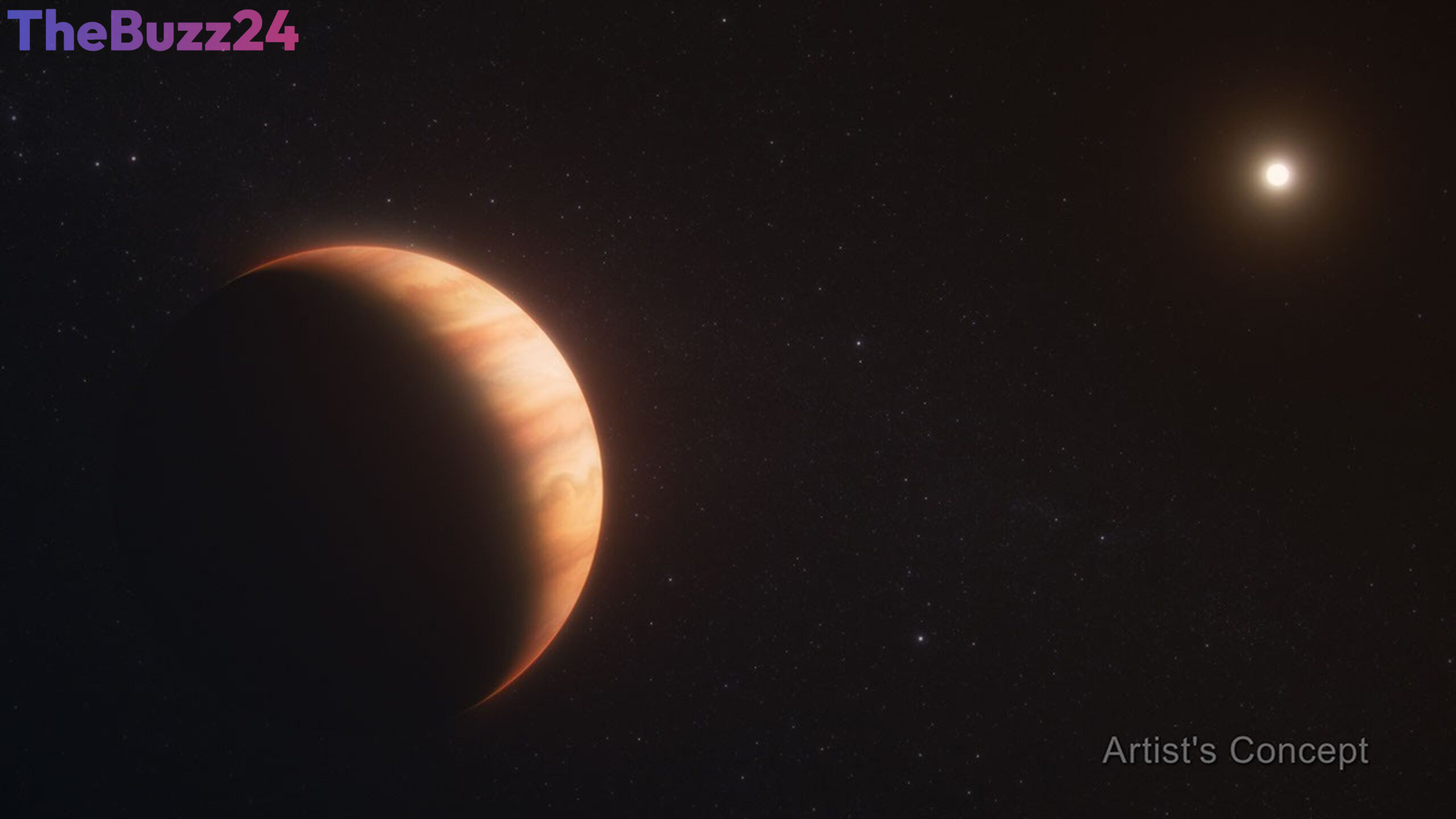
NASA’s James Webb Space Telescope (JWST) has provided unprecedented insights into the survival of exoplanet WD 1856 b, a gas giant orbiting a stellar remnant. Billions of years ago, its parent star, similar to our Sun, expanded into a red giant, a phase that typically engulfs and destroys nearby planets. However, WD 1856 b, a planet roughly the size of Jupiter, has been observed in an incredibly close orbit around its star’s dense core, known as a white dwarf, completing a revolution in just 34 hours and at a distance of less than 2 million miles.
The international team of astronomers utilized Webb’s advanced capabilities to observe WD 1856 b as it transited its host star. This observation allowed them to measure the planet’s temperature and detect key molecules within its atmosphere. The findings revealed that the exoplanet is significantly hotter than anticipated, a crucial clue in understanding its unlikely survival and its current tight orbit. This discovery offers a glimpse into potential future scenarios for planets in our own solar system.
Originally discovered in 2020 by NASA’s TESS and the Spitzer Space Telescope, WD 1856 b orbits the white dwarf WD 1856+534, located approximately 80 light-years away. The planet’s size relative to its star is striking, being seven times larger than the Earth-sized white dwarf it circles. The close proximity, 50 times nearer than Earth’s orbit to the Sun, initially posed a significant puzzle regarding its survival during the star’s red giant phase.
Webb’s analysis of the infrared light emitted by the planet during transit indicated a temperature of around 260 degrees Fahrenheit (126 degrees Celsius). This elevated temperature suggested residual heat from a past event, rather than solely from the current faint light of the white dwarf. Researchers theorize that the planet likely resided in a much wider orbit, safely avoiding the star’s destructive expansion. It subsequently migrated inward, with gravitational interactions with the white dwarf causing it to warm considerably before gradually cooling over billions of years. Furthermore, Webb detected atmospheric signatures of methane and small cloud particles, marking the first observation of an atmosphere on a planet transiting a dead star.
Key Takeaways
- The James Webb Space Telescope has studied exoplanet WD 1856 b, a Jupiter-sized planet orbiting a white dwarf star.
- The planet's survival in a close orbit around its star's remnant core challenges previous understandings of stellar death and planetary fate.
- Webb detected atmospheric molecules, including methane, and residual heat, suggesting the planet migrated to its current orbit after its star's red giant phase.
Editor’s Analysis & Impact
This discovery by the James Webb Space Telescope is a significant advancement in exoplanet research, offering a tangible look at the potential future of planetary systems, including our own. The survival of WD 1856 b around a white dwarf provides crucial data for refining models of stellar evolution and planetary dynamics. The detection of atmospheric components on such a planet is a testament to Webb’s observational power and opens new avenues for studying exoplanet atmospheres in extreme environments. This research not only deepens our understanding of cosmic processes but also fuels speculation about the resilience of life and planetary systems in the face of stellar demise, impacting fields from astrophysics to astrobiology.
Frequently Asked Questions
Q: How did the exoplanet WD 1856 b survive the death of its star?
A: Astronomers believe WD 1856 b likely survived by initially being in a wide orbit, far from its star during its red giant phase. It later migrated inward to its current close orbit around the white dwarf, a process that likely caused it to warm up considerably due to gravitational interactions.
Q: What is a white dwarf star?
A: A white dwarf is the dense remnant core of a Sun-like star that has exhausted its nuclear fuel. It is typically about the size of Earth but contains the mass of a star, and it slowly cools over billions of years.
Q: What does the James Webb Space Telescope's observation of WD 1856 b tell us about our own solar system?
A: The study of WD 1856 b provides a potential glimpse into the far future of our solar system. In about five billion years, our Sun will become a red giant and eventually a white dwarf, and understanding how planets like WD 1856 b behave offers clues about the fate of planets like Jupiter in our own system.
AI Disclosure: This article is based on verified data and official reports. Our Team and AI have cross-referenced every financial detail with primary sources to ensure total accuracy.
More from this Category