Devastating Russian Air Assault on Kyiv Leaves 13 Dead and Sparks Widespread Destruction
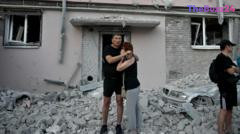
A massive overnight aerial bombardment by Russian forces has left at least 13 people dead and more than 30 injured in the Ukrainian capital of Kyiv. The large-scale assault, which involved a combination of 74 missiles and nearly 500 drones, targeted multiple residential neighborhoods and civilian infrastructure. Although Ukrainian air defense systems successfully intercepted a significant portion of the incoming threats, at least 25 ballistic missiles and 12 drones managed to breach the perimeter, striking 33 distinct locations across the city and causing widespread fires and structural damage.
The strikes caused severe damage to residential high-rises, private homes, a hotel in central Kyiv, and an ambulance station. Emergency responders worked through the night to rescue survivors from the rubble, with officials confirming that at least 34 individuals have been successfully pulled from damaged buildings. The attack came shortly after Ukrainian President Volodymyr Zelensky cut short an official visit to Dublin, citing intelligence reports that Moscow was preparing a major offensive. Zelensky urged citizens to take immediate precautions, warning that the strike had been planned for some time.
In response to the bombardment, Ukrainian Foreign Minister Andriy Sybiha renewed calls for international allies to supply advanced air defense systems and tighten economic sanctions against Moscow. Meanwhile, Russia’s Ministry of Defence claimed the strikes targeted energy and military infrastructure, framing the operation as retaliation for recent Ukrainian drone attacks on Russian power facilities. These Ukrainian strikes had previously forced a rare admission from Russian President Vladimir Putin regarding domestic fuel shortages.
On the ground, the conflict remains highly contested. While Russian forces have recently made incremental advances near the strategic eastern city of Kostyantynivka—a key gateway to the Donbas region—Ukrainian commanders report successful counter-operations that have disrupted Russian supply lines linking the mainland to occupied Crimea. Currently, Russia maintains control over approximately 20 percent of Ukrainian territory as the war of attrition continues.
Key Takeaways
- Russia launched a massive barrage of 74 missiles and 496 drones targeting Kyiv, resulting in at least 13 civilian deaths and dozens of injuries.
- The strikes caused severe damage to civilian infrastructure, including residential buildings, a hotel, and an ambulance station, prompting renewed Ukrainian pleas for advanced air defense systems.
- The escalation follows successful Ukrainian drone strikes on Russian energy infrastructure, which recently forced Vladimir Putin to acknowledge domestic fuel shortages.
Editor’s Analysis & Impact
The latest aerial assault on Kyiv underscores a critical pivot point in the conflict’s winter strategy. By deploying an unprecedented volume of drones alongside ballistic missiles, Russia is actively attempting to overwhelm Ukraine’s air defense capabilities and deplete its ammunition reserves. This escalation is highly retaliatory, aimed at projecting strength domestically after successful Ukrainian strikes on Russian oil refineries disrupted Moscow’s fuel supplies. For Ukraine, the attack highlights the vulnerability of its civilian infrastructure and the limits of its current defense systems without continuous Western military aid. Geopolitically, this will likely accelerate discussions among NATO allies regarding the delivery of advanced Patriot systems and the authorization of deeper strikes inside Russian territory. The ongoing stalemate on the ground suggests that both nations will continue to rely heavily on long-range strategic bombing to pressure the opponent’s economy and morale.
Frequently Asked Questions
Q: What was the scale of the Russian attack on Kyiv?
A: Russian forces launched 74 missiles and 496 drones overnight. While air defenses intercepted most of the threats, 25 ballistic missiles and 12 drones struck 33 locations across the capital.
Q: Why did Russia launch this specific aerial bombardment?
A: Russia's Ministry of Defence claimed the strikes were in retaliation for recent Ukrainian drone attacks on Russian energy infrastructure, which had caused notable fuel shortages within Russia.
Q: What is the current situation on the ground in Ukraine?
A: While the ground war remains largely stalled, Russian forces have recently advanced near the strategic eastern city of Kostyantynivka, while Ukrainian forces have successfully disrupted Russian supply lines to Crimea.
AI Disclosure: This article is based on verified data and official reports. Our Team and AI have cross-referenced every financial detail with primary sources to ensure total accuracy.
More from this Category