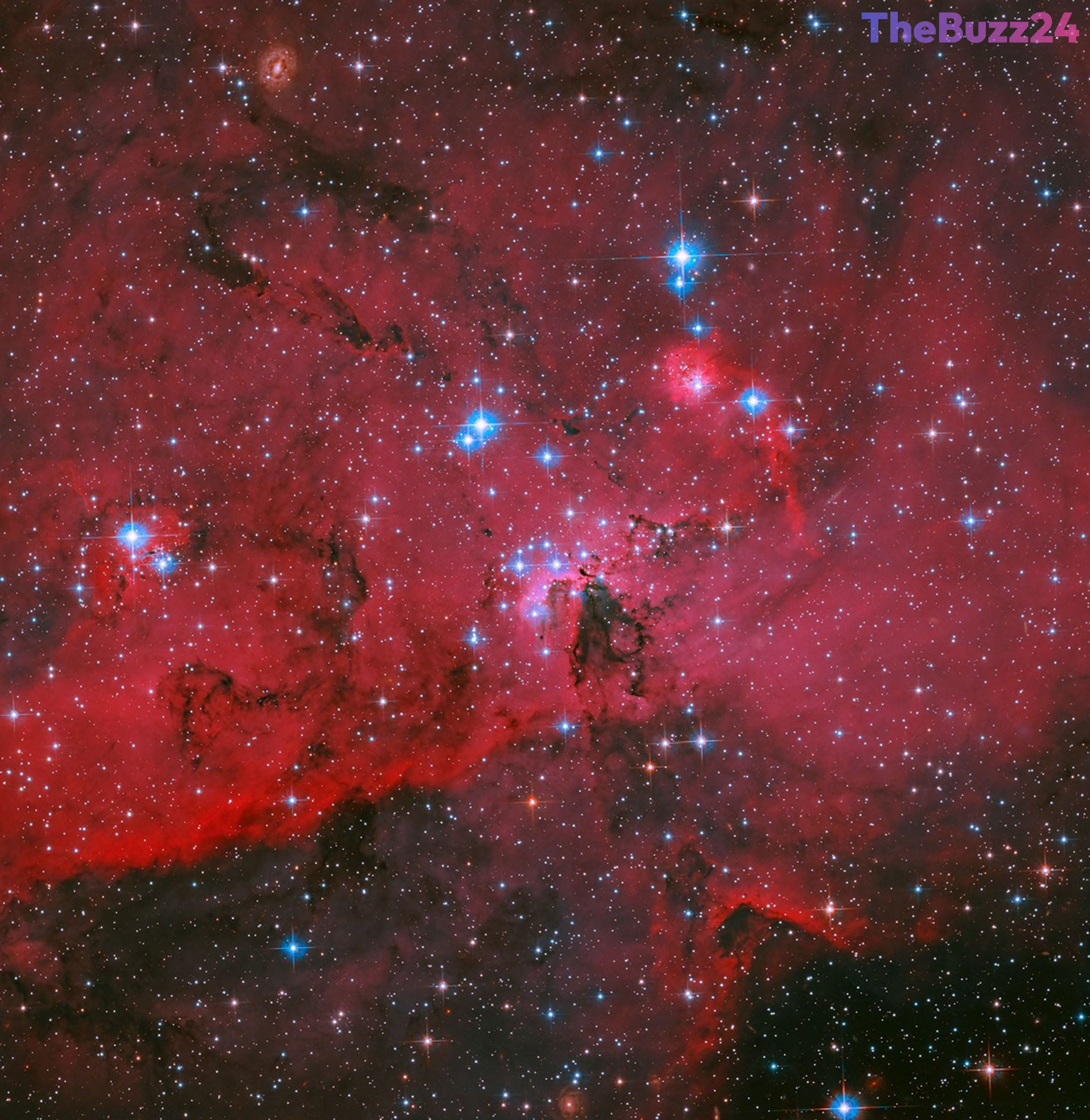
Cosmic Fireworks: Hubble Captures Stellar Nursery Glowing in Crimson and Blue
A spectacular new view of the cosmos has been revealed, showcasing a vibrant stellar nursery known as LH 95. Located within the Large Magellanic Cloud—a satellite dwarf galaxy orbiting our own Milky Way—this region resembles a brilliant display of celestial fireworks. The image captures a dense population of young, energetic stars shining in brilliant shades of blue and white, set against a dramatic, glowing backdrop of crimson hydrogen gas and dark, dusty filaments.
At the heart of LH 95, massive blue giant stars, some boasting at least three times the mass of our Sun, unleash powerful ultraviolet radiation and stellar winds. This cosmic energy heats and sculpts the surrounding hydrogen gas, while denser lanes of dust resist this erosion to form striking dark silhouettes. Astronomers have identified an extraordinary population of approximately 2,500 “pre-main-sequence” stars within this nursery. These infant stars have accumulated most of their mass from surrounding disks of gas and dust but have not yet ignited the nuclear fusion reactions required to become fully active stars.
Observations of LH 95 have provided crucial insights into the mechanics of star formation. Researchers confirmed that while the rate at which young stars accumulate matter slows down as they age, this accretion process can actually persist for several million years—longer than previously estimated. Furthermore, the region hosts multiple generations of stars living side-by-side, proving that star birth is an ongoing, multi-generational process rather than a single, isolated event. For instance, the most massive star in the region, weighing 60 to 70 times the mass of the Sun, is roughly one million years younger than its neighboring four-million-year-old stars. Because LH 95 contains far less obscuring dust than similar regions in the Milky Way, it serves as an invaluable, clear laboratory for studying the early stages of stellar evolution.
Key Takeaways
- LH 95 is a highly active stellar nursery located in the Large Magellanic Cloud, featuring a diverse population of young stars and massive blue giants.
- The region contains over 2,500 pre-main-sequence stars, allowing astronomers to study the prolonged process of stellar accretion and growth.
- Because LH 95 has relatively low dust interference compared to similar regions in the Milky Way, it offers an exceptionally clear window into stellar evolution.
Editor’s Analysis & Impact
The detailed imaging of LH 95 underscores the enduring scientific value of the Hubble Space Telescope, even as newer observatories enter service. By providing high-resolution data on pre-main-sequence stars, this research refines stellar evolution models, particularly regarding how long young stars continue to accumulate mass from their surrounding disks. Understanding these accretion timescales is vital for planetary science, as the lifespan of these disks directly dictates the window of opportunity for planet formation. Looking ahead, the synergy between Hubble’s optical capabilities, the James Webb Space Telescope’s infrared precision, and the upcoming Nancy Grace Roman Space Telescope will usher in a golden age of astrophysics. Together, these instruments will allow researchers to peer through cosmic dust with unprecedented clarity, mapping the lifecycle of stars across different galaxies and expanding our fundamental understanding of the universe’s chemistry.
Frequently Asked Questions
Q: What is a pre-main-sequence star?
A: A pre-main-sequence star is an infant star that has gathered almost all of its critical mass from surrounding gas and dust but has not yet contracted enough to initiate hydrogen fusion in its core.
Q: Why is LH 95 an ideal location for studying star formation?
A: LH 95 is located in the Large Magellanic Cloud, which has significantly less obscuring dust than similar star-forming regions within our own Milky Way galaxy, offering astronomers a much clearer, unobstructed view of young stars.
Q: What causes the crimson glow in the image of LH 95?
A: The crimson glow is caused by hydrogen-alpha emissions, which occur when hydrogen gas is heated and ionized by the intense ultraviolet radiation emitted by nearby massive, hot young stars.
AI Disclosure: This article is based on verified data and official reports. Our Team and AI have cross-referenced every financial detail with primary sources to ensure total accuracy.
More from this Category