Poland to Erect National Memorial to WWII Victims of Ukrainian Nationalist Violence
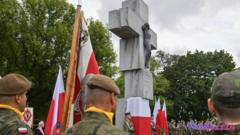
Polish Prime Minister Donald Tusk has announced plans to establish a national memorial dedicated to the victims of what he described as a “genocide committed by Ukrainian nationalists” during World War II. The announcement came on the anniversary of the events in Volhynia, a historical Polish territory now part of Ukraine, where an estimated 100,000 ethnic Poles were killed by the Ukrainian Insurgent Army (UPA) between 1943 and 1945.
This initiative highlights the enduring historical sensitivities between Poland and Ukraine regarding the Volhynia massacre. While Poland views the UPA’s actions as a brutal ethnic cleansing, many in Ukraine consider the UPA as freedom fighters who resisted Soviet and Nazi occupation, as well as Polish authorities. The historical conflict also resulted in the deaths of up to 10,000 Ukrainian civilians, adding another layer of complexity to the shared past.
Prime Minister Tusk emphasized that confronting this painful history is crucial for reconciliation and building a better future. “Truth is our duty toward the victims, but also a way to overcome a painful past for the sake of a better future,” Tusk stated, adding that “memory cannot be the servant of hatred.” He also linked the acknowledgment of this historical truth to Ukraine’s aspirations for European Union membership, suggesting that embracing this difficult past is a prerequisite for closer ties.
The announcement follows a recent diplomatic dispute where Ukrainian President Volodymyr Zelensky was stripped of Poland’s highest state honor after a Ukrainian military unit was named after the UPA. Despite this tension, Polish President Karol Nawrocki assured that the row would not diminish Poland’s unwavering support for Ukraine in its ongoing defense against Russia’s full-scale invasion. In response, three former Ukrainian presidents returned their Polish awards in solidarity with Zelensky, underscoring the deep historical connections and the current geopolitical context.
Key Takeaways
- Poland will establish a national memorial for victims of WWII violence attributed to Ukrainian nationalists.
- The memorial addresses the historical conflict in Volhynia, where both Polish and Ukrainian civilians suffered casualties.
- The initiative occurs amidst ongoing diplomatic tensions between Poland and Ukraine, though Poland reaffirms support for Ukraine against Russia.
Editor’s Analysis & Impact
The establishment of a national memorial by Poland concerning the Volhynia massacre underscores the persistent influence of historical grievances on contemporary international relations, particularly between neighboring nations. While Poland seeks to memorialize its victims and potentially influence Ukraine’s EU accession path, this move risks reigniting historical debates that could complicate bilateral ties. However, the broader context of Russia’s invasion provides a powerful incentive for both nations to manage these historical sensitivities pragmatically. The situation highlights the delicate balance required to acknowledge past atrocities while maintaining present-day strategic alliances, especially in the face of a common external threat.
Frequently Asked Questions
Q: What was the Volhynia massacre?
A: The Volhynia massacre refers to a series of ethnic cleansing operations carried out by the Ukrainian Insurgent Army (UPA) against the Polish civilian population in the Volhynia region during World War II, primarily between 1943 and 1945. Poland estimates that around 100,000 Poles were killed, while Ukrainian sources suggest up to 10,000 Ukrainian civilians also died in retaliatory actions.
Q: How does this historical issue affect current Poland-Ukraine relations?
A: The historical dispute over the Volhynia events has periodically strained relations between Poland and Ukraine. Recent events, such as Ukraine naming a military unit after the UPA, have led to diplomatic friction. However, both countries emphasize the importance of their current alliance against Russian aggression, seeking to navigate these historical sensitivities while maintaining solidarity.
Q: What is the significance of the UPA in Ukrainian history?
A: The Ukrainian Insurgent Army (UPA) is viewed by many Ukrainians as a key organization that fought for Ukraine's independence during and after World War II. They fought against both Nazi Germany and the Soviet Union, as well as Polish authorities. However, their actions, particularly the Volhynia massacre, are a source of deep historical trauma and controversy for Poland.
AI Disclosure: This article is based on verified data and official reports. Our Team and AI have cross-referenced every financial detail with primary sources to ensure total accuracy.
More from this Category