Webb Telescope Captures Rare Cosmic Collision in Deep Space
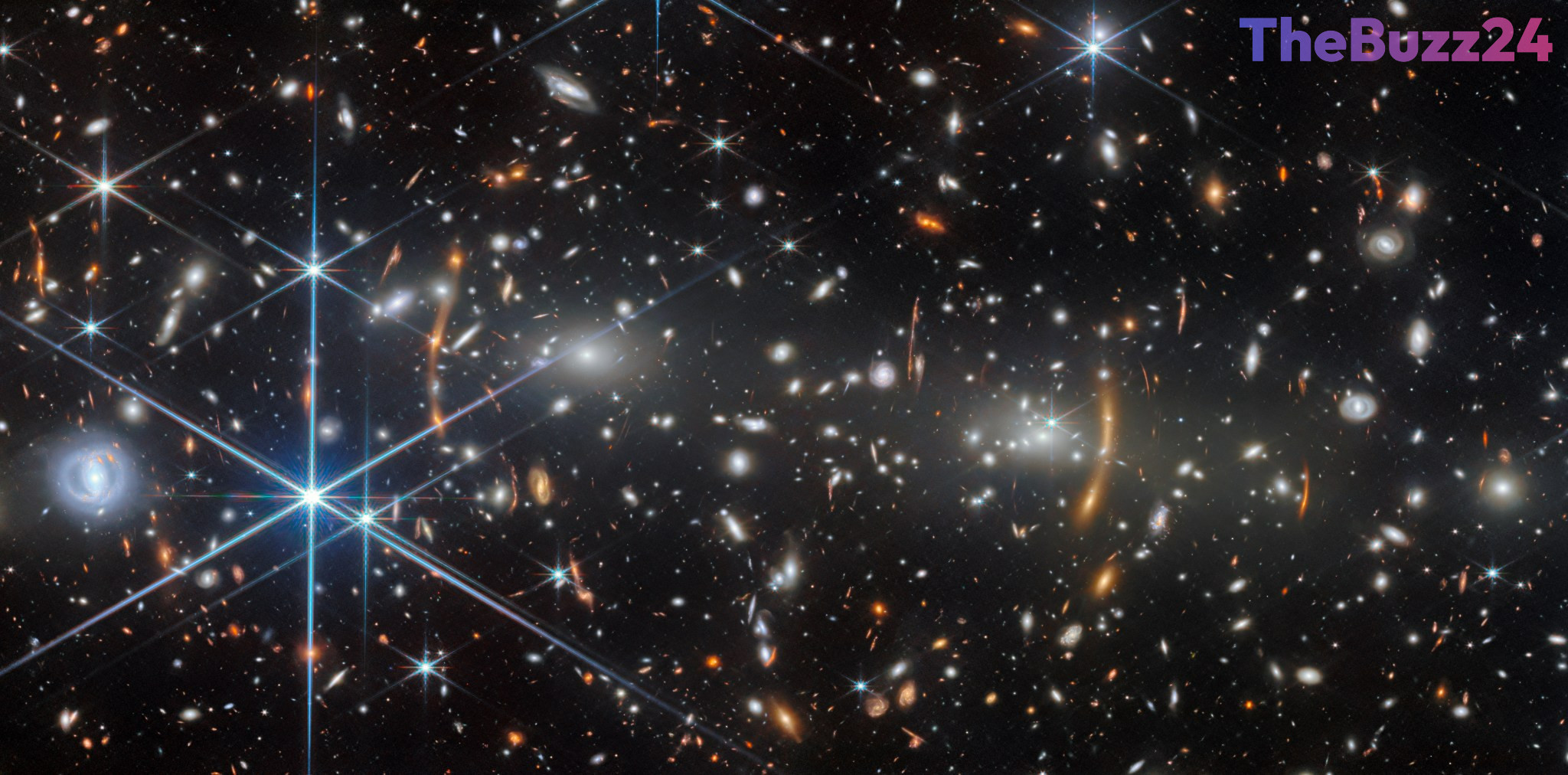
The James Webb Space Telescope has provided a stunning glimpse into the early universe, capturing a high-resolution image of the galaxy cluster MACS J0553.4-3342. This observation transports astronomers approximately 4.4 billion years into the past, revealing a dynamic and violent period of cosmic evolution. The cluster is currently in the midst of a significant transformation, characterized by the active merger of two distinct sub-clusters of roughly equal mass.
At the heart of this celestial event are two massive elliptical galaxies that serve as the gravitational anchors for the merging structures. These galaxies are clearly visible as the most luminous points within the cluster, surrounded by expansive, glowing halos that signify their immense size and gravitational influence. The interaction between these two sub-clusters offers researchers a unique opportunity to study the mechanics of galaxy formation and the growth of large-scale structures in the universe.
By analyzing the light from this distant cluster, scientists can better understand how gravity drives the assembly of galaxies over billions of years. The clarity provided by the Webb telescope allows for a detailed examination of the gas and stellar dynamics involved in such a massive collision, providing essential data that helps refine current models of cosmological development.
Key Takeaways
- The James Webb Space Telescope captured a detailed image of the galaxy cluster MACS J0553.4-3342 as it appeared 4.4 billion years ago.
- The cluster consists of two sub-clusters of similar mass that are actively merging, anchored by two massive elliptical galaxies.
- This observation provides critical data for understanding the gravitational processes that drive the formation and evolution of large-scale cosmic structures.
Editor’s Analysis & Impact
The observation of MACS J0553.4-3342 represents a significant milestone in observational cosmology. By capturing a snapshot of a major merger, the James Webb Space Telescope is enabling researchers to move beyond static models of galaxy evolution and observe the kinetic processes that shape the universe. The implications for the scientific community are profound; as we gain a clearer understanding of how these massive clusters assemble, we refine our knowledge of dark matter distribution and the expansion history of the cosmos. Future studies of such clusters will likely yield insights into the rate of star formation triggered by these collisions, potentially altering our understanding of how galaxies reach their mature states. This data is essential for validating simulations of the early universe and predicting the long-term structural trajectory of our own cosmic neighborhood.
Frequently Asked Questions
Q: What is MACS J0553.4-3342?
A: MACS J0553.4-3342 is a galaxy cluster located billions of light-years away, currently undergoing a massive merger between two sub-clusters.
Q: Why are the two brightest points in the image significant?
A: The two brightest points are massive elliptical galaxies that act as the gravitational anchors for the merging sub-clusters, playing a central role in the cluster's overall structure.
AI Disclosure: This article is based on verified data and official reports. Our Team and AI have cross-referenced every financial detail with primary sources to ensure total accuracy.
More from this Category