Tragedy in Minab: Inside the Devastating Strike That Destroyed an Iranian Primary School
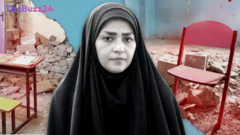
The remnants of the Shajareh Tayyebeh Primary School in Minab, a small city in southern Iran, stand as a haunting monument to one of the most devastating civilian tragedies of the ongoing conflict. On a fateful Saturday morning following the outbreak of hostilities, precision strikes fundamentally altered the landscape of the community. What was once a vibrant learning environment for young boys and girls was reduced to a chaotic field of rubble and twisted concrete, leaving an indelible scar on the families and educators who survived.
According to local authorities, the incident resulted in a catastrophic loss of life, claiming 156 victims, including 120 children. Teachers and emergency personnel recounted harrowing scenes of thick, suffocating smoke, collapsing infrastructure, and the desperate, frantic search for survivors among the ruins. Witnesses described the horrific realization that many of the children had perished instantly under the weight of the collapsed upper floor, where the girls’ classrooms and a prayer hall were located. First responders and family members alike faced harrowing conditions, often identifying the young victims only by fragments of clothing or personal belongings.
While the operation’s initial objectives targeted military infrastructure, investigations and expert analyses have increasingly focused on why the adjacent educational facility was hit. Preliminary findings from military assessments suggest that outdated intelligence data may have misidentified the walled-off school grounds, which had been separated from a neighboring Islamic Revolutionary Guard Corps compound years prior. Publicly available records and satellite imagery clearly delineated the school’s boundaries, yet precision-guided munitions severely impacted the site, fueling intense international scrutiny and profound local grief.
In the aftermath of the catastrophe, grieving families gather daily at a nearby cemetery where many of the students and teachers are laid to rest. The tragedy has deeply polarized public sentiment, complicating the broader narrative of the military campaign and uniting local communities in shared mourning. For the survivors, such as teachers returning to the desolate site and mothers visiting tiny graves, the overarching question remains an agonizing plea for accountability regarding the tragic loss of young lives whose only purpose for being there was to learn.
Key Takeaways
- A precision strike on the Shajareh Tayyebeh Primary School in Minab, Iran, resulted in the deaths of 156 people, including 120 children.
- Preliminary military investigations suggest that outdated intelligence data may have mistakenly linked the school to an adjacent military compound.
- The tragedy has drawn intense international scrutiny and deepened grief and division among local populations regarding the conflict's civilian toll.
Editor’s Analysis & Impact
The devastating strike on the primary school in Minab represents a critical turning point in the psychological and geopolitical dimensions of the conflict. Beyond the immediate human toll, the incident severely undermines the narrative of a ‘surgical’ military campaign, introducing immense friction into international accountability discussions. From a market and regional stability perspective, high-profile civilian casualties amplify internal political polarization within Iran, potentially hardening domestic resolve while complicating diplomatic efforts by external actors. Moving forward, the incident will likely serve as a focal point for international humanitarian law debates regarding target verification processes, urban warfare protocols, and the integration of outdated intelligence systems in modern military operations.
Frequently Asked Questions
Q: What happened at the Shajareh Tayyebeh Primary School?
A: The primary school in Minab, Iran, was struck during military operations, resulting in the collapse of the building and the deaths of 156 people, including 120 children.
Q: Why was the school targeted?
A: Preliminary military investigations indicate that outdated intelligence data likely led forces to mistakenly treat the school as part of an adjacent military site, despite the school being walled off and separately operated for years.
Q: Has responsibility been officially accepted?
A: While military investigators have acknowledged that forces likely carried out the strike unintentionally due to faulty data, formal admissions and the full findings of the high-level investigations have not been publicly released.
AI Disclosure: This article is based on verified data and official reports. Our Team and AI have cross-referenced every financial detail with primary sources to ensure total accuracy.
More from this Category