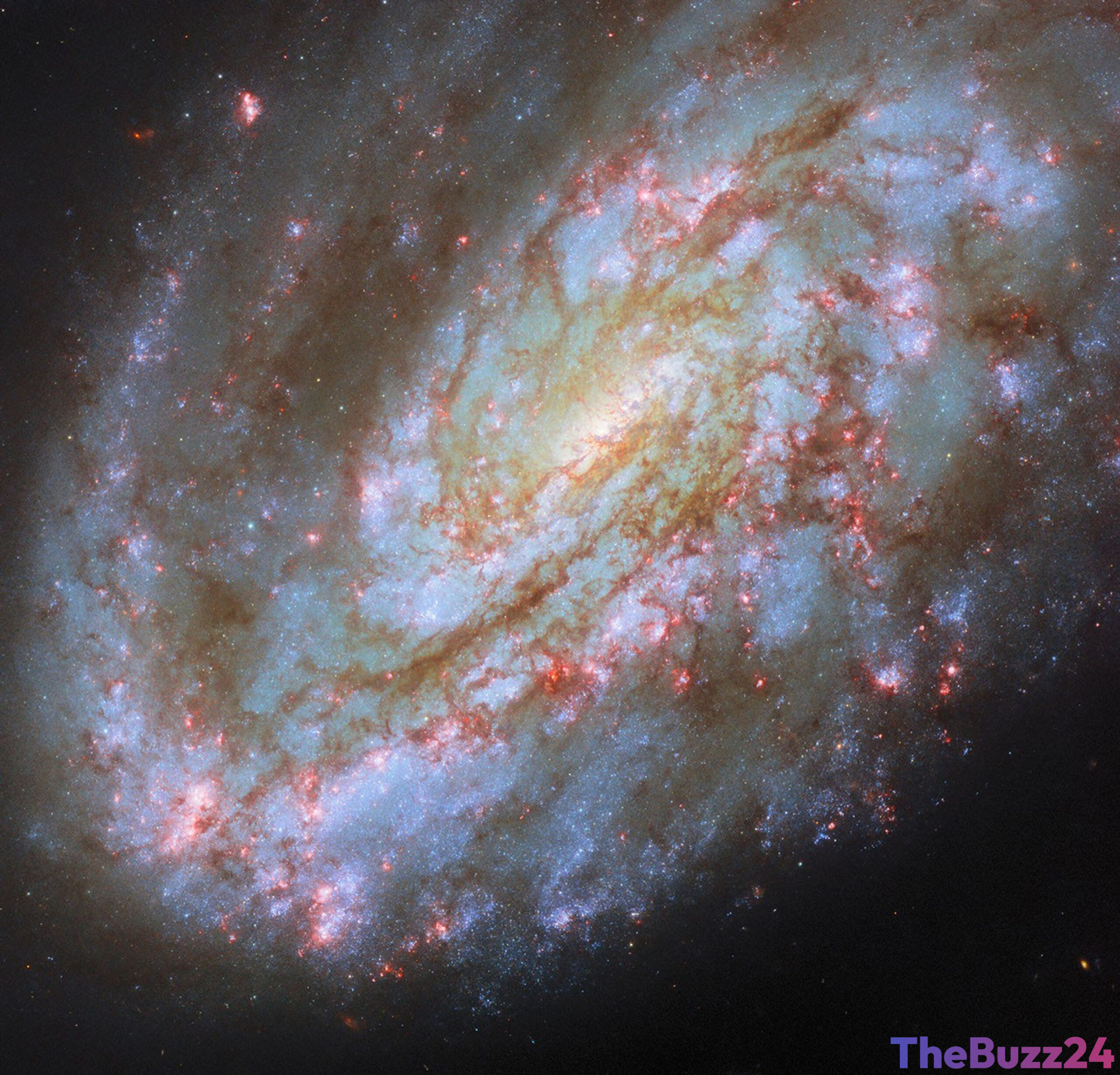
Hubble Space Telescope Captures Stunning View of Asymmetric Spiral Galaxy NGC 4654
The Hubble Space Telescope has returned a striking new image of the intermediate spiral galaxy NGC 4654, located roughly 72 million light-years away within the massive Virgo Cluster. Positioned in the constellation Virgo, NGC 4654 showcases a distinct lopsided structure that highlights the violent, invisible forces shaping cosmic bodies on a galactic scale.
Astronomers have determined that NGC 4654’s unique appearance is largely driven by a phenomenon known as ram pressure stripping. As the galaxy races through the dense, hot gas residing between the cluster’s many members, the resulting pressure compresses its leading edge while pulling an elongated trail of gas away from its core. Uniquely, this cosmic wind has affected both the gas and the distribution of stars, creating a well-defined boundary on one side and a sparse, asymmetrical arrangement on the other.
Further compounding this unusual shape is a historical gravitational encounter. Researchers believe that a close pass with neighboring galaxy NGC 4639 approximately 500 million years ago stripped away additional gas, stunting star formation on one side of the galaxy. Despite these compounding cosmic pressures, NGC 4654 continues to spawn new stars at a healthy clip of nearly two solar masses per year, a rate typical for galaxies of its size.
Recent data captured by Hubble utilizes specific wavelengths of red light to highlight glowing pink bubbles of energized gas across the galaxy’s disk and spiral arms. These vibrant regions indicate active nurseries where newborn stars are actively forming. Observations like these are part of broader initiatives to map the relationship between galactic gas reserves and stellar birth, ultimately shedding light on the complex evolutionary lifecycles of galaxies throughout the universe.
Key Takeaways
- The Hubble Space Telescope captured NGC 4654, an intermediate spiral galaxy situated 72 million light-years away in the Virgo Cluster.
- The galaxy exhibits a heavily asymmetric shape caused by ram pressure stripping and a past gravitational fly-by with a neighboring galaxy.
- Despite losing gas to the surrounding cosmic medium, NGC 4654 maintains an active star formation rate of nearly two solar masses per year.
Editor’s Analysis & Impact
The ongoing observations of galaxies like NGC 4654 by the Hubble Space Telescope provide crucial empirical data for astrophysical models examining galactic evolution. By detailing how external environmental factors such as ram pressure stripping and gravitational interactions impact star formation, researchers can better map the lifecycle of the cosmos. These findings not only enhance our understanding of the Virgo Cluster but also offer baseline comparative metrics for data expected from newer space-based observatories, ensuring a continuous bridge in observational astronomy and high-precision stellar cartography.
Frequently Asked Questions
Q: What is ram pressure stripping?
A: Ram pressure stripping is a process where a galaxy moving at high velocity through the hot gas of a galaxy cluster experiences pressure that sweeps away and compresses its own internal gas.
Q: How far away is NGC 4654?
A: NGC 4654 is located approximately 72 million light-years away from Earth in the constellation Virgo.
Q: Is NGC 4654 still forming new stars?
A: Yes, despite losing some gas to environmental pressures, NGC 4654 continues to form new stars at a rate of nearly two solar masses per year.
AI Disclosure: This article is based on verified data and official reports. Our Team and AI have cross-referenced every financial detail with primary sources to ensure total accuracy.
More from this Category