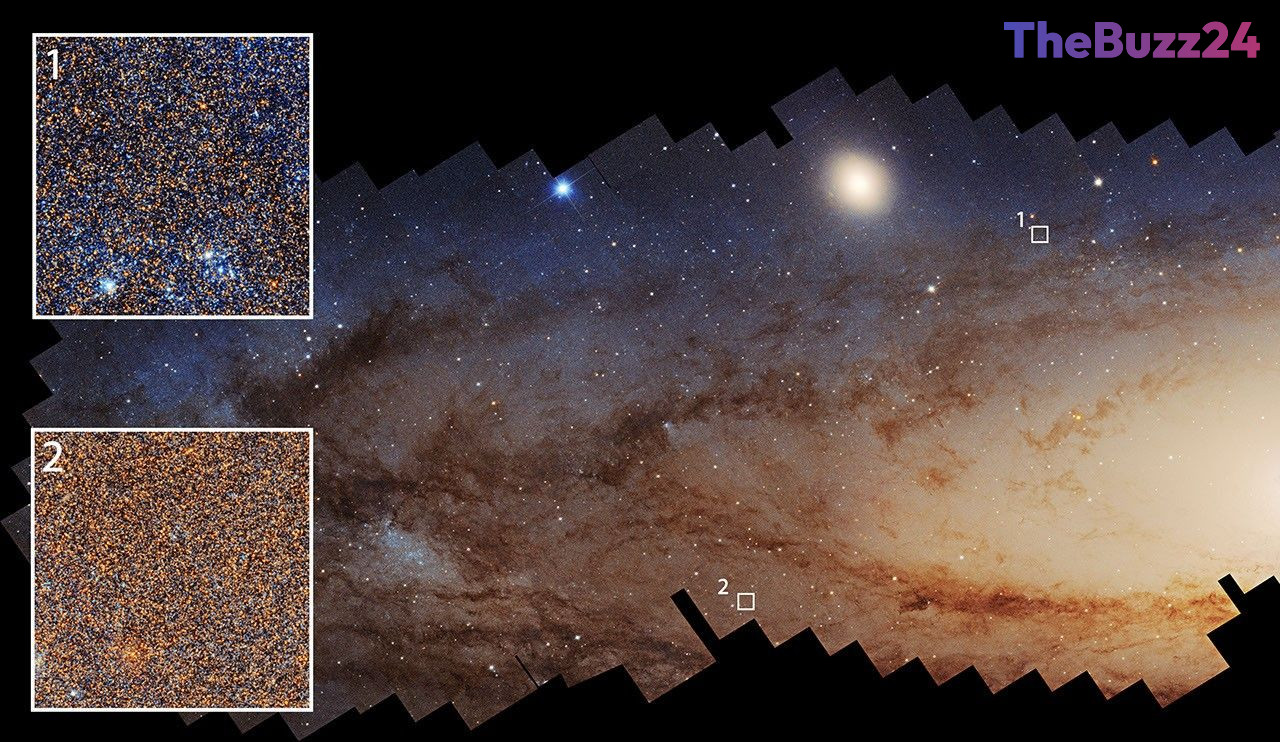
Fading Cosmic Engine: Andromeda Galaxy Experiences Dramatic Drop in Star Formation
New observational data reveals that the neighboring Andromeda galaxy is undergoing a prolonged slump in star production. Located approximately 2.5 million light-years from Earth, our nearest massive galactic neighbor has seen a steady 500-million-year decline in its star formation rates, marked by a particularly sharp drop over the last 40 million years. Astronomers analyzing nearly 200 million individual stars across two-thirds of the galaxy’s disk have traced this cooling trend, offering an unprecedented look into the lifecycles of large spiral galaxies.
By mapping vast regions of Andromeda through high-resolution deep-space surveys, researchers measured the proportion of short-lived, luminous blue stars against longer-lived, cooler red stars. The findings indicate that half a billion years ago, Andromeda was creating new stars at a rate equal to roughly one solar mass per year. That rate dropped by half roughly 40 million years ago, and today sits at a mere fraction—about one-fifth of a solar mass annually. This slowdown is especially prominent within a giant star-forming ring situated 32,000 light-years from the galactic core, suggesting the system is naturally settling down after a massive burst of activity that occurred two billion years ago.
Scientists also identified a localized slowdown near M32, one of Andromeda’s smaller satellite galaxies. Star formation in regions adjacent to M32 showed an accelerated decrease beginning around 60 million years ago, providing fresh clues about a potential past gravitational interaction between the two systems. As researchers prepare to integrate these detailed star-by-star surveys with upcoming wide-field cosmic imaging programs, the detailed stellar record in Andromeda promises to further refine existing models of galactic evolution.
Key Takeaways
- Star formation in the Andromeda galaxy has steadily declined over 500 million years, hitting a dramatic low point over the past 40 million years.
- The current star creation rate in Andromeda has dropped to just one-fifth of a solar mass per year, driven largely by reduced activity in a ring 32,000 light-years from its center.
- A gravitational encounter with nearby satellite galaxy M32 around 60 million years ago may have accelerated the star formation slowdown in adjacent regions.
Editor’s Analysis & Impact
The discovery of Andromeda’s diminishing star formation offers critical empirical data for galactic evolution models. As our closest major spiral neighbor, Andromeda serves as a primary benchmark for understanding the eventual trajectory of the Milky Way, especially given that the two galaxies are expected to interact dynamically in the distant future. Observing a galactic disk in a prolonged ‘cooling off’ phase following an ancient stellar boom helps astrophysicists map the lifecycle of interstellar gas reserves and the physical mechanisms governing star suppression. Moving forward, the deployment of next-generation wide-field space telescopes, such as the Nancy Grace Roman Space Telescope, will drastically expand observational capabilities, enabling astronomers to survey full galactic disks in a single sweep and further resolve the structural dynamics shaping our local universe.
Frequently Asked Questions
Q: How far away is the Andromeda galaxy from Earth?
A: The Andromeda galaxy is located approximately 2.5 million light-years away from Earth, making it the closest major spiral galaxy to our own Milky Way.
Q: Why is star formation declining in Andromeda?
A: The decline appears to be a natural winding down following an intensive starburst event two billion years ago, potentially accelerated in specific regions by gravitational interactions with satellite galaxies like M32.
Q: How do astronomers measure historical rates of star formation?
A: Astronomers measure star formation history by analyzing the spatial distribution and colors of individual stars, using short-lived blue stars to identify recent starbirth and longer-lived red stars to map older stellar populations.
AI Disclosure: This article is based on verified data and official reports. Our Team and AI have cross-referenced every financial detail with primary sources to ensure total accuracy.
More from this Category