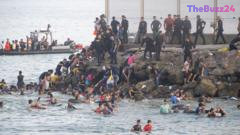
EU Pushes for Unified Border Security Strategy Following Ceuta Migration Crisis
Following a dramatic influx of migrants crossing from Morocco into the Spanish enclave of Ceuta, European Commission President Ursula von der Leyen has urged member nations to form a united front on European border security. Spanish authorities report that nearly 70,000 migrants have now been returned across the border, significantly exceeding preliminary estimates. The surge resulted in tragic casualties, with official fatalities recorded at 72 on the Spanish side and 11 on the Moroccan side, underscoring the extreme risks involved in the crossings.
The swift influx has ignited notable diplomatic friction across the European continent. In response to the situation, Italy temporarily suspended its Schengen arrangement with Spain, a decision supported by Denmark and Finland, while former Czech Prime Minister Andrej Babiš advocated for a temporary suspension of Spain’s Schengen status entirely. Spanish Prime Minister Pedro Sánchez defended his administration’s response while expressing concern over internal European divisions, noting that Ceuta falls outside the borderless Schengen area and criticizing political factions for exploiting the emergency with prejudice and inaccurate information.
In a formal communication to Sánchez, von der Leyen praised Spain’s rapid handling of the situation while emphasizing that safeguarding external boundaries remains a collective responsibility for all European Union member states. She called for heightened border monitoring, the implementation of physical barriers where necessary, and aggressive measures to dismantle human smuggling networks. EU interior ministers are gathering for emergency talks to establish a synchronized strategy focused on early warning systems, irregular migration prevention, and reinforced return policies.
On the ground, Spanish officials indicate that conditions surrounding Ceuta have largely stabilized. Spanish Interior Minister Fernando Grande-Marlaska confirmed that engineering efforts are underway to deploy specialized floating barriers to deter unauthorized maritime entry. Simultaneously, leadership pointed to legal hurdles, including a high court ruling limiting immediate deportations of sea arrivals, which officials say human traffickers actively exploited during the peak of the influx.
Key Takeaways
- European Commission President Ursula von der Leyen called for collective action and stronger physical border barriers following the emergency in Ceuta.
- Nearly 70,000 migrants have been returned to Morocco following the surge into the Spanish territory, which resulted in over 80 reported deaths.
- The crisis exposed diplomatic strains within the EU, leading several member states to temporarily alter border agreement practices with Spain.
Editor’s Analysis & Impact
The events in Ceuta underscore the ongoing challenge the European Union faces in balancing human rights commitments with strict border security. The immediate political friction among member states—demonstrated by temporary suspensions of Schengen provisions—highlights how border emergencies can quickly strain European cohesion and free movement policies. Moving forward, the EU is likely to accelerate investments in joint border defense technologies, early detection systems, and stronger diplomatic arrangements with North African transit nations. For member states on the southern frontier, establishing a durable consensus on migrant processing and return protocols remains a top political and economic priority.
Frequently Asked Questions
Q: What initiated the recent European Union discussions on border security?
A: The discussions were prompted by a sudden, large-scale influx of migrants crossing from Morocco into the Spanish enclave of Ceuta, creating an emergency that required rapid humanitarian and security intervention.
Q: How did other European nations respond to the events in Ceuta?
A: While top EU officials expressed solidarity with Spain, several countries including Italy, Denmark, and Finland temporarily instituted border checks or called for reviews of regional border-free travel arrangements.
Q: What steps are being taken to manage the border situation in Ceuta?
A: In addition to diplomatic talks among EU interior ministers, Spanish authorities have restored order on the ground and are working to install physical aquatic barriers to prevent unauthorized sea crossings.
AI Disclosure: This article is based on verified data and official reports. Our Team and AI have cross-referenced every financial detail with primary sources to ensure total accuracy.
More from this Category