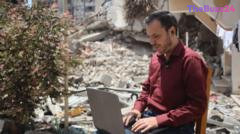
The Digital Lifeline: Gaza’s Tech Professionals Forge a Path Through Conflict
In the midst of the ongoing humanitarian crisis in Gaza, a resilient community of software engineers, developers, and digital creators is turning to the global tech economy to secure their livelihoods. For many, freelancing for international clients has become more than just a career; it is a vital lifeline that provides a sense of purpose and the financial means to support families displaced by the war. Operating from makeshift co-working spaces equipped with solar panels and generators, these professionals are overcoming near-total infrastructure collapse to maintain their connection to the global market.
The transition to remote work is fraught with extreme challenges. With the local power grid and telecommunications networks severely compromised, tech workers rely on improvised solutions to keep their equipment running. Furthermore, the scarcity of banking infrastructure and strict international financial restrictions make receiving payments a complex and costly endeavor. Many workers are forced to navigate informal broker networks, which often claim a significant portion of their earnings, leaving them with just enough to cover basic necessities.
Despite these obstacles, the determination of Gaza’s tech sector remains undeterred. For individuals like Walaa Volidis and Mahran Bayed, the ability to collaborate with teams in places like Silicon Valley or Dubai offers a rare sense of normalcy and professional agency. These workers are not only sustaining their families but are also actively planning for a future beyond the current conflict, seeking scholarships and medical evacuations for injured relatives. Their efforts highlight the transformative potential of digital work as a tool for survival and resilience in the world’s most difficult environments.
However, the path forward remains precarious. The classification of computer hardware as ‘dual-use’ items by border authorities has severely restricted the import of necessary repair parts, forcing technicians to cannibalize damaged devices to keep their workstations functional. As these professionals continue to deliver high-quality mobile apps, websites, and advertisements to global clients, they serve as a testament to the power of human ingenuity in the face of systemic adversity.
Key Takeaways
- Gaza's tech workers are increasingly turning to remote freelancing as a 'digital lifeline' to bypass local economic collapse and unemployment.
- Infrastructure damage, including power grid failure and telecommunications destruction, is being mitigated by solar-powered co-working hubs.
- Financial barriers, such as the lack of access to international banking and high fees from local money brokers, remain the primary obstacles to sustaining a stable income.
Editor’s Analysis & Impact
The emergence of a ‘digital lifeline’ in Gaza underscores a broader trend in global labor: the decoupling of professional output from physical geography. While the immediate impact is the survival of individual families, the long-term implication is the potential for a tech-literate workforce to serve as the foundation for Gaza’s eventual economic reconstruction. However, the industry faces a ‘ceiling’ imposed by geopolitical restrictions on hardware imports and financial connectivity. For this sector to scale, there must be a shift in how international entities view digital infrastructure in conflict zones. If these workers can maintain their skills and global networks, they are positioned to become the primary architects of the region’s future digital economy, provided that the physical and financial barriers to their work are eventually lowered.
Frequently Asked Questions
Q: How are Gaza's tech workers maintaining internet and power access?
A: Workers are utilizing new co-working spaces that have been established across the region, which rely on solar panels and generators to provide stable electricity and internet connectivity.
Q: What are the main financial challenges for freelancers in Gaza?
A: Freelancers face severe banking restrictions, a lack of access to standard digital payment platforms, and the necessity of using local brokers who charge high fees to convert electronic payments into cash.
AI Disclosure: This article is based on verified data and official reports. Our Team and AI have cross-referenced every financial detail with primary sources to ensure total accuracy.
More from this Category