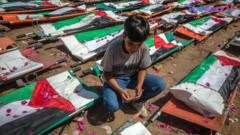
Gaza Holds Mass Funeral for 112 Victims Recovered from Rubble
A somber mass funeral took place in Gaza City this week, marking a tragic milestone as 112 individuals, primarily women and children, were laid to rest. The victims, members of the Abu Sharia and Hassayna families, were killed during an Israeli airstrike on a residential block in the Sabra neighborhood on November 22, 2023. Their remains were only recently recovered following an arduous two-week excavation operation conducted amidst the ongoing conflict.
The recovery effort, led by local Civil Defence crews with support from the International Committee of the Red Cross, highlights the immense logistical and humanitarian challenges of the war. Excavators and manual labor were required to sift through the debris of the leveled multi-story building, where it is estimated that nearly 180 civilians were present at the time of the strike. Among the 112 confirmed dead were 44 children, 38 women, and seven individuals with disabilities.
For the surviving relatives, the funeral provided a painful sense of closure after months of uncertainty. Many families had been unable to access the site immediately following the attack due to the intensity of the bombardment and the lack of security coordination. As the recovery process continues across the region, thousands of people remain unaccounted for, with many believed to be buried under the vast amounts of rubble generated by the conflict.
The scale of this tragedy underscores the profound human cost of the war, which has seen tens of thousands of casualties since late 2023. While the recovery of these remains allows families to perform traditional burial rites, the event serves as a stark reminder of the thousands of others who remain missing, leaving many families in Gaza without answers or the ability to properly mourn their loved ones.
Key Takeaways
- 112 victims from two extended families were buried in a mass funeral after being recovered from rubble in Gaza City.
- The victims were killed in a November 2023 airstrike, with recovery efforts delayed for months due to ongoing conflict and logistical hazards.
- Thousands of individuals across the Gaza Strip remain missing, with many presumed to be trapped under debris from destroyed infrastructure.
Editor’s Analysis & Impact
The recovery of these 112 victims highlights the long-term humanitarian crisis that will persist long after active hostilities cease. The destruction of residential infrastructure in Gaza has created a massive, ongoing recovery challenge that requires specialized equipment and international coordination. From a geopolitical perspective, the inability to access these sites for months illustrates the breakdown of safety corridors and the extreme difficulty of conducting search-and-rescue operations in a high-intensity conflict zone. The psychological impact on the surviving population, who are forced to wait months for the recovery of their loved ones, adds a layer of trauma that will complicate future reconstruction and reconciliation efforts. As the war continues, the international community faces increasing pressure to address the mounting death toll and the logistical nightmare of clearing debris to account for the missing.
Frequently Asked Questions
Q: Why did it take so long to recover the bodies?
A: The recovery was delayed due to the intensity of the bombardment, the danger of the area, and the lack of necessary coordination and heavy machinery required to safely clear the rubble.
Q: How many people are estimated to be missing in Gaza?
A: While exact figures are difficult to verify, it is believed that thousands of people remain unaccounted for, with many presumed to be buried under the rubble of buildings destroyed by airstrikes.
AI Disclosure: This article is based on verified data and official reports. Our Team and AI have cross-referenced every financial detail with primary sources to ensure total accuracy.
More from this Category