James Webb Space Telescope Captures Stunning Detail of the Lion’s Head Nebula
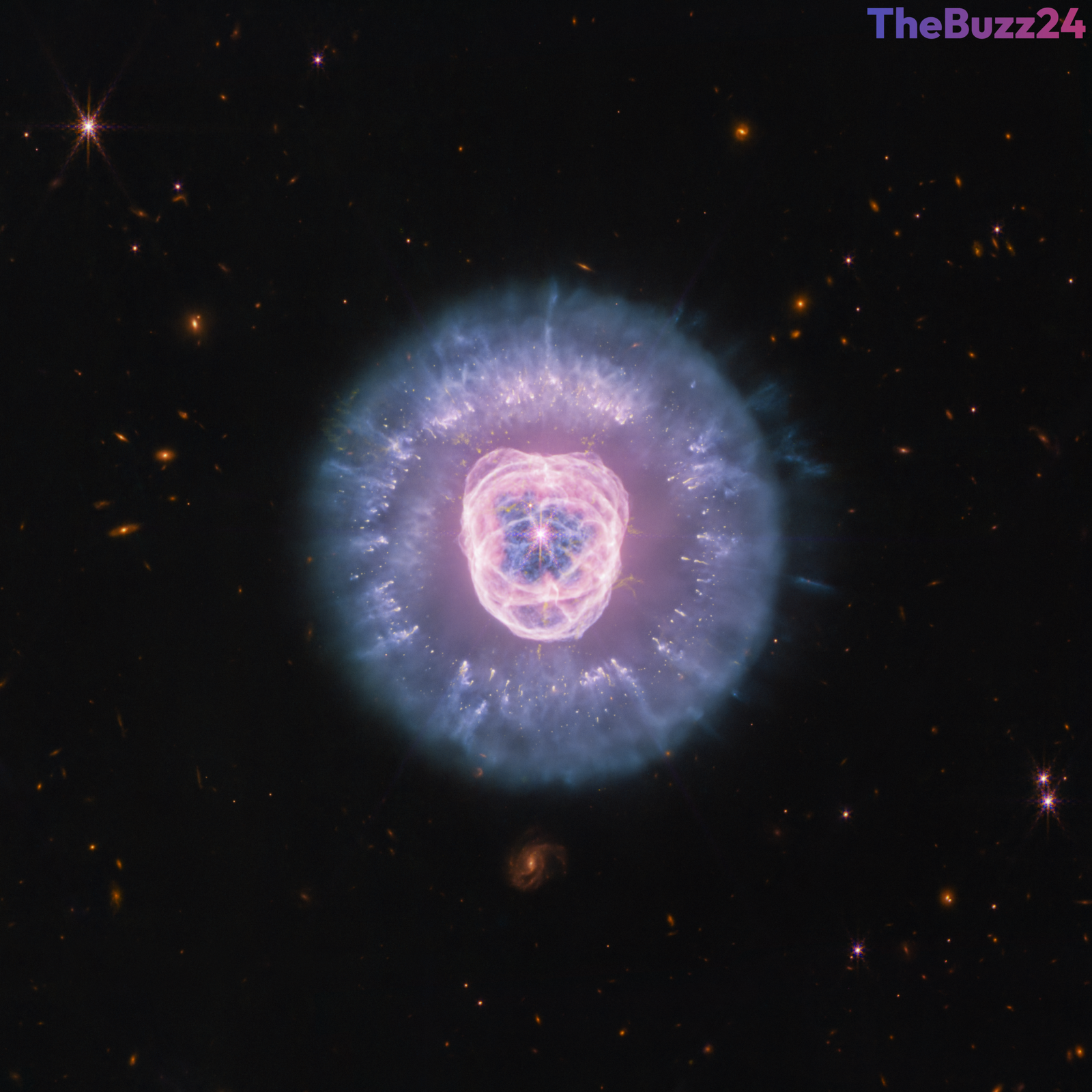
The James Webb Space Telescope has turned its advanced instruments toward the Lion’s Head Nebula, delivering an unprecedented look at a dying star’s final chapters. Utilizing both its Near-Infrared Camera (NIRCam) and Mid-Infrared Instrument (MIRI), the observatory produced a detailed composite image of NGC 2392, offering astronomers a clearer window into stellar evolution.
The nebula represents the cosmic remnant of a star similar to our own Sun. When the star exhausted the nuclear fusion processes required to maintain core stability, it began dispersing its outer layers of gas and dust into the surrounding void. At the center of this expanding cosmic structure—positioned metaphorically on the lion’s nose—lies a scorching white dwarf star, the dense remnant core powering the glowing phenomenon.
Intense radiation emitted by the surviving white dwarf continues to ionize the outward-drushing gas, shaping the complex, bubble-like visage of the nebula. Meanwhile, resilient dust clumps and ionized gas streams form the characteristic ‘mane’ surrounding the stellar core. Researchers anticipate that the enhanced clarity provided by these latest observations will significantly advance our understanding of how stellar radiation and cosmic dust dynamically interact in planetary nebulae.
Key Takeaways
- The James Webb Space Telescope captured a detailed composite image of the Lion's Head Nebula (NGC 2392).
- The nebula is formed by the remnants of a Sun-like star that shed its outer layers of gas and dust.
- A white dwarf at the center of the nebula emits intense radiation that ionizes the expanding gas.
Editor’s Analysis & Impact
The latest imagery from the James Webb Space Telescope underscores the ongoing revolution in observational astronomy, providing unprecedented data on stellar lifecycles and the fate of Sun-like stars. By capturing fine details of gas and dust interactions around a white dwarf, instruments like NIRCam and MIRI are bridging critical gaps in our astrophysical models. These insights not only enhance our comprehension of planetary nebulae dynamics but also offer a tantalizing glimpse into the potential deep-future scenario of our own solar system. As spatial resolution and infrared sensitivity continue to improve, the broader implications for stellar evolution research point toward more accurate simulations of galactic chemical enrichment and lifecycle transitions.
Frequently Asked Questions
Q: What is the Lion's Head Nebula?
A: The Lion's Head Nebula (NGC 2392) is a planetary nebula formed when a Sun-like star exhausted its nuclear fuel and shed its outer layers of gas and dust into space.
Q: What instruments were used to capture the image?
A: The image was captured using the James Webb Space Telescope's Near-Infrared Camera (NIRCam) and Mid-Infrared Instrument (MIRI).
Q: What is left at the center of the nebula?
A: A hot stellar core known as a white dwarf is left behind at the center, which emits intense radiation that ionizes the surrounding expanding gas.
AI Disclosure: This article is based on verified data and official reports. Our Team and AI have cross-referenced every financial detail with primary sources to ensure total accuracy.
More from this Category