Quest for Dark Energy: Roman Space Telescope Readies for Falcon Heavy Launch
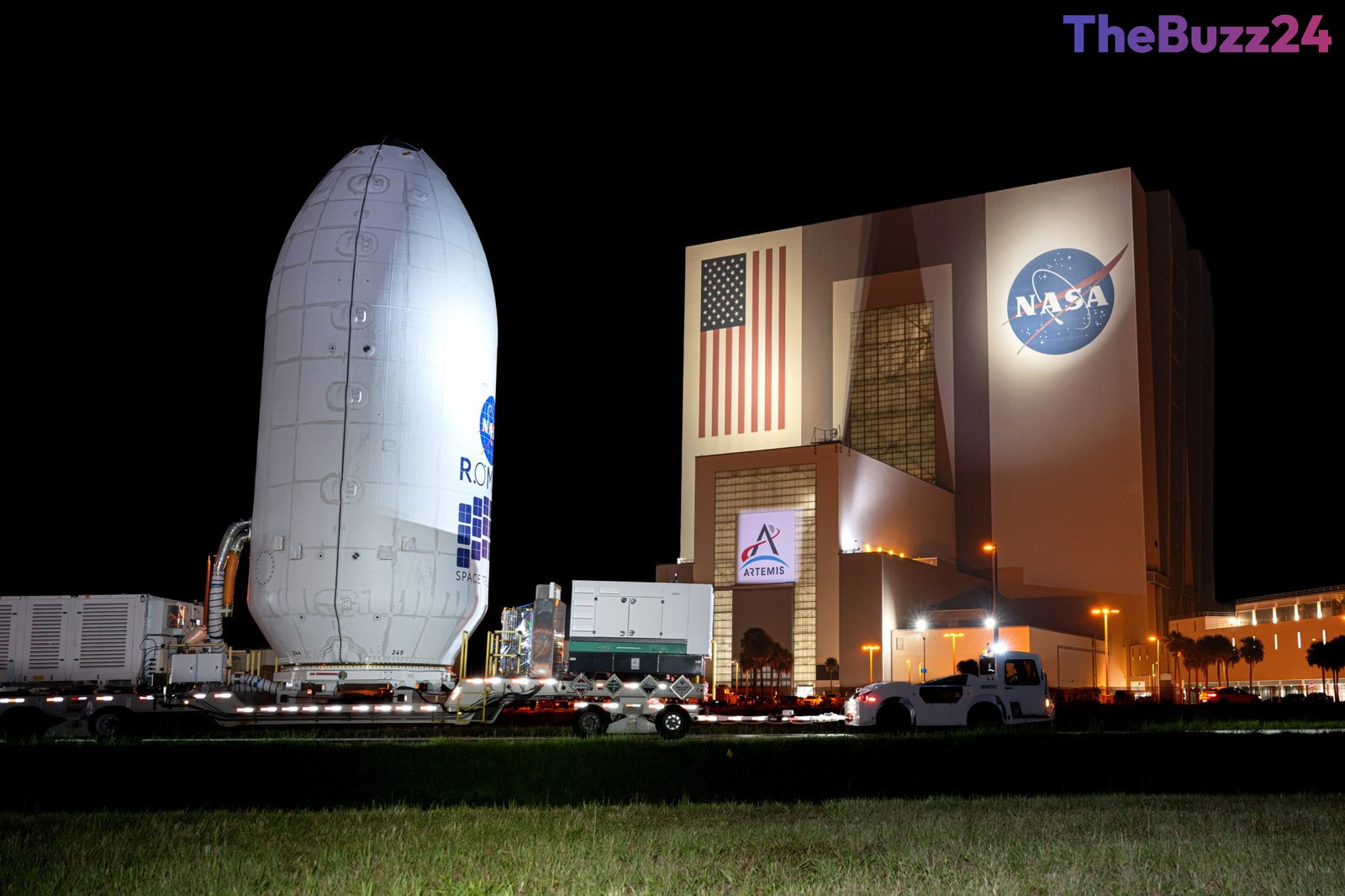
NASA’s groundbreaking Nancy Grace Roman Space Telescope has reached a critical milestone, moving into the SpaceX hangar at Launch Complex 39A at NASA’s Kennedy Space Center. The telescope, encased within its protective payload fairing, was transported on Tuesday, August 25, 2026, from the Payload Hazardous Servicing Facility, signaling its imminent integration with a SpaceX Falcon Heavy rocket.
This advanced observatory is poised to revolutionize our understanding of the cosmos. Its sophisticated science instruments are specifically engineered to investigate dark energy, the enigmatic force believed to be accelerating the universe’s expansion. Furthermore, the Roman Space Telescope will undertake an ambitious mission to map the formation, clustering, and evolution of galaxies, meticulously tracing the gravitational influence of dark matter across vast cosmic distances.
The highly anticipated liftoff from NASA Kennedy Space Center is currently targeted for no earlier than Sunday, August 30, 2026. This mission represents a significant leap forward in astrophysics, promising to deliver unprecedented insights into the fundamental components and dynamics of our universe.
Key Takeaways
- The Nancy Grace Roman Space Telescope has been moved to the SpaceX hangar at Kennedy Space Center for integration with a Falcon Heavy rocket.
- The telescope's primary mission is to study dark energy, which drives the universe's accelerated expansion, and map the influence of dark matter on galaxy formation.
- Launch is targeted for August 30, 2026, from NASA Kennedy Space Center.
Editor’s Analysis & Impact
The upcoming launch of the Nancy Grace Roman Space Telescope marks a pivotal moment in astrophysics and cosmology. Its mission to precisely measure dark energy and map dark matter has the potential to fundamentally alter our understanding of the universe’s composition and evolution. Success could lead to breakthroughs in theoretical physics, offering new insights into the forces governing cosmic expansion and structure formation. The data gathered will complement existing observations, providing a more comprehensive picture of the universe’s history and future. This mission also underscores the growing collaboration between NASA and commercial space entities like SpaceX, highlighting a new era of space exploration capabilities and efficiency.
Frequently Asked Questions
Q: What is the primary goal of the Nancy Grace Roman Space Telescope?
A: The telescope's main objective is to investigate dark energy, the mysterious force accelerating the universe's expansion, and to map the distribution and influence of dark matter on galaxy formation and evolution.
Q: What is dark energy and dark matter?
A: Dark energy is a hypothetical form of energy that permeates all of space and tends to accelerate the expansion of the universe. Dark matter is a hypothetical form of matter that is thought to account for approximately 27% of the mass-energy in the observable universe, but does not emit or reflect light, making it undetectable by direct observation.
Q: Which rocket will launch the Roman Space Telescope?
A: The Nancy Grace Roman Space Telescope will be launched aboard a SpaceX Falcon Heavy rocket from NASA's Kennedy Space Center.
AI Disclosure: This article is based on verified data and official reports. Our Team and AI have cross-referenced every financial detail with primary sources to ensure total accuracy.
More from this Category