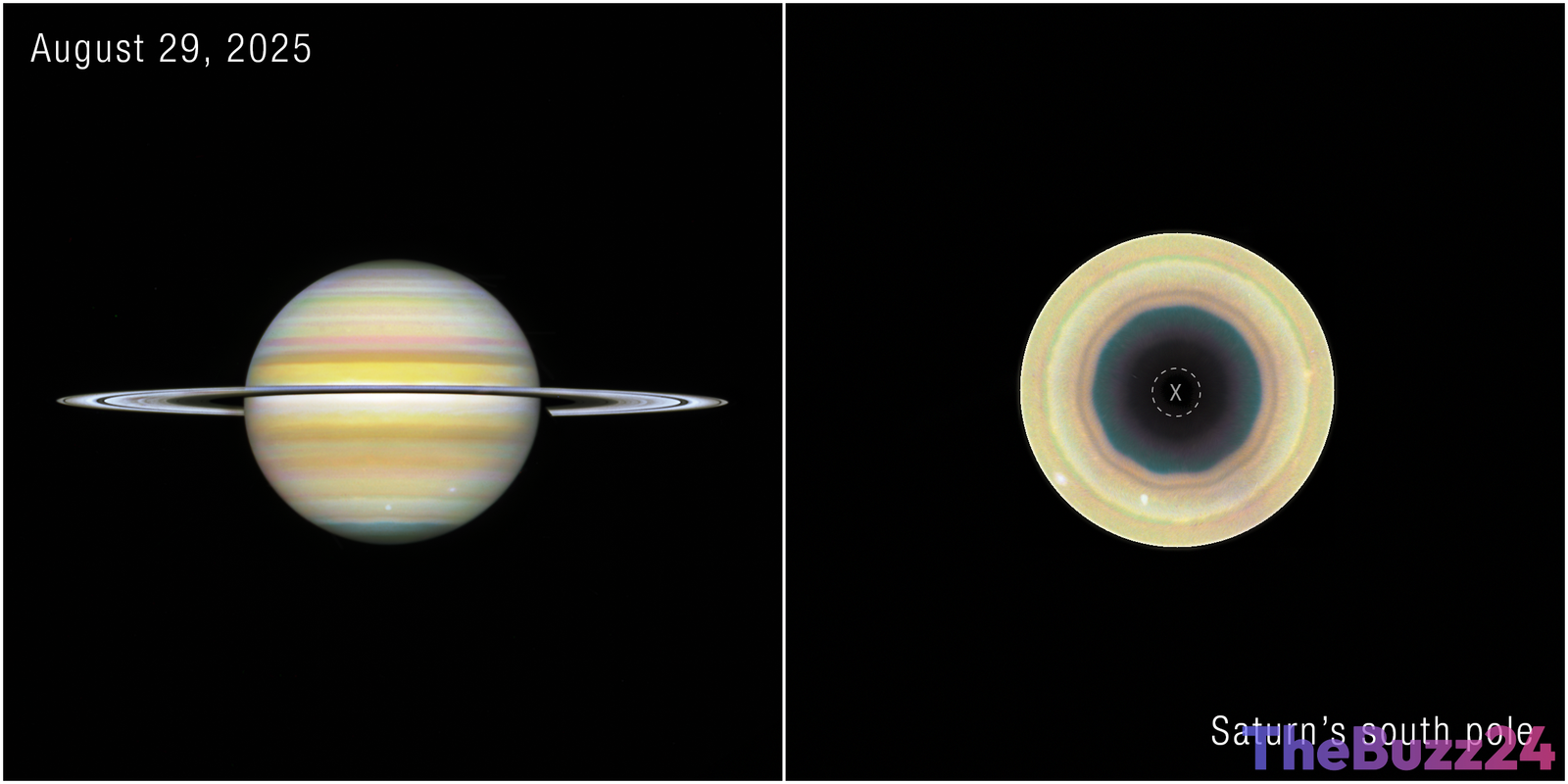
Saturn’s New Decagon: Giant 10-Sided Storm Wave Spotted at Gas Giant’s South Pole
Astronomers have detected a massive, evolving 10-sided atmospheric wave encircling the southern pole of Saturn. This newly identified “decagon” represents the first time a large, symmetrical jet stream pattern has been observed in the gas giant’s southern hemisphere. The structure bears a striking resemblance to the famous northern hexagon that has fascinated scientists for decades, yet its sudden emergence suggests a dynamic and evolving atmospheric phenomenon.
The discovery was made possible by analyzing years of observational data, which revealed subtle hints of the structure forming as early as 2023. While Saturn’s northern hexagon has remained stable for over 40 years, previous missions—including the Cassini spacecraft which orbited the planet until 2017—showed no signs of a similar shape at the south pole. The shifting of Saturn’s seasons gradually brought the southern polar region back into view, allowing both ground-based observers and space-based instruments to capture the emerging pattern.
Researchers confirmed that the decagon is not merely a superficial cloud formation. Instead, it sits within one of Saturn’s high-speed jet streams and penetrates multiple layers of the atmosphere, indicating a deeply rooted, vertically extended structure. Because different wavelengths of light probe different altitudes, observations show slight shifts in the wave’s appearance, helping scientists map its vertical profile.
The sudden appearance of this geometric wave raises fundamental questions about planetary atmospheric dynamics. Scientists plan to utilize both the Hubble Space Telescope and the James Webb Space Telescope to monitor the decagon’s evolution. Ongoing observations will determine whether this 10-sided wave will stabilize into a permanent fixture like its northern counterpart or if it is a transient seasonal event, offering fresh insights into the meteorology of gas giants.
Key Takeaways
- Astronomers have discovered a giant, 10-sided atmospheric wave (a decagon) encircling Saturn's south pole, marking the first such symmetrical structure found in the southern hemisphere.
- Data indicates the decagon began forming around 2023 and is deeply rooted, extending through multiple layers of Saturn's atmosphere.
- Unlike the northern hexagon, which has been stable for over four decades, this southern decagon appears to be a newly developing phenomenon.
Editor’s Analysis & Impact
The discovery of Saturn’s southern decagon highlights the critical importance of long-term planetary monitoring programs. While single-flyby missions provide invaluable high-resolution snapshots, understanding the complex, seasonal atmospheric dynamics of gas giants requires decades of continuous observation. This finding challenges existing meteorological models, which previously assumed a degree of hemispheric asymmetry regarding stable geometric jet streams. From an industry perspective, this breakthrough underscores the ongoing value of legacy space assets working in tandem with next-generation observatories like the James Webb Space Telescope and advanced ground-based amateur networks. As researchers attempt to model how a 10-sided wave forms and sustains itself, the findings could refine our broader understanding of fluid dynamics, atmospheric physics, and weather patterns on both giant exoplanets and Earth.
Frequently Asked Questions
Q: How does the new southern decagon differ from Saturn's northern hexagon?
A: While the northern hexagon has been a stable, permanent fixture observed for over 40 years, the southern decagon is a newly emerging 10-sided wave that was not detected by previous missions like Cassini, suggesting it is a recently formed atmospheric structure.
Q: How deep does this 10-sided wave go into Saturn's atmosphere?
A: Observations across different wavelengths reveal that the decagon extends through multiple atmospheric layers, proving it is a deeply rooted, vertically extended structure rather than a temporary, shallow cloud formation.
Q: What instruments were used to detect and confirm this phenomenon?
A: The structure was initially noticed in ground-based images contributed by global observers to the Planetary Virtual Observatory Laboratory, and its existence was subsequently confirmed and analyzed using high-resolution data from the Hubble Space Telescope.
AI Disclosure: This article is based on verified data and official reports. Our Team and AI have cross-referenced every financial detail with primary sources to ensure total accuracy.
More from this Category