Succession Dispute Clouds Uganda’s Mourning as Body of World’s Youngest Monarch Returns Home
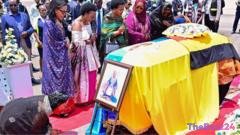
The body of King Oyo Nyimba Kabamba Iguru Rukidi IV, celebrated globally as the world’s youngest reigning monarch, has returned to Uganda following his passing in the United States. The 34-year-old traditional ruler of the Tooro kingdom succumbed to an aggressive form of cancer last week. His arrival at Entebbe International Airport was met with deep solemnity, with high-ranking officials, including Ugandan President Yoweri Museveni, gathering to pay their respects before the casket was transported to the royal palace in Fort Portal.
King Oyo ascended the throne at the tender age of three and was formally crowned upon reaching adulthood at 18. His sudden death occurred just ahead of what would have been his coronation anniversary. During a special parliamentary tribute, lawmakers and government officials praised the late monarch as a modernizing force who leveraged his cultural influence to champion youth empowerment, education, and public health initiatives, particularly HIV/AIDS awareness. A nine-day official mourning period has commenced, culminating in a traditional burial at the Karambi Royal Tombs.
Despite the collective grief, a sharp division has emerged within the Tooro kingdom regarding who will succeed the late king, who was unmarried. Tooro Prime Minister Calvin Armstrong Rwomiire Akiiki announced that King Oyo had fathered a young son whose identity would be disclosed in due course according to custom—a claim supported by President Museveni, who noted the king’s mother had confirmed the heir’s existence. However, this assertion has been publicly challenged by Charles Kamurasi, the head of the Babiito royal clan, and other close relatives who claim they were kept in the dark, sparking an unusual public rift over royal protocol.
In response to the escalating tension, the Ugandan government has stepped in to urge calm. Culture Minister Henry Tumukunde appealed to the public and royal family members to refrain from spreading rumors on social media, emphasizing that any succession disputes must be resolved through established legal and cultural frameworks. While Uganda’s traditional kingdoms hold no formal political power under the country’s republican constitution, they retain immense cultural and social authority over millions of citizens, making the stability of the Tooro throne a matter of national significance.
Key Takeaways
- King Oyo Nyimba Kabamba Iguru Rukidi IV of Uganda's Tooro kingdom has passed away at age 34 in the United States after battling cancer.
- A major succession dispute has erupted because the king was unmarried, with the kingdom's prime minister claiming a secret young heir exists, while the royal clan leadership denies knowledge of the child.
- The Ugandan government has called for calm and restraint, urging the public to avoid social media speculation as the nation observes a nine-day mourning period.
Editor’s Analysis & Impact
The passing of King Oyo and the subsequent succession dispute highlight the delicate balance of power and tradition in modern Uganda. Although the country’s 1995 constitution bars traditional leaders from active politics, these monarchs wield immense cultural capital and influence voting blocs, making their stability vital to the central government. President Museveni’s swift involvement and the government’s call for calm underscore the state’s anxiety over potential unrest in the western region. The dispute between the Tooro Prime Minister and the Babiito royal clan reveals a deeper institutional friction regarding traditional customs versus modern administrative transparency. How the kingdom navigates this transition will set a significant precedent for other traditional polities in East Africa, demonstrating whether ancient customs can withstand the pressures of modern public scrutiny and legal frameworks.
Frequently Asked Questions
Q: Who was King Oyo and why was he famous?
A: King Oyo Nyimba Kabamba Iguru Rukidi IV was the traditional ruler of the Tooro kingdom in Uganda. He gained international fame after being recognized by Guinness World Records as the world's youngest reigning monarch, having ascended the throne in 1995 at just three years old.
Q: Why is there a dispute over his succession?
A: Because King Oyo was unmarried at the time of his death, his direct successor was not publicly established. While the kingdom's prime minister and the king's mother claim he left a young son as an heir, the head of the royal clan has disputed this, stating that close family members were not informed, leading to a public disagreement.
Q: What role do traditional kings play in Uganda?
A: Traditional kingdoms in Uganda do not hold sovereign political or executive power, which lies with the elected president and parliament. However, they possess significant cultural, historical, and developmental influence over millions of subjects, championing local education, healthcare, and cultural preservation.
AI Disclosure: This article is based on verified data and official reports. Our Team and AI have cross-referenced every financial detail with primary sources to ensure total accuracy.
More from this Category