Hubble Telescopes Paves the Way for Upcoming Roman Space Mission via Gravitational Lenses
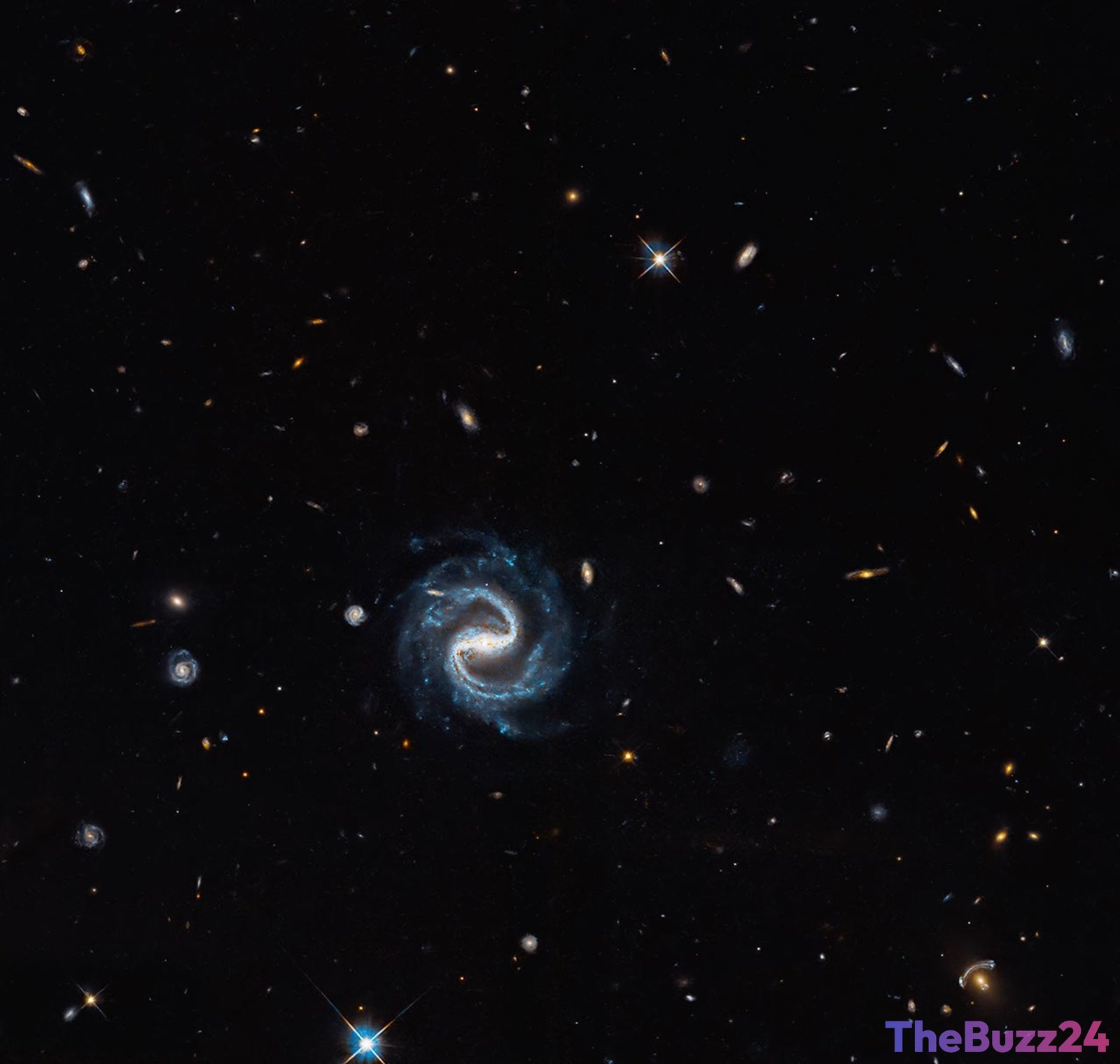
The Hubble Space Telescope has captured a stunning cosmic alignment featuring a barred spiral galaxy alongside a vivid gravitational lens, offering astronomers a vital preview for upcoming observations by the Nancy Grace Roman Space Telescope. The captured phenomenon involves a massive foreground elliptical galaxy warping spacetime to bend, distort, and magnify the light of a background galaxy located nearly twice as far away.
In the striking image, the foreground galaxy sits approximately 4.5 billion light-years from Earth, while the background target rests roughly eight billion light-years away. Due to the intense gravitational pull of the closer object, light from the distant galaxy is stretched into distinctive luminous arcs on opposite sides of the lens. This unique arc-counterarc configuration allows astrophysicists to calculate the total mass of the foreground object, providing critical insights into the distribution of dark matter—the elusive, invisible substance that comprises the vast majority of the universe’s mass.
While Hubble excels at capturing high-resolution details of individual cosmic targets primarily in visible and ultraviolet light, the upcoming Roman Space Telescope is designed to survey expansive panoramic fields mainly across infrared wavelengths. Because Hubble is limited to analyzing these gravitational lenses on an individual basis, current observations are being utilized to develop sophisticated computer models. These models will prepare researchers to efficiently process the massive volume of wide-field data expected from the Roman mission.
Ultimately, the synergy between these advanced observatories promises to revolutionize our understanding of cosmic structures. By leveraging Hubble’s sharp imagery to decode gravitational distortions today, scientists are laying a robust foundation for groundbreaking discoveries when the Roman Space Telescope begins operations, ultimately opening new windows into the mysteries of the cosmos.
Key Takeaways
- NASA's Hubble Space Telescope has captured a rare gravitational lensing event to help prepare for the Nancy Grace Roman Space Telescope mission.
- Gravitational lensing occurs when a massive foreground object warps spacetime, magnifying and distorting the light of a more distant background galaxy.
- By analyzing these cosmic distortions, researchers can calculate the mass of foreground galaxies and map the distribution of elusive dark matter.
Editor’s Analysis & Impact
The collaborative strategy between the Hubble Space Telescope and the upcoming Nancy Grace Roman Space Telescope marks a significant milestone in modern observational astrophysics. By using Hubble’s high-resolution capabilities to model gravitational lenses, researchers are establishing a critical analytical pipeline for the massive datasets expected from Roman’s wide-field surveys. This methodological bridge not only enhances our current understanding of dark matter distribution and galactic mass, but it also sets a new benchmark for multi-telescope synergy. As space agencies continue to deploy instruments with complementary spectral ranges and field-of-view dimensions, the resulting acceleration in cosmological discoveries will likely drive increased public and private interest in deep-space exploration technologies.
Frequently Asked Questions
Q: What is gravitational lensing?
A: Gravitational lensing is a phenomenon where the intense gravity of a massive foreground object, such as a galaxy, warps spacetime. This causes the light from a more distant background object to bend, distort, and magnify as it passes through.
Q: How do astronomers use gravitational lenses to study dark matter?
A: Because visible matter alone cannot account for the heavy distortion seen in background galaxies, scientists can calculate the total mass of the foreground lens—including its invisible dark matter component—by measuring how severely the background light is bent.
Q: How will Hubble and the Roman Space Telescope work together?
A: Hubble provides high-resolution, detailed views of individual targets, while the Roman Space Telescope offers a much larger field of view for panoramic surveys. Together, they allow astronomers to discover numerous lenses with Roman and study them in fine detail using Hubble's sharp optics.
AI Disclosure: This article is based on verified data and official reports. Our Team and AI have cross-referenced every financial detail with primary sources to ensure total accuracy.
More from this Category