Shark’s Great Escape Fails: ‘Bukangi’ Repeatedly Returns to Busan Canal
A celebrity shark, affectionately nicknamed Bukangi, has become the center of a persistent rescue saga in Busan, South Korea, after repeatedly returning to a canal where it was discovered last month. The three-meter-long marine creature captivated the public, drawing over 1.6 million visitors and becoming an unofficial mascot for the port city. However, concerns for its well-being, including visible injuries and a lack of appetite, prompted authorities to attempt its relocation to the open sea.
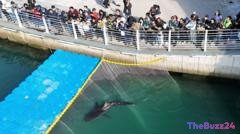
Despite a meticulously planned, eight-hour operation involving rescue workers and nets, which was cheered on by hundreds of onlookers, Bukangi’s journey back to freedom proved short-lived. Shortly after being guided into open waters, the shark was observed swimming back towards the canal’s entrance. Authorities subsequently reinforced barriers in an effort to prevent its return, but Bukangi has continued to circle back to the waterway’s mouth, defying efforts to keep it at bay.
The shark’s unusual presence in the canal is speculated to be due to unusually warm waters and an abundance of fish, leading experts to suggest that warmer seas may lead to more frequent shark encounters in the region. While Bukangi’s popularity provided a significant boost to local tourism, its health appeared to be deteriorating, with social media users sharing images of a potentially injured snout. This prompted a debate among Busan residents, with some advocating for the shark’s continued stay, viewing it as a special gift, while others emphasized the importance of its return to a natural, healthy life in the ocean.
After multiple failed attempts, rescue operations have now concluded, with authorities focusing on preventing Bukangi’s re-entry into the canal. The situation highlights the complex challenges of wildlife intervention and the emotional connection communities can form with unexpected animal visitors, even as the natural needs of the animal remain paramount.
Key Takeaways
- A shark nicknamed Bukangi, found in a Busan canal, has repeatedly returned despite rescue attempts to guide it to the open sea.
- The shark's presence boosted tourism in Busan, but concerns for its health led to intervention efforts.
- Authorities have concluded rescue operations and are now focused on preventing the shark from re-entering the canal.
Editor’s Analysis & Impact
The saga of Bukangi, the shark that refuses to leave the Busan canal, underscores a growing trend of human-wildlife interaction in urbanized coastal areas, potentially exacerbated by climate change. While the shark became a tourism boon, its apparent distress and the logistical challenges of its rescue highlight the delicate balance between economic benefits and animal welfare. This incident serves as a case study for coastal cities worldwide, prompting discussions on preparedness for unusual wildlife encounters and the ethical considerations of intervention. The long-term implications may involve developing more sophisticated strategies for managing and protecting marine life that ventures into human-dominated environments, especially as warming oceans continue to alter marine ecosystems.
Frequently Asked Questions
Q: Why did the shark, Bukangi, go into the canal in the first place?
A: It is believed that Bukangi was attracted to the canal by unusually warm water temperatures and a plentiful supply of fish, creating an appealing environment compared to the open sea.
Q: What were the main concerns regarding Bukangi's health?
A: Concerns included visible injuries, such as a potentially bloodied snout, a lack of appetite, and the risk of declining water temperatures weakening the shark further.
Q: What is the current status of the rescue efforts?
A: Authorities have concluded their active rescue operations to guide the shark out. Their current focus is on reinforcing barriers to prevent Bukangi from re-entering the canal, though the shark continues to circle back to its entrance.
AI Disclosure: This article is based on verified data and official reports. Our Team and AI have cross-referenced every financial detail with primary sources to ensure total accuracy.
More from this Category