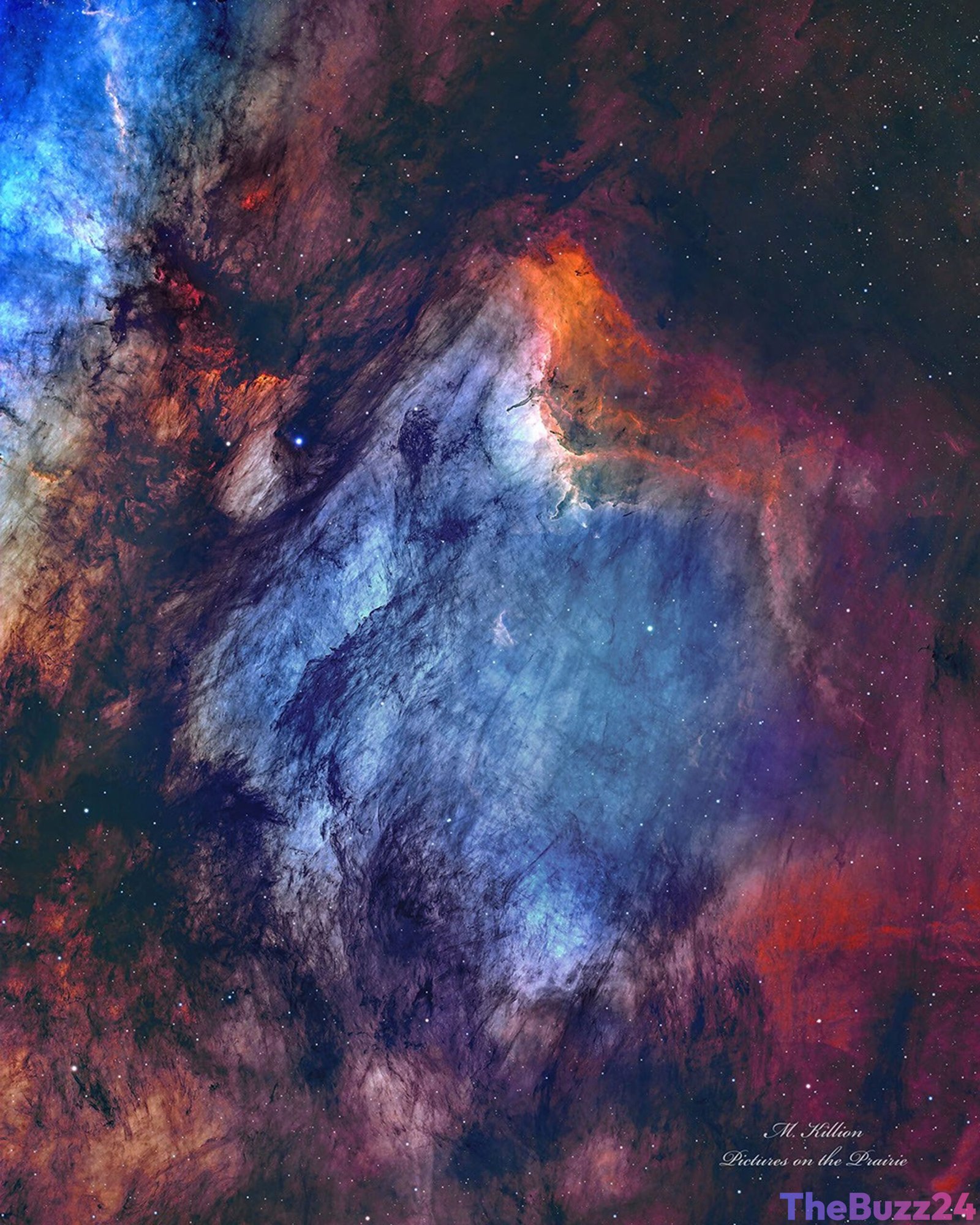
Cosmic Metamorphosis: The Pelican Nebula’s Dynamic Transformation
The vast expanse of the cosmos continually presents breathtaking spectacles, and among them, the Pelican Nebula stands out as a vibrant laboratory of stellar birth and gaseous evolution. Officially designated IC 5070, this celestial marvel is undergoing a slow yet profound transformation, a process driven by the energetic forces of nascent stars. Separated from its larger neighbor, the North America Nebula, by a dense molecular cloud teeming with dark dust, the Pelican Nebula offers astronomers a unique window into the lifecycle of cosmic matter.
Recent deep-exposure imagery, captured with over 25 hours of observation, reveals intricate details of the nebula’s filamentary dust structures. This region is particularly scrutinized due to its intense activity, where a dynamic interplay of star formation and evolving gas clouds is constantly reshaping its landscape. The powerful radiation emanating from newly formed, energetic stars is gradually converting the surrounding cold gas into hot, ionized gas. This boundary, where the transformation occurs, is vividly visible as a bright orange “ionization front” in the upper right portions of the nebula, highlighting the ongoing cosmic alchemy.
Within this turbulent environment, particularly dense “tentacles” of cold gas persist, resisting the ionizing radiation for now. However, the balance of stars and gas within IC 5070 is far from static. Bounded by the dark nebula LDN 935, the Pelican Nebula’s current appearance is merely a snapshot in its long evolutionary journey. Scientists predict that millions of years into the future, the continuous processes of stellar birth and gas dispersal will have altered its structure so significantly that it may no longer resemble the familiar “Pelican” shape we observe today, evolving into something entirely different.
Key Takeaways
- The Pelican Nebula (IC 5070) is a highly active region of star formation and evolving gas clouds, undergoing continuous transformation.
- Energetic young stars are ionizing surrounding cold gas, creating a visible "ionization front" that marks the boundary of this cosmic change.
- Over millions of years, the nebula's dynamic processes are expected to dramatically alter its structure, leading to a completely different appearance.
Editor’s Analysis & Impact
The ongoing study of nebulae like the Pelican Nebula is crucial for advancing our understanding of stellar evolution and the fundamental processes that govern the universe. These cosmic nurseries provide direct observational evidence of how stars are born, how they interact with their environment, and how they ultimately shape the galaxies we inhabit. The detailed imagery and analysis of IC 5070 offer invaluable data for refining astrophysical models, helping scientists unravel the complex interplay of gravity, radiation, and matter that drives cosmic change. This research not only expands our scientific knowledge but also inspires public interest in space exploration and the wonders of the cosmos.
Frequently Asked Questions
Q: What is the Pelican Nebula?
A: The Pelican Nebula, officially known as IC 5070, is a large emission nebula located in the constellation Cygnus. It is an active region of star formation and evolving gas clouds, named for its distinctive shape that resembles a pelican.
Q: Why is the Pelican Nebula important to study?
A: It is a key area for astronomers to study the processes of star formation and how young, energetic stars interact with and transform their surrounding gas and dust clouds. Its dynamic nature provides insights into the lifecycle of cosmic matter.
Q: What is an ionization front?
A: An ionization front is the boundary region in a nebula where intense ultraviolet radiation from hot, young stars ionizes the surrounding neutral gas, causing it to glow. In the Pelican Nebula, this front is visible as a bright orange area where cold gas is being converted into hot, ionized gas.
AI Disclosure: This article is based on verified data and official reports. Our Team and AI have cross-referenced every financial detail with primary sources to ensure total accuracy.
More from this Category