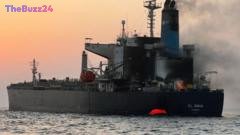
Two Sailors Missing After Oil Tanker Attacked in Strait of Hormuz
Two sailors remain unaccounted for following a recent attack on an oil tanker in the strategically vital Strait of Hormuz. Oman’s Maritime Security Centre confirmed that 23 other crew members were successfully rescued after a fire erupted in the engine room of the Panama-flagged vessel, El Gaia. The tanker was reportedly targeted approximately 1.3 nautical miles north of the Musandam peninsula and was subsequently being towed to an Omani port.
Conflicting reports have emerged regarding the nature of the incident. Iran’s Revolutionary Guards initially stated the tanker struck naval mines and caught fire while navigating a restricted route. However, the U.S. military has disputed this account, asserting that the vessel was previously struck by an Iranian missile last month and, more recently, by a drone over the weekend. The UK Maritime Trade Operations also reported receiving information about a fire on a vessel struck by an unknown projectile in the early hours of Sunday while transiting the same strait.
This incident follows a pattern of maritime disruptions in the region. Earlier this month, a similar claim by Iran regarding a naval mine incident on the Saudi-owned oil supertanker Sidr, which resulted in the deaths of two Filipino sailors, was contradicted by Saudi authorities and maritime security firms, who attributed the attack to projectiles. The International Maritime Organization has documented a significant number of incidents in the Strait of Hormuz and surrounding Middle Eastern waters since late February, with at least 22 seafarers losing their lives.
Adding to the regional tensions, Iran’s semi-official Fars news agency reported that “enemy drones” targeted two fishing boats near the Iranian port of Kargan, resulting in several missing fishermen and prompting a search-and-rescue operation. Concurrently, U.S. military forces reported destroying two boats that attempted to seize a sea drone, highlighting ongoing confrontations in the critical shipping lane.
Key Takeaways
- An oil tanker, El Gaia, was attacked in the Strait of Hormuz, resulting in two missing sailors and 23 rescued.
- Conflicting reports from Iran and the U.S. military offer different explanations for the tanker's damage, involving missiles, drones, and naval mines.
- The incident is part of a broader pattern of maritime attacks in the Strait of Hormuz, a critical global oil and gas transit route.
Editor’s Analysis & Impact
The repeated attacks on commercial shipping in the Strait of Hormuz underscore the escalating geopolitical tensions in the region and their direct impact on global energy markets. The conflicting narratives surrounding these incidents create uncertainty and risk, potentially driving up insurance costs for vessels and influencing oil prices. The strait’s critical role in global trade means any sustained disruption could have far-reaching economic consequences. The U.S. military’s active role in responding to these incidents suggests a continued commitment to maintaining freedom of navigation, but also raises the specter of wider conflict. The long-term outlook depends heavily on diplomatic de-escalation and the resolution of underlying political disputes.
Frequently Asked Questions
Q: What is the Strait of Hormuz?
A: The Strait of Hormuz is a narrow waterway connecting the Persian Gulf and the Gulf of Oman. It is one of the world's most important oil transit chokepoints, with approximately one-fifth of global oil consumption passing through it.
Q: Why are attacks occurring in the Strait of Hormuz?
A: Attacks in the Strait of Hormuz are often linked to geopolitical tensions between Iran and other regional and international powers, particularly the United States and its allies. These incidents can be part of broader strategic maneuvering, attempts to disrupt trade, or retaliatory actions.
Q: What are the consequences of these attacks?
A: The attacks can lead to disruptions in oil supply, increased shipping costs, higher insurance premiums for vessels, and a general increase in regional instability. They also pose a direct threat to the lives of seafarers.
AI Disclosure: This article is based on verified data and official reports. Our Team and AI have cross-referenced every financial detail with primary sources to ensure total accuracy.
More from this Category