Curiosity Rover Navigates Subtle Banded Terrain in Valle Grande on Mars
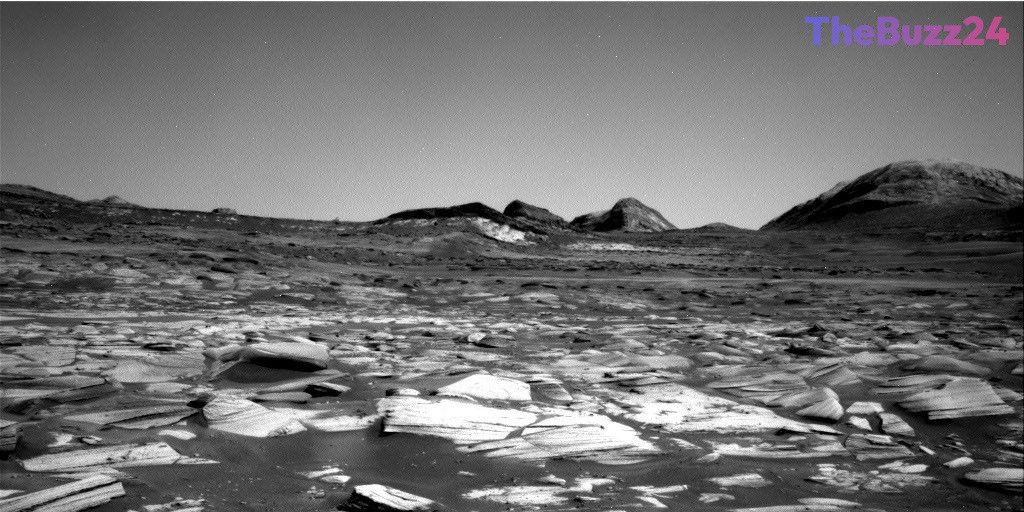
NASA’s Mars rover Curiosity is continuing its scientific journey across the Red Planet, recently navigating through a distinct region characterized by subtle geological banding within the valley informally known as “Valle Grande.” Operating on Martian days, or sols, 5010 through 5015, the robotic explorer has been actively examining the diverse landscape of sand-filled terrain and rocky outcrops.
During recent planning cycles, the mission team directed the rover to investigate several interesting geological features. Using instruments such as the Alpha Particle X-ray Spectrometer (APXS) and Mars Hand Lens Imager (MAHLI), scientists targeted brushed nodular bedrock areas dubbed “Cerro Armazones” and “Monte Melimoyu.” Additionally, the ChemCam instrument performed Laser-Induced Breakdown Spectroscopy (LIBS) on dark-toned nodules and float rocks in the vicinity, gathering crucial data on the local mineral composition.
Following a recent drive of approximately 60 meters, the rover encountered a unique block featuring abundant small flakes, laminated smoother areas, and rougher textures that immediately drew the attention of researchers. Contact science and imaging activities were quickly scheduled to analyze these distinct morphological properties. Alongside the geological investigations, Curiosity’s environmental monitoring team maintained a robust schedule, capturing dust-devil movies, analyzing atmospheric dust, and recording horizon views to better understand the Martian climate.
The broader exploration campaign continues to document the surrounding buttes and sand fields, including the “Sullivan Field” region, which features complex wind-blown sediment patterns and sand ripples. As Curiosity presses forward through the banded terrain, researchers are eager to closely examine how these tonal variations evolve, providing deeper insights into the geological history of Gale Crater and the ancient environments of Mars.
Key Takeaways
- Curiosity is currently traversing a subtly banded geological region within the Valle Grande valley on Mars.
- The rover recently conducted contact science and LIBS analysis on unique rock formations, including nodular bedrock and laminated blocks.
- Environmental teams are running a full suite of atmospheric monitoring tasks, including dust-devil and horizon observations.
Editor’s Analysis & Impact
The ongoing mission of the Curiosity rover continues to yield invaluable geological and environmental data from Mars, advancing our understanding of planetary evolution and ancient habitability. As the spacecraft surpasses major operational milestones—such as its recent 5000th sol and multi-kilometer elevation achievements—the focus remains on meticulous, incremental exploration of transitional zones like Valle Grande. These detailed insitu analyses of sedimentary structures, wind-blown deposits, and mineralogical variations not only refine our models of Martian geological history but also lay critical groundwork for future human and robotic missions to the Red Planet. The ability of an aging spacecraft to maintain high-frequency science operations underscores the enduring success of long-duration interplanetary missions.
Frequently Asked Questions
Q: What is a 'sol' in the context of the Curiosity rover mission?
A: A sol is a solar day on Mars. It is slightly longer than an Earth day, lasting approximately 24 hours, 39 minutes, and 35 seconds.
Q: What scientific instruments are being used to analyze the rocks in Valle Grande?
A: The team uses instruments such as the Alpha Particle X-ray Spectrometer (APXS), the Mars Hand Lens Imager (MAHLI), and ChemCam for Laser-Induced Breakdown Spectroscopy (LIBS) to study rock textures and compositions.
Q: What kind of terrain is Curiosity currently exploring?
A: Curiosity is moving through a valley known as 'Valle Grande,' which features sparse outcrops with rough, nodular textures surrounded by extensive sand and coarse pebbly material, arranged in subtle tonal bands.
AI Disclosure: This article is based on verified data and official reports. Our Team and AI have cross-referenced every financial detail with primary sources to ensure total accuracy.
More from this Category