Rare Desert Bloom Transforms Western Australian Outback into Vibrant Tapestry
Arid shrublands across the Western Australian outback have undergone a stunning transformation, bursting with life as a massive profusion of wildflowers blankets the traditionally rusty ochre landscape. Following several months of unusually high rainfall earlier in the year, dormant seeds buried deep within the soil have awakened, generating what local environmental experts project to be the most magnificent floral display the region has witnessed in nearly two decades.
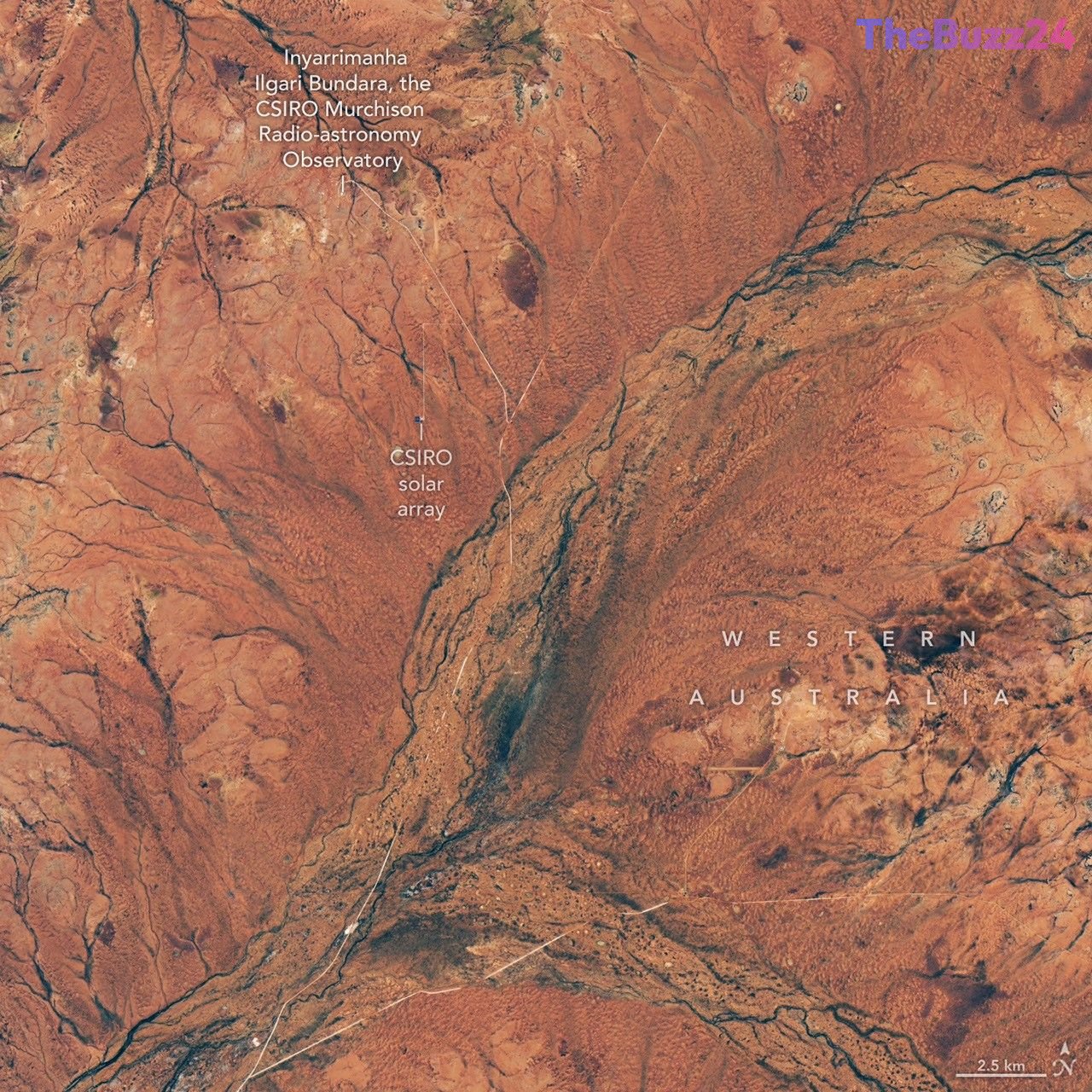
Satellite imagery captured by the Operational Land Imager on Landsat 8 vividly illustrates the stark contrast between the parched terrain of late August 2025 and the deeply verdant, blossoming landscape of August 2026. Situated roughly 600 kilometers north of Perth within the Murchison region—a primary area historically utilized for sheep and cattle grazing—the landscape typically features sparse grasses, resilient saltbushes, and slow-growing evergreen mulga trees.
The extraordinary botanical exhibition was catalyzed by above-average rainfall totals in June, followed by significantly higher-than-average precipitation in August driven by a series of passing cold fronts. These moisture levels successfully triggered a diverse array of flora to emerge across the outback, unexpectedly carpeting even specialized scientific facilities. Notably, the vibrant color display reached the grounds of the Inyarrimanha Ilgari Bundara Murchison Radio-astronomy Observatory, a remote scientific site managed by the Commonwealth Scientific and Industrial Research Organisation that ordinarily focuses on deep space exploration rather than terrestrial botany.
While the sprawling carpets of white and mulla mulla flowers temporarily stole the spotlight, the remote facility remains a critical hub for astronomical observation situated within a strictly controlled “radio quiet” zone. Beyond its domestic scientific contributions, Australia’s network of advanced telescopes has historically partnered with global space agencies to support landmark interplanetary missions, including tracking early planetary probes and facilitating communications for historic lunar landings and recent deep space exploration initiatives.
Key Takeaways
- Heavy-than-normal rainfall in June and August 2026 triggered massive wildflower blooms across the Western Australian outback.
- Satellite imagery highlights the dramatic visual shift from dry conditions in 2025 to a lush landscape in 2026.
- The rare botanical display even reached scientific zones, including the Murchison Radio-astronomy Observatory.
Editor’s Analysis & Impact
The rare and vibrant wildflower bloom in the Western Australian outback highlights the remarkable resilience of arid ecosystems when subjected to unusual precipitation patterns. While primarily a natural spectacle driven by localized climate variations, events like these offer critical data points for ecologists studying seed dormancy, climate resilience, and biodiversity in extreme environments. Furthermore, the convergence of high-tech radio astronomy facilities and fragile desert ecosystems underscores the unique coexistence of scientific exploration and environmental conservation in remote regions. As climate variability continues to influence weather patterns globally, monitoring such ecological responses provides vital insights into how arid landscapes adapt to shifting meteorological realities over multi-decade cycles.
Frequently Asked Questions
Q: What caused the massive wildflower bloom in Western Australia?
A: The bloom was triggered by above-average rainfall in June and significantly higher-than-average precipitation in August 2026, which awoke dormant seeds in the soil.
Q: How long has it been since the region saw a bloom of this magnitude?
A: Local experts estimate that this year's display is the best the area has experienced in nearly two decades.
Q: Where is the Murchison region located?
A: The Murchison region is located about 600 kilometers north of Perth in Western Australia and serves as a primary area for sheep and cattle grazing, as well as radio astronomy.
AI Disclosure: This article is based on verified data and official reports. Our Team and AI have cross-referenced every financial detail with primary sources to ensure total accuracy.
More from this Category