Astronomers Capture Stunning Deep-Space Image Revealing Five Ancient Supernova Remnants
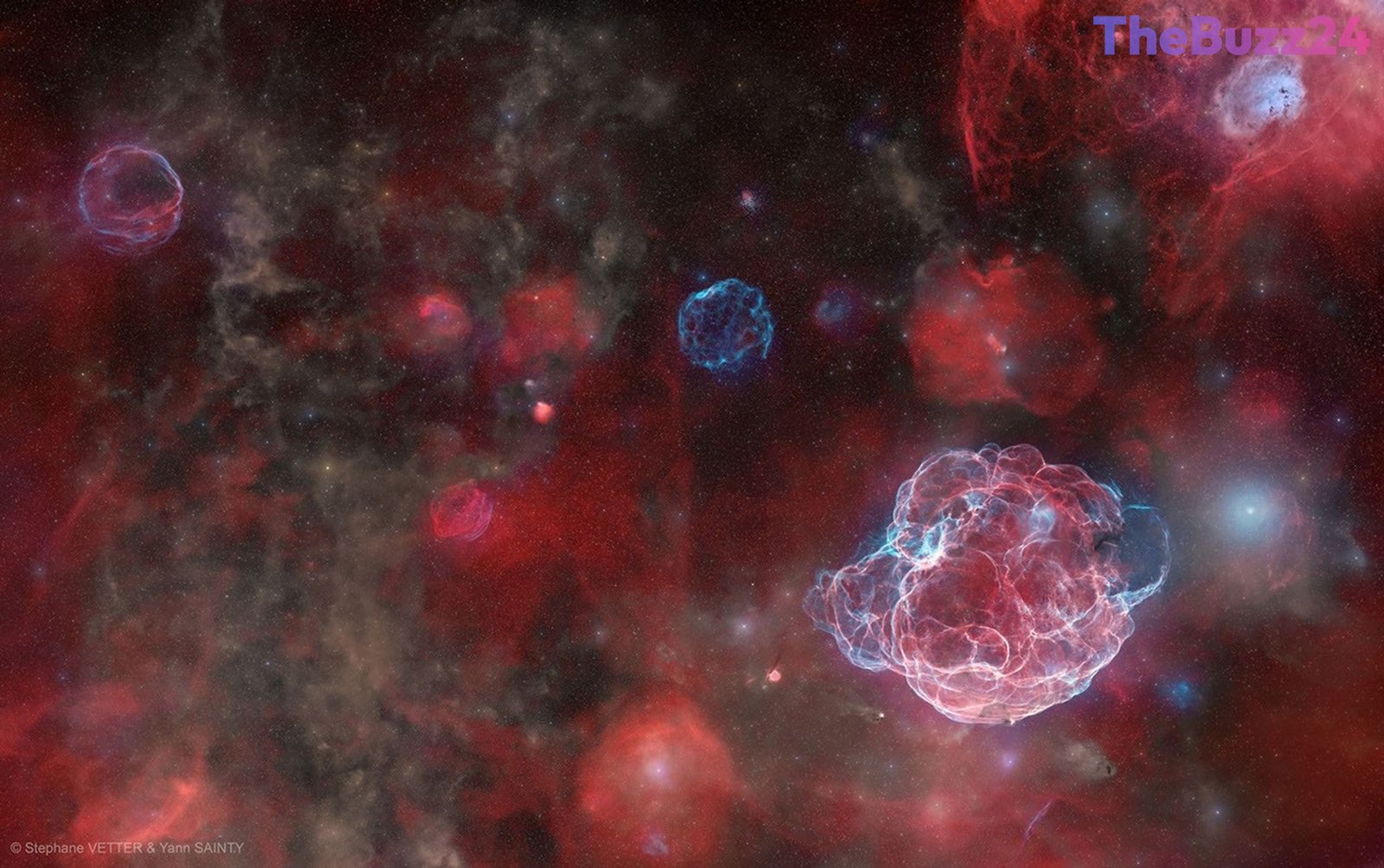
A breathtaking astronomical image captured from the Oukaïmeden Observatory in Morocco has brought to light the haunting remnants of five distinct ancient supernova explosions. Spanning a massive patch of the night sky in the constellation of Auriga—equivalent to the visual area of one thousand full moons—the composition is the result of roughly 200 hours of intensive observation.
The newly highlighted field showcases five supernova remnants: G181.1+9.5, G182.4+4.3, G179.0+2.6, G180.0−1.7 (widely known as the Spaghetti Nebula), and G178.2−4.2. Alongside these stellar ghosts, the annotated mosaic points out features like the open cluster M37 and the Tadpole Nebula, mapping out a complex web of cosmic history.
Each of these stellar cataclysms unfolded independently, leaving behind expanding shells of shocked gas characterized by delicate filamentary structures. In the detailed imaging, hydrogen gas glows in vibrant red hues, while oxygen is mapped in contrasting blue tones. Located at varying distances up to several thousand light-years from Earth, these remnants date back tens of thousands of years, suggesting that early human civilizations may have originally witnessed the brilliant outbursts as temporary new stars in the ancient sky.
Key Takeaways
- Observers at the Oukaïmeden Observatory in Morocco captured a massive celestial mosaic requiring around 200 hours of observation.
- The image reveals five distinct supernova remnants—G181.1+9.5, G182.4+4.3, G179.0+2.6, G180.0−1.7, and G178.2−4.2—in the constellation of Auriga.
- Advanced imaging techniques highlight shocked gas structures in red for hydrogen and blue for oxygen, offering clues about ancient stellar deaths.
Editor’s Analysis & Impact
This remarkable deep-space mosaic underscores the continuous evolution and accessibility of ground-based astrophotography. By pooling hundreds of hours of observation time, modern observatories are able to map complex, large-scale structures that were previously difficult to visualize in a single cohesive frame. Discoveries like these not only enrich our astronomical archives but also serve as vital public engagement tools, bridging complex astrophysics with stunning visual narratives. As imaging technology and robotic telescopes advance, amateur and professional astronomers alike will likely continue to uncover hidden remnants of our galaxy’s violent and fascinating past, deepening our understanding of stellar lifecycles.
Frequently Asked Questions
Q: What is a supernova remnant?
A: A supernova remnant is the expanding, glowing structure of gas and dust left behind after a massive star explodes at the end of its life cycle.
Q: Where was the new deep-space image captured?
A: The image was captured using roughly 200 hours of observation at the Oukaïmeden Observatory located in Morocco.
Q: Which constellation contains these five supernova remnants?
A: The five supernova remnants are located in the constellation of Auriga, the charioteer.
AI Disclosure: This article is based on verified data and official reports. Our Team and AI have cross-referenced every financial detail with primary sources to ensure total accuracy.
More from this Category