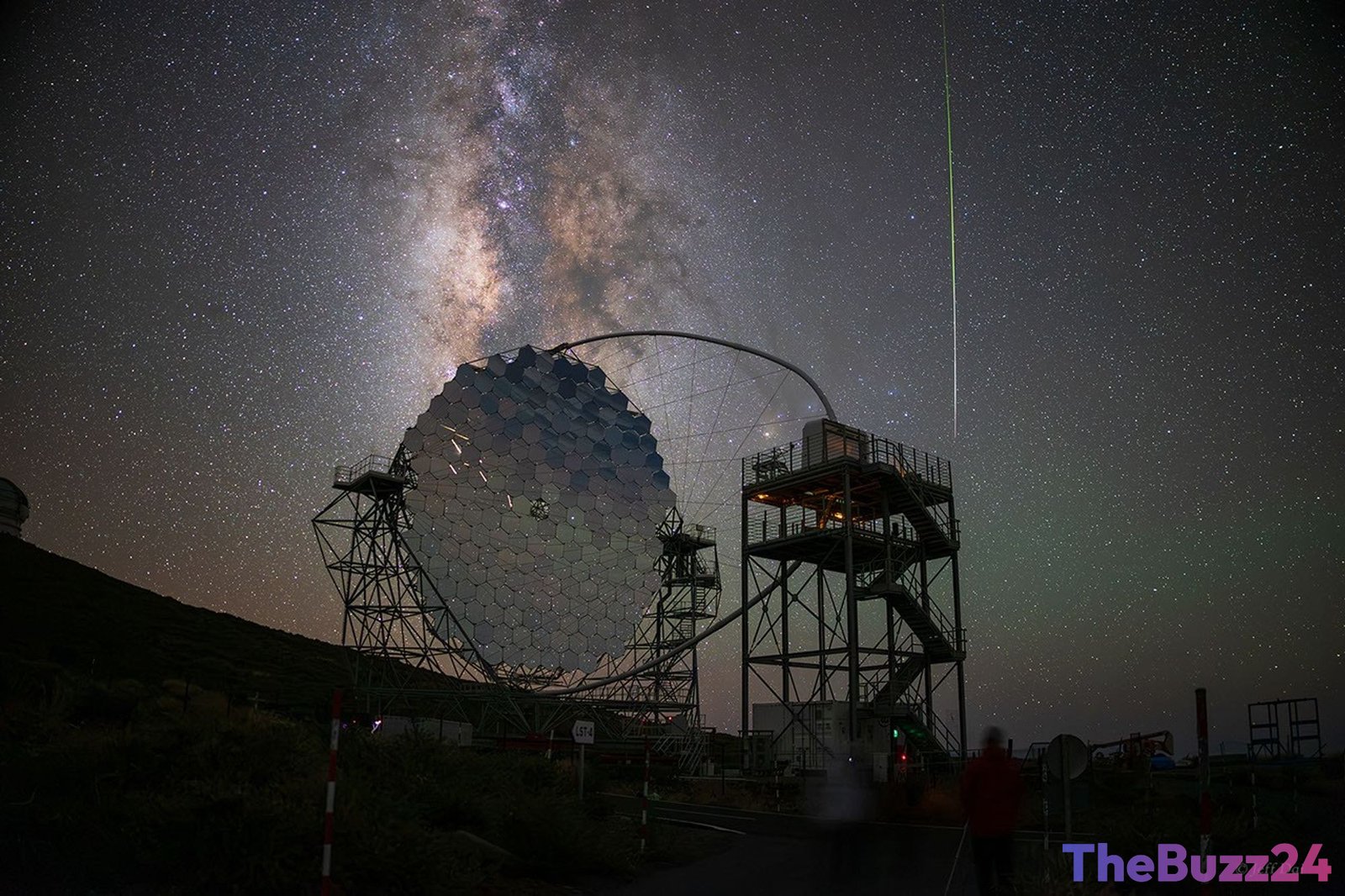
Cosmic Spectacle: Meteor Streaks Across Milky Way Beside Giant Telescope Mirror
A breathtaking image captured on August 15 showcases a brilliant Perseid meteor illuminating the night sky over the Canary Islands. The celestial event occurred above the Observatorio del Roque de los Muchachos on La Palma, where the meteor’s vibrant trail was silhouetted against the majestic sweep of the central Milky Way. The galactic band, characterized by its dark interstellar dust clouds and luminous starlight, arched above the horizon, creating a stunning backdrop.
In the foreground of this remarkable scene stands the prototype Large-Sized Telescope (LST-1), a significant component of the Cherenkov Telescope Array Observatory. This innovative telescope, with its impressive 23-meter diameter mirror composed of 198 hexagonal segments, is designed to detect fleeting flashes of atmospheric visible light. These brief, billionth-of-a-second light bursts are generated by high-energy gamma-rays originating from distant cosmic phenomena like active galaxies and gamma-ray bursts.
Interestingly, on the very night this meteor was observed, the reflective surfaces of the LST-1’s mirror segments also caught and mirrored the brilliant flash of the Perseid meteor. This convergence of a terrestrial astronomical instrument, a natural atmospheric phenomenon, and the vastness of the Milky Way offers a unique perspective on humanity’s ongoing exploration of the universe and the tools we employ to study it.
Key Takeaways
- A Perseid meteor was photographed streaking across the Milky Way in the Canary Islands.
- The image features the Large-Sized Telescope (LST-1), part of the Cherenkov Telescope Array Observatory.
- The LST-1 is designed to detect brief light flashes caused by high-energy gamma-rays from cosmic sources.
Editor’s Analysis & Impact
This stunning astronomical photograph highlights the intersection of natural cosmic events and cutting-edge scientific instrumentation. The capture of a meteor alongside the Milky Way, with a powerful gamma-ray telescope in the foreground, underscores the advancements in our ability to observe and study the universe. The Cherenkov Telescope Array represents a significant leap in astrophysics, promising deeper insights into high-energy phenomena. The image serves as a powerful reminder of the beauty of the cosmos and the human drive to explore its mysteries, potentially inspiring future generations of scientists and astronomers.
Frequently Asked Questions
Q: What is the Cherenkov Telescope Array (CTA)?
A: The Cherenkov Telescope Array (CTA) is a planned global network of ground-based gamma-ray telescopes designed to observe the universe in the high-energy gamma-ray spectrum. The LST-1 is the first telescope constructed for the northern hemisphere site of this innovative observatory.
Q: What are Perseid meteors?
A: Perseid meteors are a prolific meteor shower associated with the comet Swift-Tuttle. They are visible every year between mid-July and late August, with the peak typically occurring around August 12-13. They appear to originate from the constellation Perseus.
Q: How do Cherenkov telescopes detect gamma-rays?
A: Cherenkov telescopes detect the faint flashes of visible light, known as Cherenkov radiation, produced when high-energy gamma-rays from space interact with the Earth's atmosphere. These interactions create showers of particles that emit this light, which the telescopes are designed to capture.
AI Disclosure: This article is based on verified data and official reports. Our Team and AI have cross-referenced every financial detail with primary sources to ensure total accuracy.
More from this Category