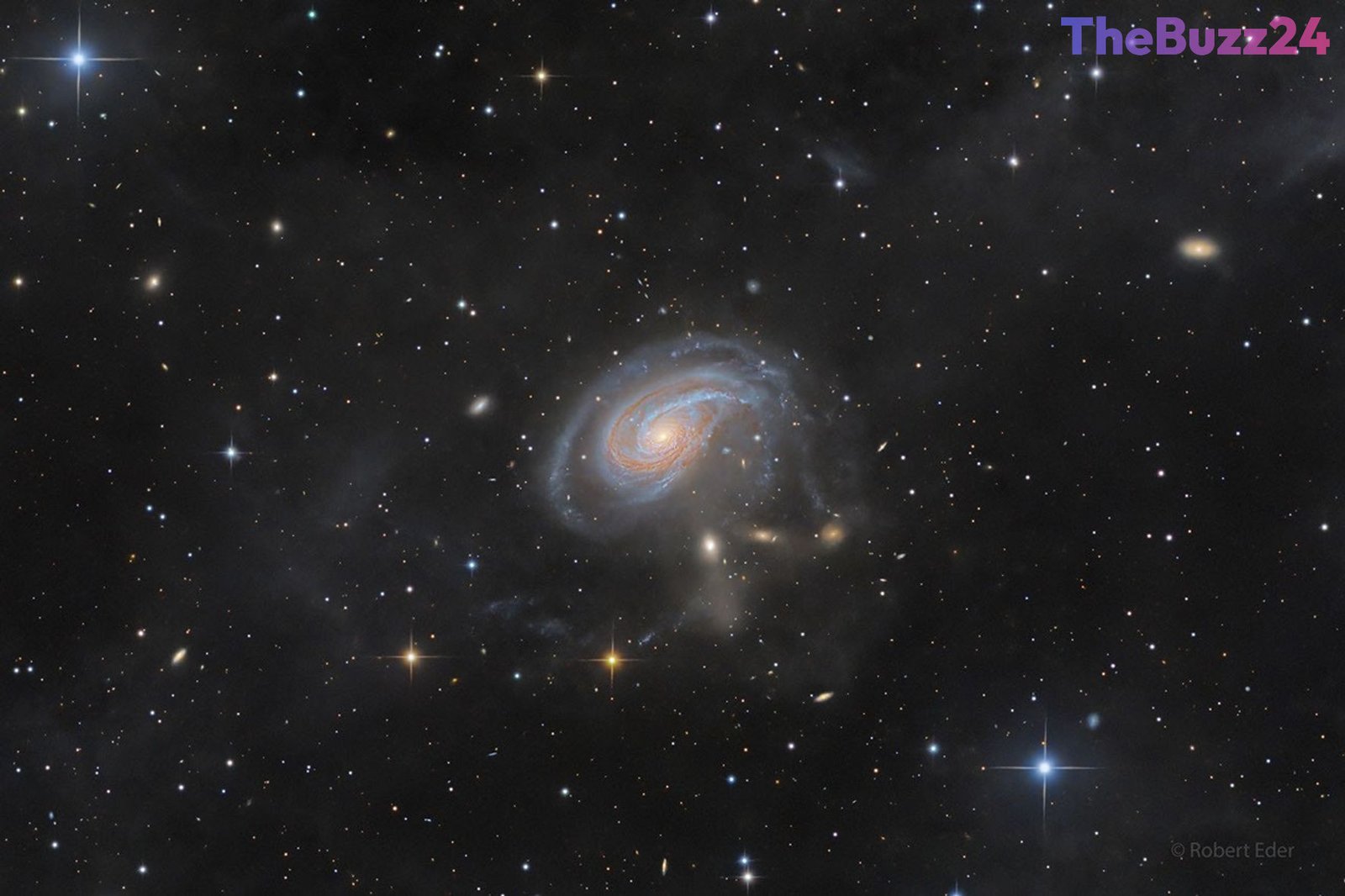
A Cosmic Tug-of-War: The Distorted Beauty of Arp 78
Deep within the constellation Aries, astronomers have captured a striking portrait of Arp 78, a peculiar spiral galaxy that offers a masterclass in galactic interaction. Located approximately 100 million light-years from our own Milky Way, this massive island universe spans an impressive 200,000 light-years in diameter. The galaxy, also cataloged as NGC 772, is defined by its dramatic, overdeveloped spiral arm that stretches across the cosmic void.
This distinctively asymmetrical structure is not a natural occurrence but rather the result of intense gravitational tides. The spiral arm is lined with dense dust lanes and clusters of young, brilliant blue stars, which highlight the violent beauty of the galaxy’s evolution. These features are the direct consequence of a gravitational dance with its smaller companion, the compact elliptical galaxy NGC 770, situated just below the larger spiral.
Advanced telescopic imaging has revealed faint, wispy star streams connecting the two celestial bodies, providing clear evidence of their ongoing interaction. While the foreground is cluttered with the sharp, spiky stars of our own galaxy, the distant, fuzzy silhouette of NGC 770 serves as a stark contrast to the sprawling, active nature of Arp 78. This cosmic encounter serves as a vivid reminder of the dynamic and ever-changing nature of the universe.
Key Takeaways
- Arp 78 (NGC 772) is a massive spiral galaxy located 100 million light-years away in the constellation Aries.
- The galaxy's prominent, distorted spiral arm is caused by gravitational tidal forces exerted by its companion galaxy, NGC 770.
- Deep-space imaging reveals faint star streams between the two galaxies, confirming their ongoing gravitational interaction.
Editor’s Analysis & Impact
The study of interacting galaxies like Arp 78 and NGC 770 is fundamental to our understanding of galactic evolution. These ‘cosmic collisions’ are not merely aesthetic phenomena; they are primary drivers of star formation and structural transformation in the universe. By observing the gravitational tides and the resulting star-forming regions within the distorted spiral arms, astrophysicists can better model how galaxies grow and merge over billions of years. As telescope technology improves, the ability to map these faint stellar streams provides critical data on dark matter distribution and the history of galactic assembly. This observation highlights the violent, yet constructive, processes that shape the architecture of the cosmos, reinforcing the theory that galaxies are not static entities but active participants in a constant state of gravitational flux.
Frequently Asked Questions
Q: What is causing the unusual shape of the Arp 78 galaxy?
A: The distorted shape of Arp 78 is caused by gravitational tidal forces resulting from its interaction with a smaller, compact companion galaxy named NGC 770.
Q: How far away is Arp 78 from Earth?
A: Arp 78 is located approximately 100 million light-years away from our Milky Way galaxy.
AI Disclosure: This article is based on verified data and official reports. Our Team and AI have cross-referenced every financial detail with primary sources to ensure total accuracy.
More from this Category