Astrophotographer Captures Entire Sharpless Catalog in Monumental 800-Hour Project
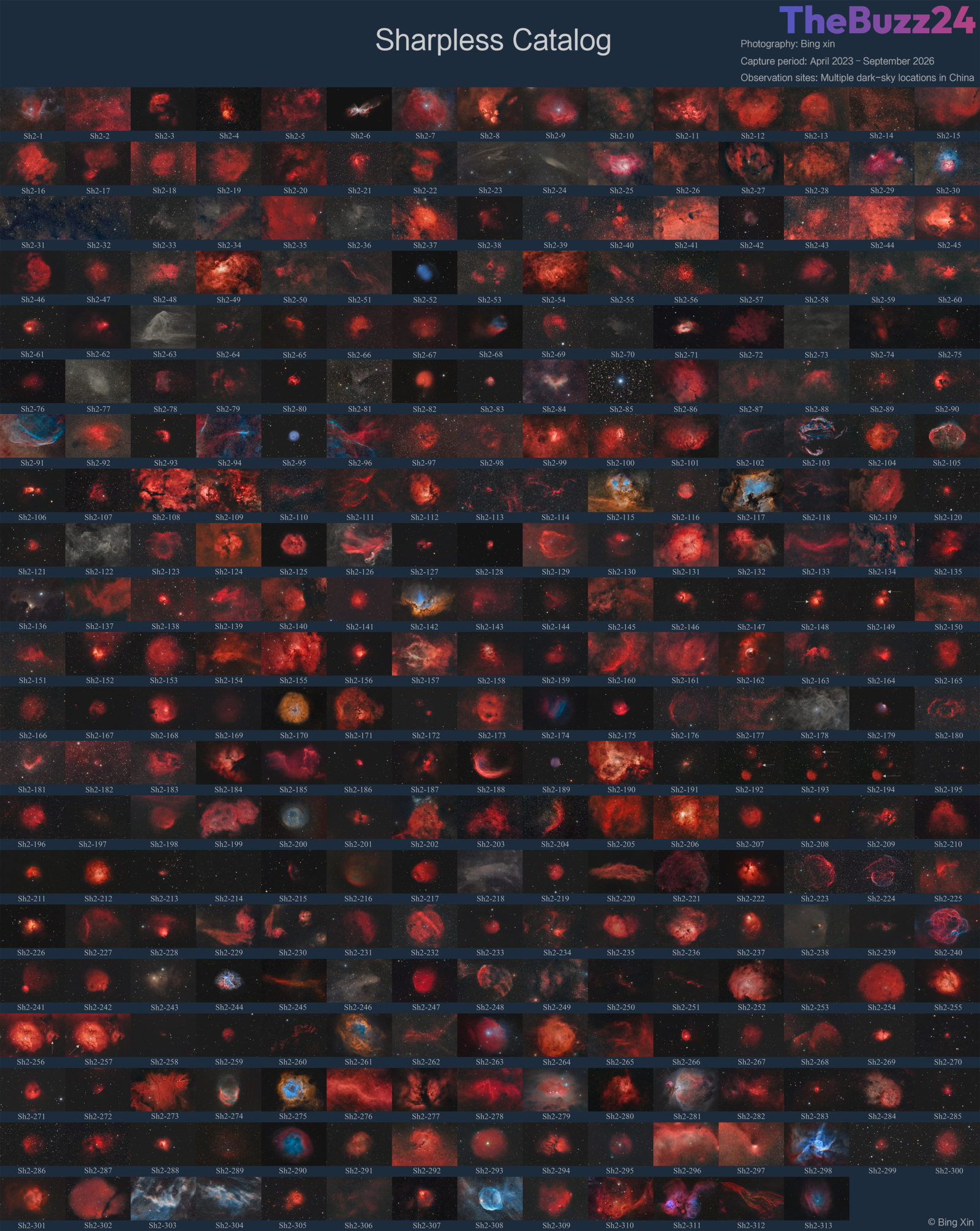
Astrophotography enthusiasts and space admirers have been treated to a breathtaking mosaic showcasing the complete Sharpless Catalog of H II regions. Featuring a staggering 313 distinct cosmic objects, the massive compilation offers an unprecedented, zoomable window into the vast expanse of the universe.
Crafted by dedicated astrophotographer Bing Xin, the project required immense patience and meticulous planning. Xin traveled across the remote dark skies of Eastern China and Inner Mongolia to escape light pollution and capture the faint light of these distant cosmic structures. The final masterpiece includes well-known celestial landmarks such as the Eagle, Heart, and Orion nebulas.
Beyond glowing clouds of ionized hydrogen, the comprehensive catalog also houses planetary nebulas like the Medusa Nebula and intricate supernova remnants such as the Spaghetti Nebula. Utilizing advanced narrowband and red-green-blue filters, Xin spent between two and six hours on each individual target, culminating in an astounding 800 hours of total exposure time to bring the entire catalog to life.
Key Takeaways
- Astrophotographer Bing Xin completed a monumental image featuring the entire Sharpless Catalog, comprising 313 nebulas.
- The massive project required approximately 800 hours of total exposure time under the dark skies of Eastern China and Inner Mongolia.
- The catalog includes iconic celestial formations alongside planetary nebulas and supernova remnants.
Editor’s Analysis & Impact
The completion of the entire Sharpless Catalog by a single astrophotographer represents a monumental achievement in modern amateur and professional-adjacent astronomy. Projects of this scale bridge the gap between scientific archiving and public engagement, offering educators and enthusiasts high-resolution visual data that fosters a deeper appreciation for stellar nurseries and galactic remnants. As imaging technology and narrowband filtering techniques continue to advance, we can expect to see more ambitious, long-exposure projects that democratize deep-space observation and inspire the next generation of astronomers.
Frequently Asked Questions
Q: What is the Sharpless Catalog?
A: The Sharpless Catalog is a comprehensive list of H II regions (ionized hydrogen emission nebulae), along with other celestial phenomena like planetary nebulas and supernova remnants, totaling 313 objects.
Q: How long did it take to complete the imaging project?
A: Astrophotographer Bing Xin spent roughly 800 hours capturing the entire catalog, dedicating two to six hours to each individual object.
Q: Where were the photographs taken?
A: The images were captured from dark-sky locations across Eastern China and Inner Mongolia.
AI Disclosure: This article is based on verified data and official reports. Our Team and AI have cross-referenced every financial detail with primary sources to ensure total accuracy.
More from this Category