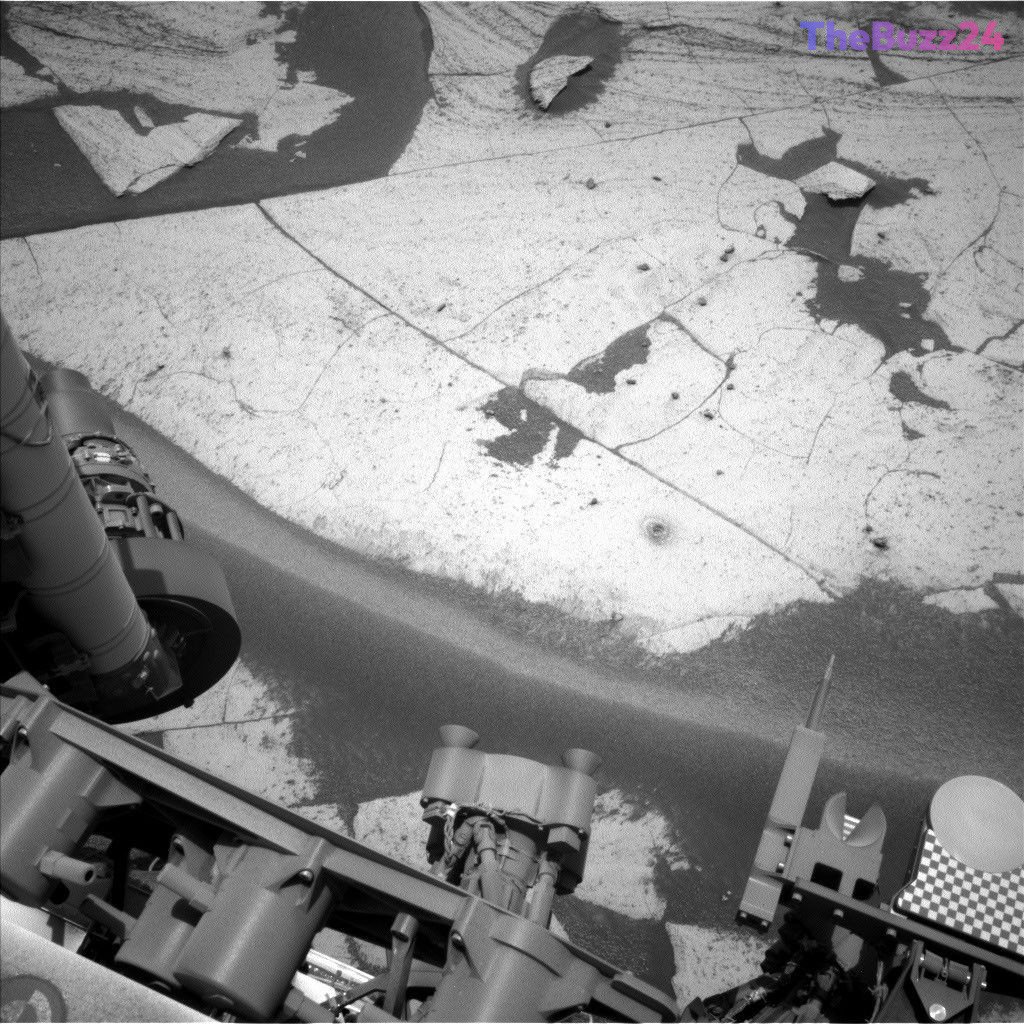
Mars Curiosity Rover Powers Up Onboard Laboratories to Analyze Ancient Rock Samples
The Curiosity rover has transitioned into a high-power laboratory phase on Mars, focusing its advanced analytical instruments on rock samples extracted from the “Basque Lakes” drill site. Operating during Martian days (Sols) 5029 through 5035, the mobile science laboratory prioritized deep-dive chemical and mineralogical testing. This intensive campaign required managing the rover’s strict daily power budget, temporarily scaling back other operations to allow its onboard laboratories to run complex experiments on the Martian soil.
Central to this scientific push are the Chemistry and Mineralogy (CheMin) instrument and the Sample Analysis at Mars (SAM) suite. CheMin’s initial mineralogical data provided critical insights that allowed the science team to greenlight further testing by SAM. Subsequently, SAM utilized its Tunable Laser Spectrometer (TLS) to measure volatile compounds within the Basque Lakes sample. Researchers are currently awaiting the TLS results to determine whether to proceed with a highly detailed mass spectrometry analysis in the coming days, which could reveal more about the history of water and organic molecules in the region.
While the onboard laboratories consumed the lion’s share of Curiosity’s power, the rover still managed to gather crucial contextual data. The Mastcam instrument captured a comprehensive 360-degree panoramic mosaic of the surrounding landscape, helping scientists map the geological setting of the drill site. Additionally, Mastcam and Navcam conducted photometry observations at various times of day to study how changing sunlight angles affect the spectral signatures of Martian rocks. ChemCam also targeted nearby features, including the “Cordillera” butte, sand ripples named “French Creek,” and mysterious loose gray clasts dubbed “Wooley” and “Fireside.” Meanwhile, the rover’s environmental sensors continued tracking atmospheric dust, cloud formations, and dust-devil activity.
Key Takeaways
- Curiosity prioritized its onboard laboratories, CheMin and SAM, to analyze rock samples from the 'Basque Lakes' drill hole during Sols 5029-5035.
- The high-power demands of the laboratory instruments required a temporary reduction in other payload activities, though contextual imaging and environmental monitoring continued.
- Scientists are using the Tunable Laser Spectrometer (TLS) to detect volatiles, which will determine if further mass spectrometry analysis is needed.
Editor’s Analysis & Impact
The Curiosity rover’s ongoing mission, now well past its original planned duration, highlights the incredible durability and engineering of modern space exploration hardware. By utilizing sophisticated onboard laboratories like CheMin and SAM, scientists can conduct high-fidelity chemical analysis directly on the Martian surface, bypassing the need for immediate sample return. This capability is crucial for identifying volatile compounds and organic precursors that could indicate past habitability. The power management strategies demonstrated during this drill campaign also offer valuable lessons for future autonomous missions, such as those planned for the Moon and deeper into the solar system. As robotic explorers become more self-sufficient, the integration of real-time decision-making—where one instrument’s data determines the operational path of another—will become the standard for planetary science, maximizing scientific yield under tight resource constraints.
Frequently Asked Questions
Q: What is the significance of the 'Basque Lakes' drill site?
A: The Basque Lakes drill site provides fresh rock samples from Mars' surface, allowing the Curiosity rover's onboard instruments to analyze the mineral and chemical composition of the area to understand its geological history and past environmental conditions.
Q: Why does Curiosity have to limit other activities during drilling and analysis?
A: Running the rover's internal laboratories, CheMin and SAM, requires a significant amount of electrical power. To ensure these critical instruments have enough energy to complete their complex chemical analyses, other sensors and cameras are temporarily put on a restricted power budget.
Q: How do CheMin and SAM work together?
A: CheMin first analyzes the mineralogy of the drilled sample. These initial results help scientists decide whether the sample is a good candidate for the SAM instrument, which then uses tools like a Tunable Laser Spectrometer to search for volatile organic compounds and other key elements.
AI Disclosure: This article is based on verified data and official reports. Our Team and AI have cross-referenced every financial detail with primary sources to ensure total accuracy.
More from this Category