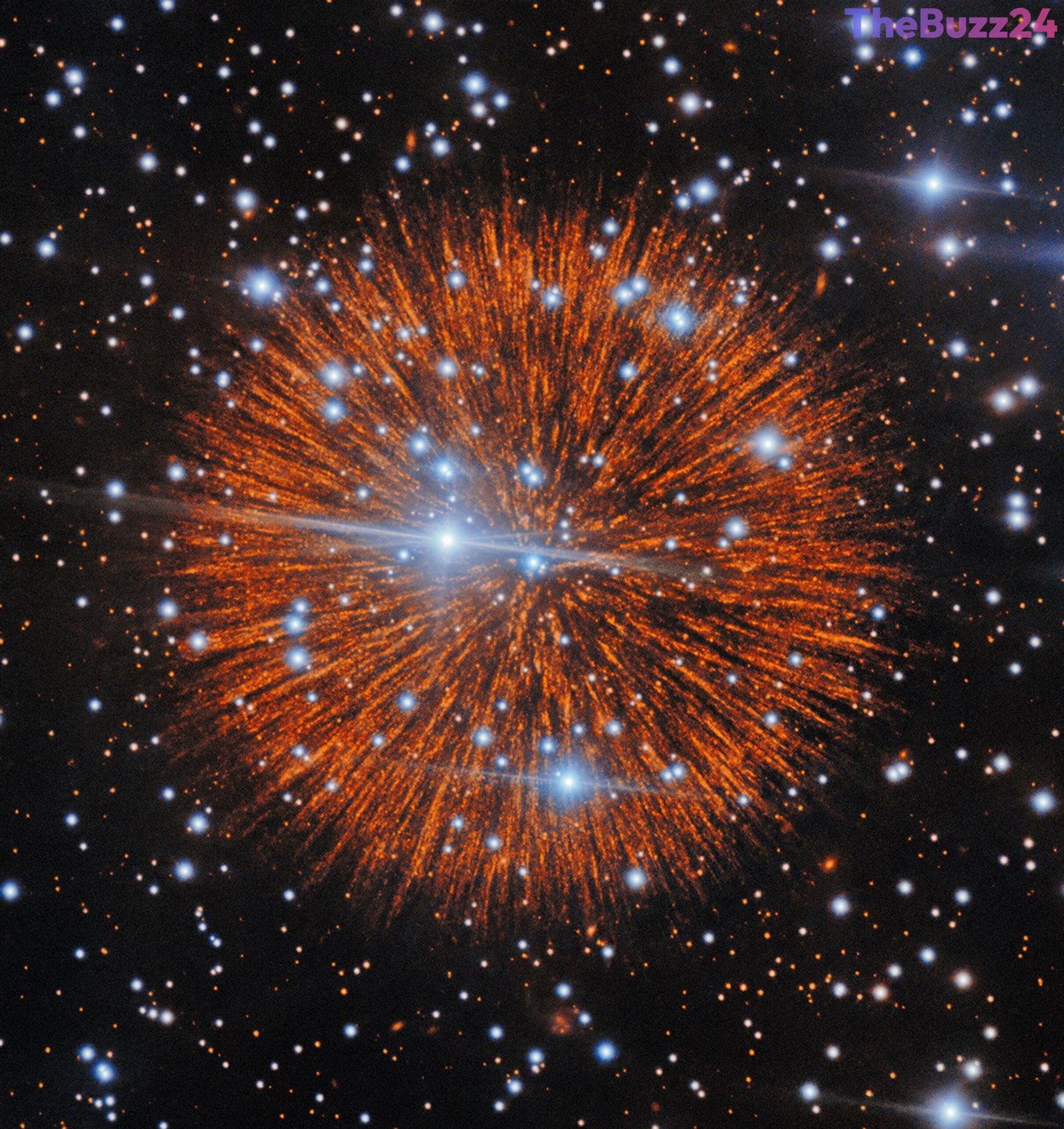
Cosmic Fireworks: Gemini North Captures Stunning Remnant of 845-Year-Old Supernova Mystery
A spectacular new image captured by the Gemini North Telescope in Hawai’i has revealed the intricate, fireworks-like structure of Nebula Pa 30. This vibrant cosmic display is not a fleeting celebration, but rather the expanding remnant of a violent stellar explosion that occurred nearly a millennium ago. The glowing gas filaments offer a rare glimpse into the aftermath of one of the universe’s most dramatic events.
Historical records from Chinese, Japanese, and Arabic astronomers document the sudden appearance of a temporary “guest star” in the night sky in the year 1181. This bright point of light remained visible for 185 days before fading from view. Modern astronomers believe that this historical event was the very supernova that birthed the Pa 30 nebula, linking ancient human observations with cutting-edge modern astrophysics.
Classified as a rare Type Iax supernova, the explosion is hypothesized to have resulted from the violent merger of two white dwarf stars. At the heart of the nebula lies an exceptionally hot, surviving central star. This star generates powerful stellar winds that are believed to carve out the striking radial filaments that stretch outward into space, resembling cosmic streamers.
Upon closer inspection, these filaments reveal pearl-like knots of gas and dust, each measuring an astonishing four light-days in diameter. As researchers continue to study the unique structure of Pa 30, they hope to unlock the remaining secrets of this 845-year-old cosmic puzzle, deepening our understanding of how binary star systems end their lifecycles.
Key Takeaways
- Nebula Pa 30 is the remnant of a historic supernova first observed by global astronomers in 1181 AD.
- The explosion is classified as a rare Type Iax supernova, likely triggered by the merger of two white dwarf stars.
- High-resolution imaging from the Gemini North Telescope reveals intricate radial filaments with massive knots spanning four light-days in diameter.
Editor’s Analysis & Impact
The detailed imaging of Nebula Pa 30 represents a significant milestone in observational astrophysics, bridging historical human records with modern space science. By linking a 12th-century ‘guest star’ to a physical remnant visible today, astronomers can study the long-term evolution of supernova remnants with unprecedented temporal context. The classification of this event as a Type Iax supernova—a relatively rare and poorly understood subclass of stellar explosions—offers a unique laboratory to test models of white dwarf mergers. Understanding these events is crucial, as white dwarf interactions are key to mapping cosmic distances and understanding the chemical enrichment of the universe. As telescope technology advances, Pa 30 will remain a primary target for researchers seeking to decode the mechanics of exotic stellar deaths.
Frequently Asked Questions
Q: What is a Type Iax supernova?
A: A Type Iax supernova is a faint, sub-luminous class of supernova that is believed to occur when two white dwarf stars merge or when a white dwarf experiences a partial thermonuclear explosion, leaving behind a surviving stellar remnant instead of being completely destroyed.
Q: How do historical records help modern astronomers?
A: Historical records of 'guest stars' provide precise timelines for cosmic events. By knowing exactly when the supernova occurred (in this case, 1181 AD), scientists can calculate the precise rate of expansion and age of the resulting nebula.
Q: What are the 'pearl-like knots' in the nebula?
A: These are dense clumps of gas and dust strung along the radial filaments of the nebula. Measuring about four light-days in diameter, they are shaped by the intense stellar winds blowing from the extremely hot central star.
AI Disclosure: This article is based on verified data and official reports. Our Team and AI have cross-referenced every financial detail with primary sources to ensure total accuracy.
More from this Category