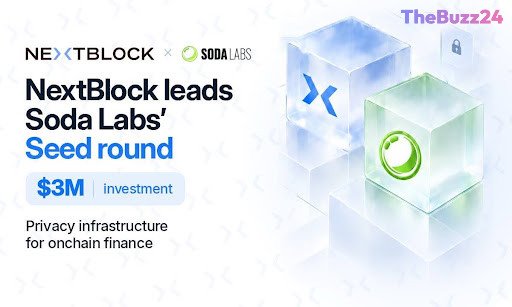
Soda Labs Secures $3 Million to Advance Blockchain Privacy Infrastructure
Blockchain infrastructure developer Soda Labs has successfully closed a $3 million seed funding round led by NextBlock. The capital injection is earmarked to accelerate the development and commercial deployment of the company’s privacy-focused technology, specifically its new ‘Soda Bubble’ coprocessor. This system is designed to enable private computation across various blockchain networks, addressing a critical gap for institutional players who require confidentiality while operating on public ledgers.
For the past two and a half years, Soda Labs has been refining its cryptographic solution, which utilizes garbled circuits and multiparty computation (GC-MPC). Unlike many privacy solutions that require specialized hardware, Soda’s architecture is built to run on standard cloud CPUs using established cryptographic standards like AES and SHA256. This practical approach has already seen significant real-world application, with the company’s technology processing over 100 million transactions on the COTI network and supporting platforms like PriveX, which has facilitated over $20 billion in trading volume.
With this new funding, Soda Labs plans to expand its Bubble Validator Network across major ecosystems, including Ethereum, Polygon, Arbitrum, Base, and eventually Solana. The company is shifting its focus toward scaling commercial adoption, aiming to integrate its privacy-preserving tools with banks, payment processors, and tokenization platforms. By allowing regulated financial entities to conduct transactions without exposing sensitive data, Soda Labs aims to bridge the gap between traditional financial requirements and the transparency of public blockchain networks.
Looking ahead, the company is preparing to release updated performance benchmarks that demonstrate significant improvements in throughput and cost-efficiency. As Soda Labs moves into its next phase of growth, it is actively working on several undisclosed pilot programs with financial infrastructure providers, signaling a strategic push to make private, on-chain financial activity a standard for institutional users.
Key Takeaways
- Soda Labs raised $3 million in a seed round led by NextBlock to scale its privacy-preserving blockchain infrastructure.
- The company is transitioning from its gcEVM layer to 'Soda Bubble,' a chain-agnostic coprocessor that enables private computation on public blockchains.
- The technology is designed for institutional adoption, targeting banks and payment companies that need to maintain privacy while utilizing public blockchain liquidity.
Editor’s Analysis & Impact
The investment in Soda Labs highlights a growing trend in the blockchain sector: the shift from experimental privacy tools to enterprise-grade, compliant infrastructure. By focusing on GC-MPC technology that runs on standard hardware, Soda Labs is lowering the barrier to entry for traditional financial institutions that have historically been wary of the transparency inherent in public ledgers. If the company successfully scales its ‘Bubble’ architecture across major networks like Ethereum and Solana, it could become a foundational layer for ‘regulated DeFi.’ The ability to offer privacy without sacrificing the liquidity of public chains is the ‘holy grail’ for institutional adoption. Future success will depend on the company’s ability to convert its current pilot programs into long-term production deployments and maintain performance advantages over emerging zero-knowledge proof alternatives.
Frequently Asked Questions
Q: What is the primary function of Soda Bubble?
A: Soda Bubble is a chain-agnostic coprocessor that allows for private computation across different blockchain networks, enabling developers to process sensitive data without exposing it publicly.
Q: Does Soda Labs require specialized hardware to run its privacy solutions?
A: No, Soda Labs' architecture is designed to operate on standard cloud CPUs using established cryptographic standards, making it more accessible and cost-effective than hardware-dependent alternatives.
AI Disclosure: This article is based on verified data and official reports. Our Team and AI have cross-referenced every financial detail with primary sources to ensure total accuracy.
More from this Category