Antarctic Ice Reveals Cosmic Secrets: IceCube Observatory Leader Honored with Nobel Prize
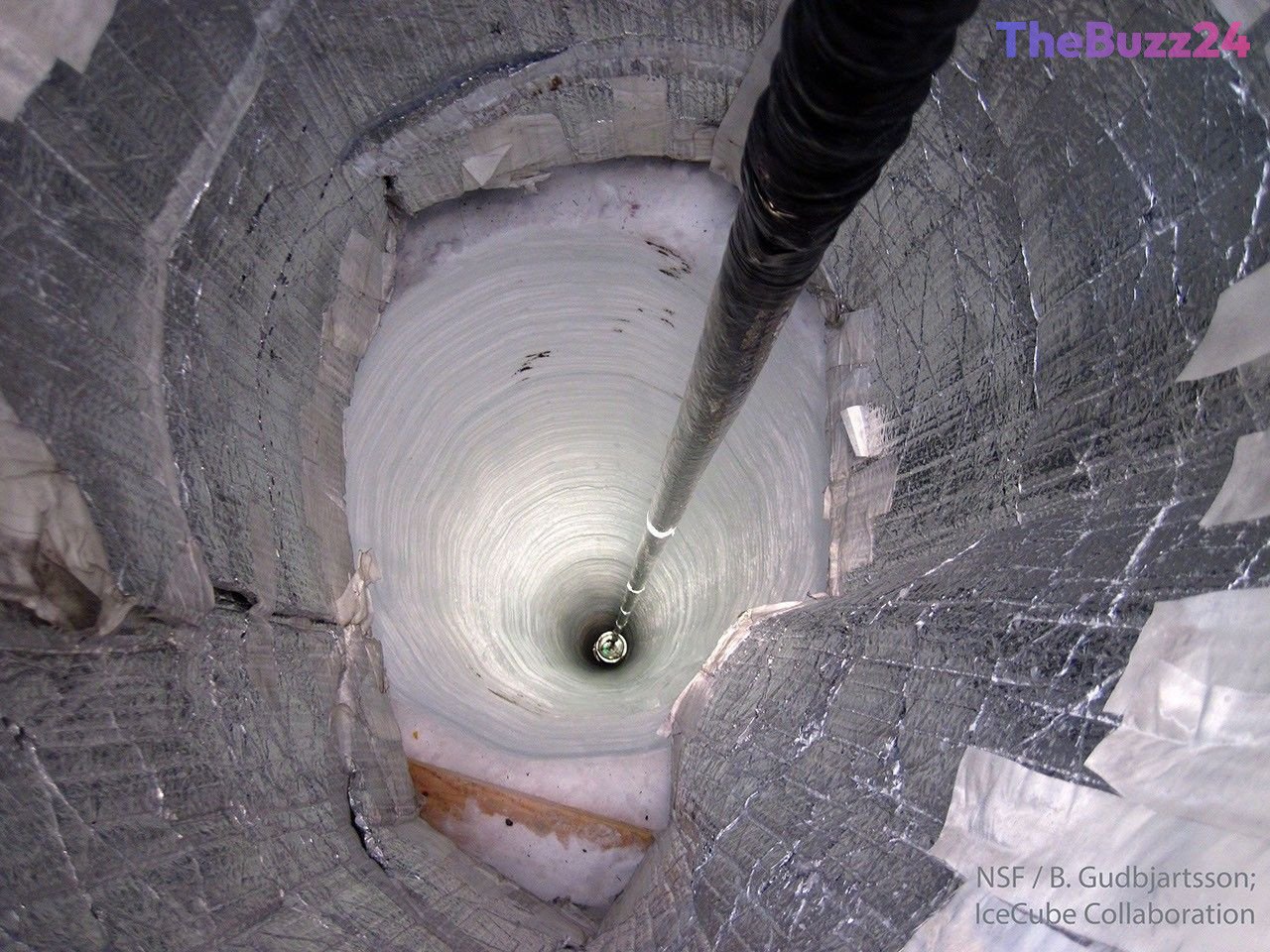
Deep beneath the South Pole’s frozen expanse, a groundbreaking scientific endeavor known as the IceCube Neutrino Observatory is unlocking mysteries of the universe. This unique astronomical facility, built by melting nearly a hundred vertical shafts into the Antarctic ice, serves as the world’s largest neutrino detector. Its pioneering work in capturing elusive cosmic neutrinos has recently garnered significant recognition, with a founding leader of the IceCube Collaboration set to receive the prestigious Nobel Prize in Physics for their unprecedented discoveries.
The observatory’s ingenious design involves lowering long strings, each adorned with basketball-sized light detectors, into the melted holes. Once deployed, the frigid Antarctic environment quickly refreezes the water, encasing these sensitive instruments within a vast, clear block of ice. These detectors are specifically engineered to register faint blue light, known as Cherenkov radiation. This light is produced when high-energy neutrinos, originating from powerful astrophysical processes across the cosmos, collide with ice molecules, liberating fast-moving secondary particles.
Since its completion, with the final detector strings being installed as early as 2010, IceCube has successfully captured a multitude of these illuminating neutrinos. These detections provide scientists with a unique window into extreme cosmic events, such as supernovae, gamma-ray bursts, and active galactic nuclei, which are otherwise obscured by interstellar dust and gas. The ability of IceCube to “see” these high-energy particles has revolutionized our understanding of the most energetic phenomena in the universe, solidifying its place as a cornerstone of modern astrophysics and earning its collaborators the highest scientific accolades.
Key Takeaways
- The IceCube Neutrino Observatory in Antarctica is the world's largest detector for cosmic neutrinos.
- It operates by detecting blue light emitted when high-energy neutrinos interact with ice molecules deep within the ice.
- A founding leader of the IceCube Collaboration has been awarded the Nobel Prize in Physics for groundbreaking discoveries made using the observatory.
Editor’s Analysis & Impact
The recognition of the IceCube Neutrino Observatory with a Nobel Prize underscores the profound impact of fundamental research on our understanding of the cosmos. This achievement not only validates decades of scientific and engineering effort but also invigorates the field of astroparticle physics. It highlights the potential for extreme environment observatories to unlock secrets inaccessible by traditional telescopes. The future outlook for neutrino astronomy is exceptionally bright, promising further insights into the universe’s most energetic phenomena, such as black holes, supernovae, and the origins of cosmic rays. This breakthrough could inspire new international collaborations and technological advancements in detector design, pushing the boundaries of human knowledge and potentially leading to a new era of multi-messenger astronomy where neutrinos, light, and gravitational waves are all used to observe the universe.
Frequently Asked Questions
Q: What are cosmic neutrinos?
A: Cosmic neutrinos are subatomic particles that originate from extreme astrophysical events in the universe, such as exploding stars, black holes, and active galaxies. They are incredibly elusive, interacting very weakly with matter, which allows them to travel vast distances across the cosmos without being absorbed or deflected, carrying unique information about their distant sources.
Q: How does the IceCube Neutrino Observatory detect these particles?
A: IceCube detects neutrinos indirectly. When a high-energy neutrino collides with an atom in the Antarctic ice, it produces secondary charged particles. These particles travel faster than the speed of light in ice, creating a cone of blue light (Cherenkov radiation). The observatory's embedded light detectors register this faint blue light, allowing scientists to reconstruct the neutrino's path and energy.
Q: Why is the South Pole an ideal location for the IceCube Observatory?
A: The South Pole offers several unique advantages. Its deep, clear, and stable ice provides an excellent medium for detecting the faint Cherenkov light produced by neutrino interactions, acting as a giant, natural detector. The extreme cold ensures the ice remains pristine and free of biological contaminants that could interfere with measurements. Additionally, its remote location minimizes light and radio interference, creating an ideal environment for sensitive astronomical observations.
AI Disclosure: This article is based on verified data and official reports. Our Team and AI have cross-referenced every financial detail with primary sources to ensure total accuracy.
More from this Category