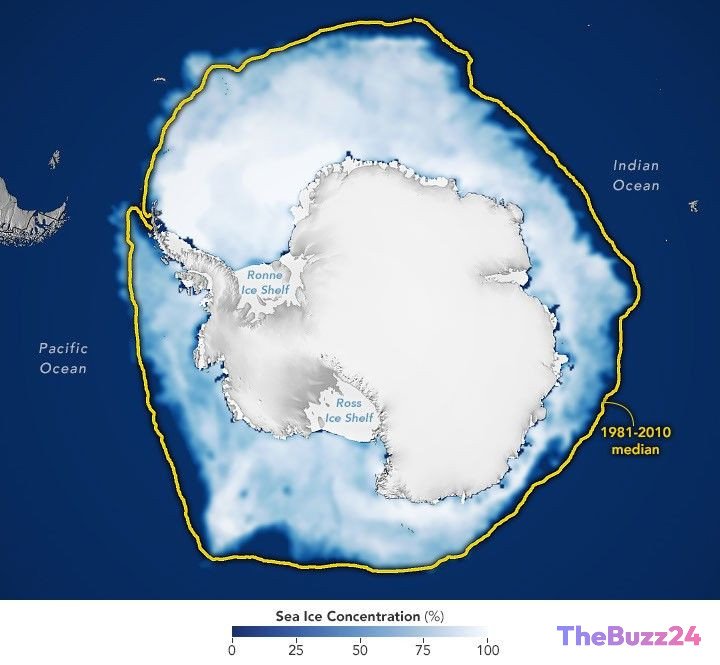
Antarctica’s Shrinking Ice: 2026 Marks Third-Lowest Sea Ice Maximum on Record
Antarctic sea ice reached its annual maximum extent on September 14, 2026, marking the third-lowest maximum recorded in the satellite era. This year’s peak saw the ice cover an estimated 17.59 million square kilometers (6.79 million square miles), a figure that continues a concerning trend observed in recent years. The data highlights the dynamic and increasingly vulnerable nature of the continent’s ice cover.
Unlike the Arctic, which is an ocean basin surrounded by land, Antarctica is a vast continent encircled by ocean. This unique geography allows Antarctic sea ice more room to expand during the Southern Hemisphere’s winter months, typically peaking in September. However, this expansion also extends into warmer latitudes, leading to more extensive melting during the summer, with the minimum usually occurring in February.
For several decades, from 1979 until 2014, Antarctic sea ice showed a modest increase, growing by approximately 1 percent per decade. This period even saw new record highs for winter sea ice extent between 2012 and 2014, contrasting sharply with the steep decline simultaneously observed in the Arctic. However, this trend reversed dramatically in 2015, with significant decreases becoming apparent around Antarctica starting in 2016. While there have been minor rebounds in some years, overall sea ice coverage has remained consistently lower than historical norms, culminating in both record low minimum and maximum extents in 2023.
Scientists rely on advanced satellite technology to monitor these critical changes. Passive microwave sensors, which measure the Earth’s naturally emitted microwave energy, are instrumental in determining sea ice extent, as ice emits more of this energy than open water. This allows for consistent observation regardless of cloud cover. The long-term record began in late 1978 with data from NASA’s Nimbus-7 satellite, followed by the Defense Meteorological Satellite Program (DMSP) satellites, NASA’s Aqua satellite, and more recently, the Japan Aerospace Exploration Agency’s (JAXA) GCOM-W satellite, ensuring continuous and comprehensive tracking of polar ice dynamics.
Key Takeaways
- Antarctic sea ice reached its third-lowest maximum extent on record on September 14, 2026, covering 17.59 million square kilometers.
- This continues a significant decline observed since 2015-2016, reversing a previous trend of modest growth from 1979 to 2014.
- Satellite technology from agencies like NASA, the National Snow and Ice Data Center (NSIDC), and JAXA is crucial for monitoring these long-term changes in polar ice dynamics.
Editor’s Analysis & Impact
The continued decline in Antarctic sea ice, culminating in the third-lowest maximum on record in 2026, represents a critical shift in global climate patterns. Historically, Antarctic sea ice showed periods of growth, distinguishing it from the rapidly shrinking Arctic. This reversal suggests that the Antarctic’s unique geographical resilience may be diminishing, indicating a more pervasive impact of climate change on both poles. The broader implications include potential disruptions to global ocean currents, marine ecosystems reliant on sea ice for habitat and food sources, and ultimately, contributions to global sea-level rise. Future outlook demands intensified research and monitoring to understand if this decline is part of a long-term systemic change or a significant statistical fluctuation, informing climate models and policy decisions.
Frequently Asked Questions
Q: When did Antarctic sea ice reach its maximum extent in 2026?
A: Antarctic sea ice reached its annual maximum extent on September 14, 2026, marking the end of the Southern Hemisphere's winter.
Q: How does the 2026 maximum compare to historical records?
A: The 2026 maximum extent, estimated at 17.59 million square kilometers, was the third-lowest on record since satellite observations began in 1979.
Q: What is the long-term trend for Antarctic sea ice?
A: After increasing by about 1 percent per decade from 1979 to 2014, Antarctic sea ice began a significant decline in 2015-2016, with record low minimum and maximum extents observed in 2023.
AI Disclosure: This article is based on verified data and official reports. Our Team and AI have cross-referenced every financial detail with primary sources to ensure total accuracy.
More from this Category