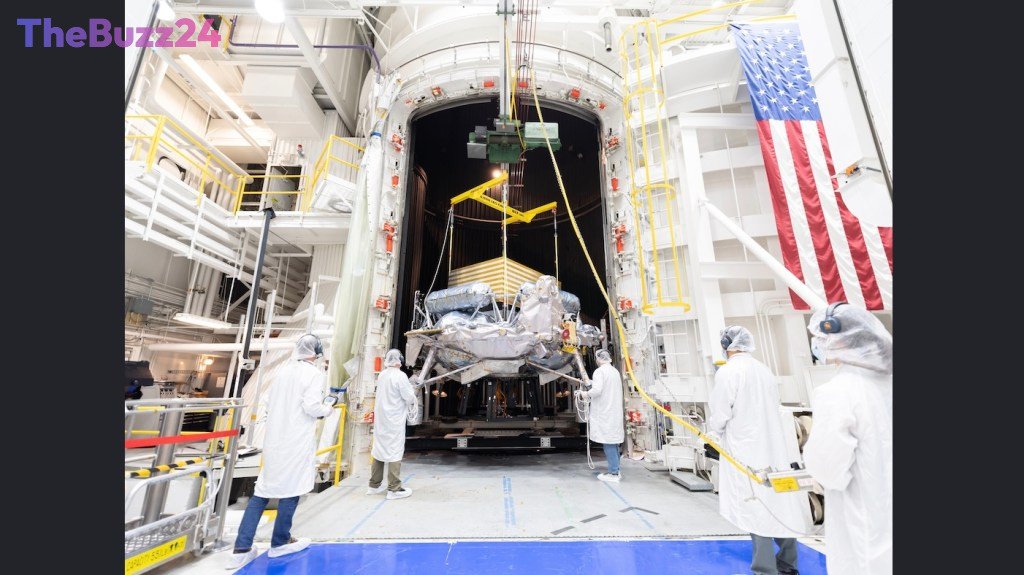
Voyager Technologies’ Griffin Lander Passes Rigorous NASA Tests for Historic Moon Mission
Voyager Technologies’ Griffin Mission One (Griffin-1) lunar lander has successfully completed a comprehensive suite of environmental tests at NASA’s Jet Propulsion Laboratory (JPL), marking a significant milestone in preparations for its upcoming mission to the Moon. These critical tests simulated the harsh conditions of space, including extreme temperatures, vacuum, intense vibrations, and acoustic pressures, ensuring the spacecraft’s readiness for the journey and operations on the lunar surface.
The Griffin-1 lander, designed to be a key component in NASA’s ambitious Moon Base Program, is slated to launch later this year aboard a SpaceX Falcon Heavy rocket. Its mission is to deliver over 1,100 pounds of cargo to the resource-rich Nobile Crater near the lunar South Pole. This substantial payload capacity categorizes Griffin-1 as an infrastructure-class lander, essential for establishing humanity’s first permanent lunar outpost. The lander will carry a diverse array of 10 science and technology demonstrations from six different countries, including Astrolab’s FLIP rover, which will be the largest commercial payload ever sent to the Moon.
During its testing phase at JPL, the 2,789-pound spacecraft underwent meticulous evaluations. Engineers assessed its mass properties to understand its stability and navigation capabilities in space. The lander was also subjected to electromagnetic interference and compatibility testing within an anechoic chamber to ensure its electronic systems function without interfering with each other. Furthermore, vibration and acoustic tests simulated the violent forces experienced during rocket launch, with hundreds of sensors monitoring the spacecraft’s resilience.
The final stages of testing took place in JPL’s historic 25-Foot Space Simulator, a thermal vacuum chamber that has supported numerous iconic space missions since the 1960s. Here, Griffin-1 endured extreme temperature fluctuations, ranging from 167 degrees Fahrenheit (75 degrees Celsius) to minus 148 degrees Fahrenheit (minus 100 degrees Celsius), replicating the thermal challenges of deep space and the lunar surface. Having passed these demanding trials, Griffin-1 has returned to Voyager Lunar Systems’ facilities for final assembly and preparation for its launch readiness operations.
Key Takeaways
- Voyager Technologies' Griffin-1 lunar lander has successfully passed rigorous environmental testing at NASA's Jet Propulsion Laboratory.
- The Griffin-1 lander is scheduled to launch later this year on a SpaceX Falcon Heavy rocket, carrying over 1,100 pounds of cargo to the lunar South Pole.
- The mission is part of NASA's CLPS initiative and aims to support the establishment of the first lunar outpost, carrying significant scientific and technological payloads.
Editor’s Analysis & Impact
The successful completion of rigorous testing for the Griffin-1 lunar lander signifies a crucial step forward in the burgeoning commercial lunar exploration sector. As part of NASA’s CLPS initiative, this mission underscores the growing collaboration between government agencies and private companies to achieve ambitious space exploration goals. The Griffin-1’s substantial payload capacity and its role in delivering infrastructure highlight a shift towards sustained lunar presence rather than short-term visits. This development is pivotal for the future of the Moon Base Program, paving the way for more complex operations and scientific research on the lunar surface, and potentially setting a precedent for future commercial ventures in space.
Frequently Asked Questions
Q: What is the CLPS initiative?
A: CLPS stands for Commercial Lunar Payload Services. It is a NASA program that utilizes commercial partners to deliver science and technology payloads to the Moon, supporting NASA's lunar exploration goals.
Q: What is the significance of Nobile Crater?
A: Nobile Crater, located near the lunar South Pole, is of significant interest due to the potential presence of water ice in permanently shadowed regions, making it a key target for future lunar bases and resource utilization.
Q: What is the 'infrastructure-class' lander designation?
A: An 'infrastructure-class' lander refers to a spacecraft capable of delivering a large amount of mass and volume to the lunar surface, essential for establishing foundational elements of a lunar base, such as power systems, habitats, or significant scientific equipment.
AI Disclosure: This article is based on verified data and official reports. Our Team and AI have cross-referenced every financial detail with primary sources to ensure total accuracy.
More from this Category