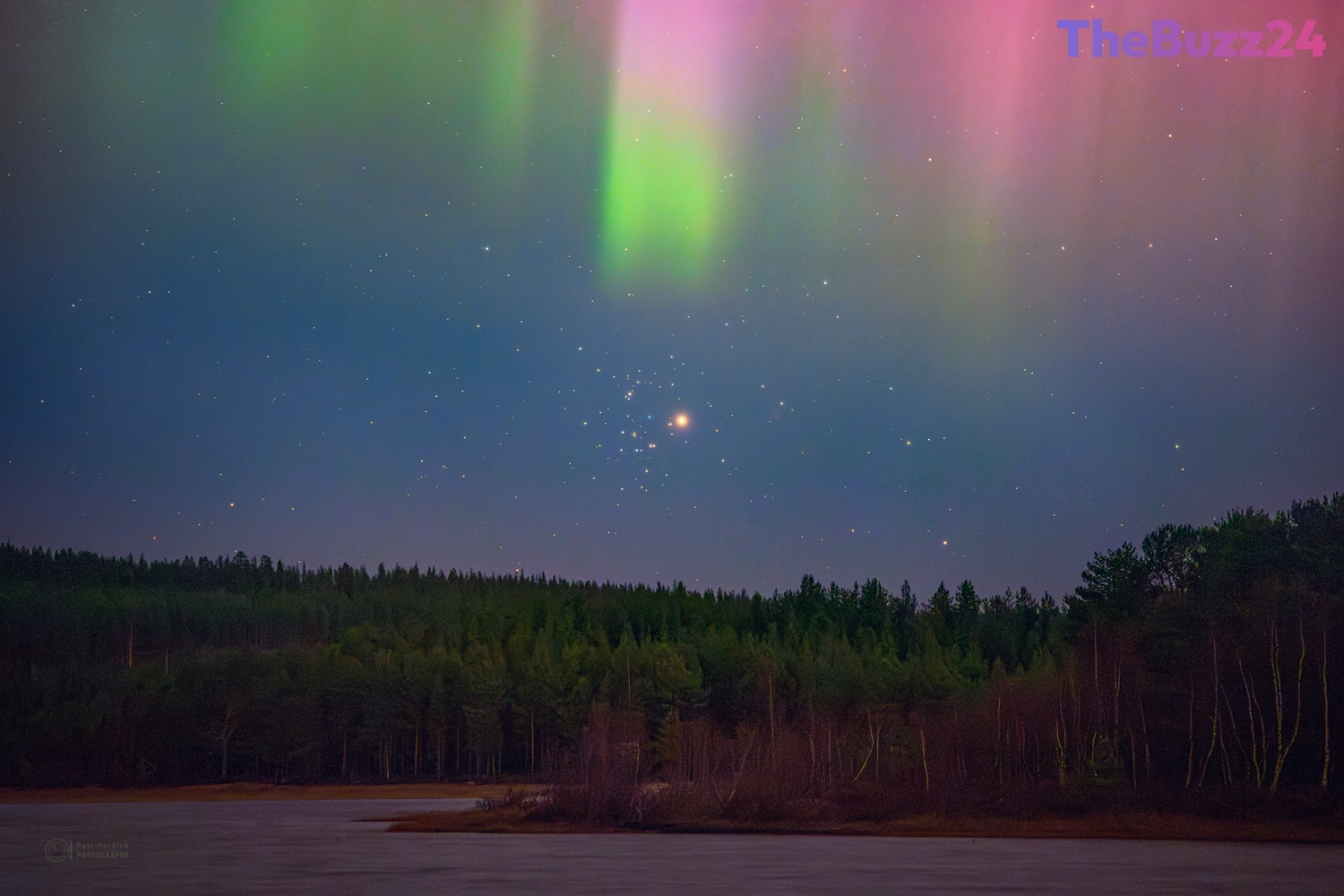
Celestial Alignment: Mars and the Beehive Cluster Shine Beneath Arctic Auroras
A rare and striking celestial display occurred over Lansjärv, Sweden, on October 14, 2026, as Mars appeared to drift directly into the Beehive cluster, also known as M44 or Praesepe. This astronomical alignment was framed by a vibrant auroral curtain, creating a unique visual event that captivated observers in the Arctic region. The atmospheric phenomenon was triggered by a significant solar eruption on October 10, which sent a wave of energetic particles toward Earth, resulting in intense geomagnetic disturbances.
As these solar particles interacted with Earth’s atmosphere, they energized gas molecules, producing the vivid, dancing lights known as the aurora. For the indigenous Sámi people, who refer to these lights as ‘guovssahasat,’ the display holds deep cultural significance and is traditionally regarded with profound respect. The backdrop of the Swedish landscape, featuring silhouettes of trees, provided a stark contrast to the cosmic activity occurring thousands of miles above.
Beyond the visual spectacle, the event highlighted the scientific importance of the Beehive cluster. While the name suggests a swarm of insects, M44 is actually a dense collection of young stars. Astronomers have long utilized this cluster to study stellar evolution, specifically how stars lose mass through stellar winds and gradually slow their rotation over time. The proximity of Mars to this cluster during the auroral event offered a rare opportunity for both casual stargazers and professional researchers to observe the interplay between planetary motion and deep-space objects.
Key Takeaways
- A solar eruption on October 10, 2026, triggered a powerful auroral display over Sweden.
- Mars aligned visually with the Beehive cluster (M44), a group of young stars used by scientists to study stellar rotation.
- The event highlights the intersection of space weather, planetary astronomy, and indigenous cultural heritage.
Editor’s Analysis & Impact
The event captured in Sweden serves as a poignant reminder of the dynamic relationship between solar activity and Earth’s environment. From a scientific perspective, the Beehive cluster remains a critical laboratory for understanding stellar aging processes. As we continue to monitor space weather, events like this underscore the importance of global observation networks. The broader implication is the increasing public interest in ‘astrotourism’ and the cultural preservation of celestial phenomena. As solar activity fluctuates, we can expect more frequent and intense auroral displays, providing both challenges for satellite infrastructure and unparalleled opportunities for public engagement with space science. The integration of indigenous perspectives with modern astronomical data continues to enrich our collective understanding of the night sky.
Frequently Asked Questions
Q: What is the Beehive cluster?
A: The Beehive cluster, or M44, is a group of young stars located in the constellation Cancer. It is a frequent subject of study for astronomers researching how stars evolve and lose mass over time.
Q: What causes the aurora borealis?
A: Auroras are caused by energetic particles from the Sun colliding with gas molecules in Earth's atmosphere. These collisions release energy in the form of light, creating the colorful curtains seen in polar regions.
AI Disclosure: This article is based on verified data and official reports. Our Team and AI have cross-referenced every financial detail with primary sources to ensure total accuracy.
More from this Category