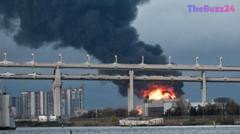
St. Petersburg Energy and Tech Facilities Hit in Deadly Overnight Drone Strikes
A series of overnight drone strikes targeted major industrial and technology facilities in St. Petersburg, leaving at least one person dead and five others injured. Regional officials confirmed that emergency response teams were deployed to contain blazes at both the St. Petersburg Oil Terminal and the Ruchyi oil depot. The heavy aerial assault also forced the temporary suspension of flights at Pulkovo Airport and caused structural damage to twelve apartment complexes and two residential homes across the city.
Beyond fuel infrastructure, the targeted strike disrupted significant Russian commercial and digital operations. A major logistics hub operated by top e-commerce platform Ozon caught fire after being hit by a drone, forcing an emergency evacuation of staff and forcing the facility to suspend seller deliveries. Additionally, social media giant VKontakte (VK) reported that its regional data center was struck, leading to temporary service outages for users before full network recovery was achieved. This follows recent actions targeting other digital services, such as search giant Yandex, as part of a broader strategy against key economic targets.
The renewed offensive comes amid escalating tensions over critical power grid security ahead of the freezing winter season. Ukrainian leadership indicated that Russian forces have repeatedly pounded their domestic power system, executing thousands of drone and missile strikes over the past week alone that left tens of thousands of civilians without electricity. Although a brief pause in strikes on petroleum sites had been observed following US diplomatic proposals, deep-strike operations against fuel hubs have quickly resumed in full force.
Despite the military escalation, diplomatic dialogue remains active behind the scenes. High-level discussions between Ukrainian leadership and US negotiators continue in an attempt to plot future diplomatic maneuvers. However, with mutual strikes against civilian energy targets reaching new heights, both sides face mounting logistical pressures and severe economic disruptions as winter sets in.
Key Takeaways
- Overnight drone strikes damaged two major oil facilities, an Ozon logistics hub, and a VKontakte data center in St. Petersburg, causing one death and several injuries.
- The attack temporarily grounded flights at Pulkovo Airport and inflicted damage on over a dozen residential structures.
- Reciprocal strikes on critical energy and fuel infrastructure are intensifying on both sides ahead of the winter season.
Editor’s Analysis & Impact
The targeting of critical petroleum nodes like the St. Petersburg Oil Terminal demonstrates a clear strategy aimed at eroding primary revenue sources and domestic energy distribution. The collateral impact on high-profile digital assets—including Ozon and VKontakte—underscores the operational vulnerabilities of major economic centers situated far from the primary frontlines. Moreover, these escalations highlight the complex geopolitical backdrop, particularly as international powers attempt to balance global energy stabilization with diplomatic mediation. As winter approaches, the accelerated rate of mutual attacks against power grids and refined fuel logistics is likely to heighten volatility in global energy markets and compound humanitarian challenges across the region.
Frequently Asked Questions
Q: Which major facilities in St. Petersburg were damaged during the attack?
A: The strikes hit the St. Petersburg Oil Terminal, the Ruchyi oil depot, an Ozon logistics center, and a regional data center belonging to social media provider VKontakte.
Q: Was civilian transportation or housing impacted by the strikes?
A: Yes, Pulkovo Airport was temporarily closed to air traffic, and twelve apartment buildings along with two private homes sustained structural damage.
Q: Why has energy infrastructure become a central focus of recent strikes?
A: Both parties are aggressively targeting power grids, oil depots, and fuel networks ahead of the winter months to degrade military supply lines, restrict state revenues, and weaken operational logistics.
AI Disclosure: This article is based on verified data and official reports. Our Team and AI have cross-referenced every financial detail with primary sources to ensure total accuracy.
More from this Category