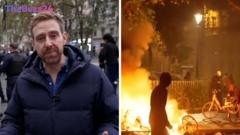
France Sees Calm Night Following Emergency Curfews and Crackdown on Nationwide Riots
French urban centers experienced a notably peaceful night following the implementation of targeted curfews designed to suppress days of intense rioting and looting. Prime Minister Sébastien Lecornu confirmed that emergency restrictions significantly contributed to restoring order after a weekend of widespread civil unrest.
Emergency measures, including strict curfews, were deployed in key areas of central Paris, such as the Place de la République and the Les Halles commercial district, where demonstrators had previously assembled. Similar restrictions targeting the movement of juveniles and large assemblies were enacted in major metropolitan areas including Marseille, Bordeaux, Nice, Lyon, Lille, and surrounding northern towns. Lecornu expressed gratitude to law enforcement personnel for successfully implementing the mandates, noting that future curfew extensions will be evaluated based on localized necessity and determined directly by regional authorities and municipal leaders.
The recent wave of demonstrations originated last month as student-led movements advocating for improved educational conditions. However, the scope of the protests rapidly expanded, drawing widespread participation from trade unions and various activist coalitions addressing a broader array of grievances. The escalation led to intense clashes, resulting in over 2,500 arrests since the outbreak of the crisis. Authorities reported that approximately 1,000 police officers sustained injuries during the disturbances, while ongoing investigations continue into the full extent of property damage inflicted upon national landmarks.
Key Takeaways
- Targeted curfews across Paris and other major French cities successfully restored calm after a weekend of severe riots.
- Over 2,500 individuals have been arrested and approximately 1,000 police officers injured since the protests began last month.
- What started as student demonstrations for better school conditions has escalated into broader protests backed by trade unions.
Editor’s Analysis & Impact
The recent wave of civil unrest in France highlights deep-seated socioeconomic and educational tensions that extend far beyond initial student grievances. The government’s reliance on localized curfews and heavy policing has successfully quelled immediate violence, but it represents a temporary fix rather than a systemic resolution. For the business and economic landscape, recurring nationwide protests disrupt retail activity, tourism, and supply chains, potentially dampening consumer confidence and foreign investment in the short term. Moving forward, the administration of President Emmanuel Macron faces the delicate challenge of balancing public safety with meaningful political dialogue to address the root causes of civil discontent. Failure to engage with union demands and broader public concerns risks igniting further cycles of unrest, which could pose sustained political and economic risks for the nation.
Frequently Asked Questions
Q: What triggered the recent protests in France?
A: The protests initially began with students demanding better school conditions before expanding to include broader grievances supported by trade unions and various activist groups.
Q: Which cities implemented emergency curfews?
A: Curfews and movement restrictions were introduced in central Paris, Marseille, Bordeaux, Nice, Lyon, Lille, and several other northern towns.
Q: How many arrests have been made during the unrest?
A: Officials reported that more than 2,500 people have been arrested since the civil disorder first broke out.
AI Disclosure: This article is based on verified data and official reports. Our Team and AI have cross-referenced every financial detail with primary sources to ensure total accuracy.
More from this Category