Japan’s Ambitious Mission Blasts Off to Capture Martian Moon Dust
A groundbreaking space mission has been launched from Japan with the ambitious goal of retrieving samples from Phobos, one of Mars’s two small moons. If successful, this endeavor marks the first time material from a Martian moon will be brought back to Earth for detailed analysis in laboratories, potentially unlocking secrets about the formation of the Red Planet and its celestial companions.
The Mars Moons Exploration (MMX) mission, spearheaded by the Japan Aerospace Exploration Agency (JAXA), is slated to reach the vicinity of Mars in August 2027. The mission aims to shed light on the enduring mystery of how Mars’s moons, Phobos and Deimos, came into existence. Scientists are particularly interested in Phobos, a potato-shaped moon approximately 20 kilometers across, which presents unique challenges for exploration due to its low gravity and proximity to Mars.
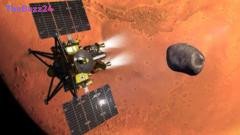
Upon arrival, the MMX spacecraft will first observe Deimos before focusing its attention on Phobos. A key challenge will be the deployment of a small rover onto Phobos’s surface, a feat never before attempted on a moon with such minimal gravitational pull. This rover will scout a suitable landing site for the main MMX spacecraft. Once the mothership lands, a robotic arm will collect approximately 10 grams of lunar dust. This precious material will be sealed in a capsule and dispatched back to Earth, with a planned landing in South Australia in 2031.
Scientists are eager to study the composition of the Phobos samples. Current theories suggest the moons either formed from debris after a massive impact on early Mars or are captured asteroids from the outer solar system. Analyzing the chemical and mineral makeup of the returned dust is expected to provide definitive evidence to support or refute these hypotheses. Furthermore, there’s a tantalizing possibility that the samples might contain traces of Mars itself, embedded in the Phobos dust from ancient impacts on the Red Planet, offering direct insights into Martian history.
Key Takeaways
- Japan has launched the MMX mission to collect dust samples from Mars's moon Phobos and return them to Earth.
- The mission aims to solve the mystery of how Mars's moons formed and could potentially bring back samples of Mars itself.
- If successful, this will be the first sample return mission from a Martian moon, with samples expected back in 2031.
Editor’s Analysis & Impact
The MMX mission represents a significant leap in planetary science and space exploration, particularly in the realm of sample return. By targeting Phobos, Japan is not only pursuing fundamental scientific questions about planetary formation but also pushing the boundaries of robotic exploration technology. The challenges of landing and sampling on a low-gravity body are substantial, and success would pave the way for future complex missions. The potential for discovering Martian material within the Phobos samples adds another layer of excitement, offering a unique opportunity to study Mars directly. This mission underscores the growing international competition and collaboration in space, with China also planning its own Mars sample return mission, highlighting the increasing strategic importance of understanding the Red Planet.
Frequently Asked Questions
Q: What is the main goal of the MMX mission?
A: The primary goal of the Mars Moons Exploration (MMX) mission is to collect dust samples from Phobos, one of Mars's moons, and return them to Earth for scientific analysis. This aims to help determine how Mars's moons formed and potentially provide insights into Mars itself.
Q: When is the MMX mission expected to return samples to Earth?
A: The MMX spacecraft is scheduled to arrive at Phobos in August 2027. The collection of samples and their return journey are planned, with the samples expected to land on Earth in the Woomera desert of South Australia in 2031.
Q: Why is collecting samples from Phobos scientifically important?
A: Scientists believe that analyzing the chemical and mineral composition of Phobos dust will help resolve the debate on whether the moon formed from debris after a giant impact on Mars or is a captured asteroid. Additionally, the samples might contain grains of Mars itself, offering direct information about the Red Planet's composition and history.
AI Disclosure: This article is based on verified data and official reports. Our Team and AI have cross-referenced every financial detail with primary sources to ensure total accuracy.
More from this Category