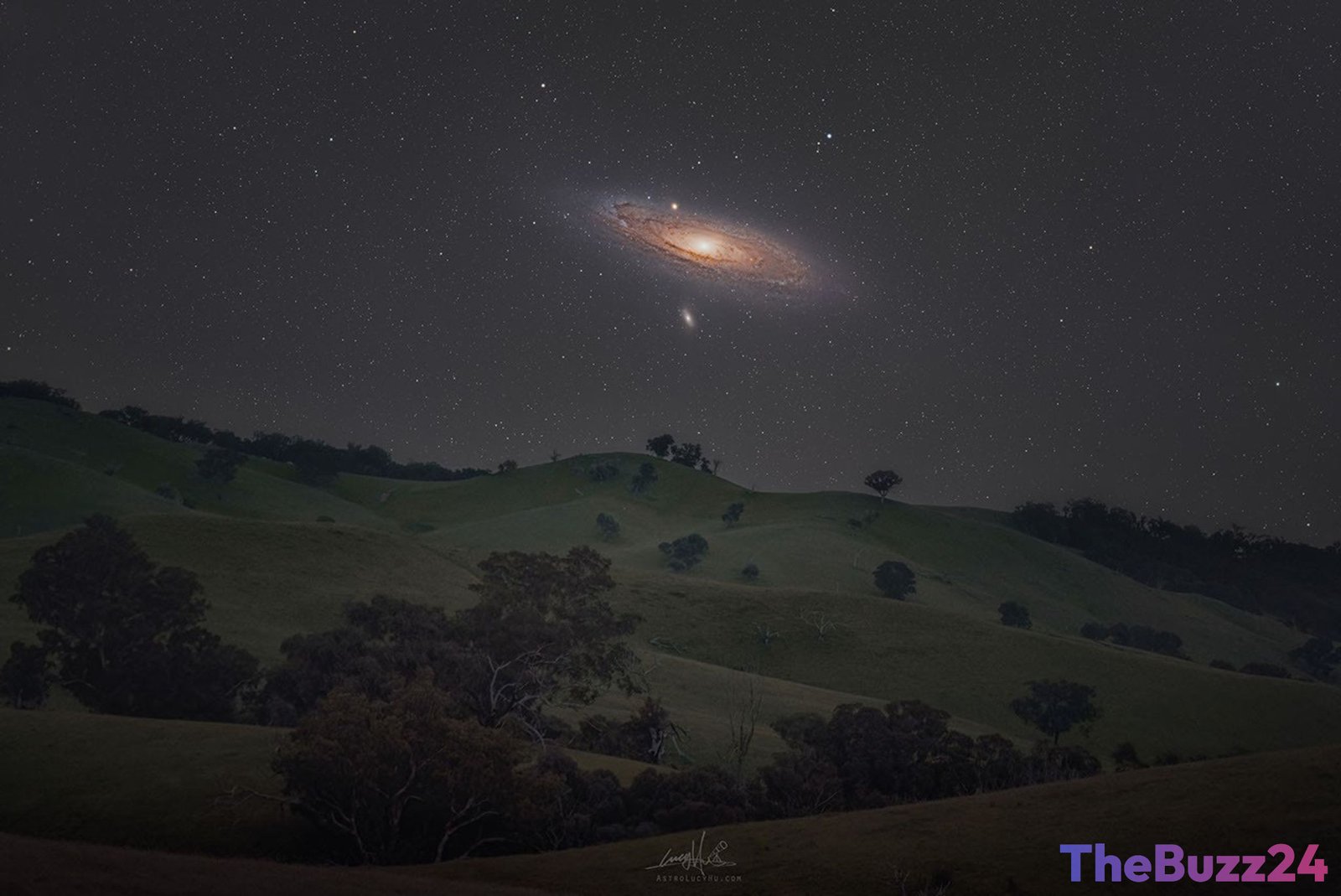
Andromeda Galaxy Shines in Southern Spring Sky
The Andromeda Galaxy, also known as M31, presents a stunning spectacle in the night sky during the southern hemisphere’s spring. While it hovers low on the northern horizon for observers in Australia, it reaches its highest point around midnight.
A recent telephoto image captured during the early days of October beautifully illustrates the galaxy’s grandeur. This composite image, created by combining multiple exposures, reveals the spiral galaxy in remarkable detail against the backdrop of rolling Australian hills. The Andromeda Galaxy, a prominent object in the Messier catalog, is typically perceived by the naked eye as a faint, fuzzy patch.
However, through advanced digital processing, including tracking and stacking numerous frames with a foreground shot, the true extent of this celestial neighbor is brought to light. This deep astro-image composite showcases the galaxy’s impressive span, which, during the springtime night, can stretch across nearly six full moons in the Earth’s sky. The image serves as a testament to the power of modern astrophotography in unveiling the universe’s hidden wonders.
Key Takeaways
- The Andromeda Galaxy (M31) is best viewed in the southern hemisphere's spring, reaching its highest point around midnight.
- Advanced astrophotography techniques are required to reveal the Andromeda Galaxy's full detail and extent, which appears as a faint patch to the naked eye.
- The composite image highlights the galaxy's impressive size, spanning nearly six full moons in the night sky.
Editor’s Analysis & Impact
This image of the Andromeda Galaxy underscores the ongoing advancements in astrophotography and data processing. It highlights how technology allows us to perceive celestial objects with unprecedented detail, transforming faint smudges into breathtaking cosmic vistas. For the public, it fosters a deeper appreciation for astronomy and the vastness of space. For the scientific community, such detailed imagery can contribute to a better understanding of galactic structures, evolution, and our place within the universe. The accessibility of such images through platforms like APOD democratizes astronomical discovery, inspiring future generations of scientists and enthusiasts alike.
Frequently Asked Questions
Q: What is the Andromeda Galaxy?
A: The Andromeda Galaxy, also known as M31, is a spiral galaxy located approximately 2.5 million light-years away from Earth. It is the closest large galaxy to our own Milky Way and is a prominent object in the night sky.
Q: Why is the Andromeda Galaxy only visible as a faint patch to the naked eye?
A: While the Andromeda Galaxy is one of the brightest objects in the Messier catalog, its immense distance means that only its brightest core is discernible to the unaided eye as a small, fuzzy patch of light. Detailed observation requires telescopes or advanced photographic techniques.
Q: What does 'southern spring' mean for viewing Andromeda?
A: For observers in the southern hemisphere, 'southern spring' refers to the months of September, October, and November. During this period, the Andromeda Galaxy appears highest in the sky around midnight, offering a better, though still low, viewing opportunity compared to other times of the year.
AI Disclosure: This article is based on verified data and official reports. Our Team and AI have cross-referenced every financial detail with primary sources to ensure total accuracy.
More from this Category