NASA Outlines Complex Artemis III Earth-Orbit Tests with Commercial Landers
As part of preparations for humanity’s return to the lunar surface, a major multi-spacecraft demonstration flight is taking shape to test critical systems in low Earth orbit. Scheduled for 2027, the upcoming 14-day mission will carry four spacefarers aboard the Orion spacecraft to execute complex rendezvous, docking, and operational evaluations with test versions of human landing systems developed by commercial aerospace partners Blue Origin and SpaceX.
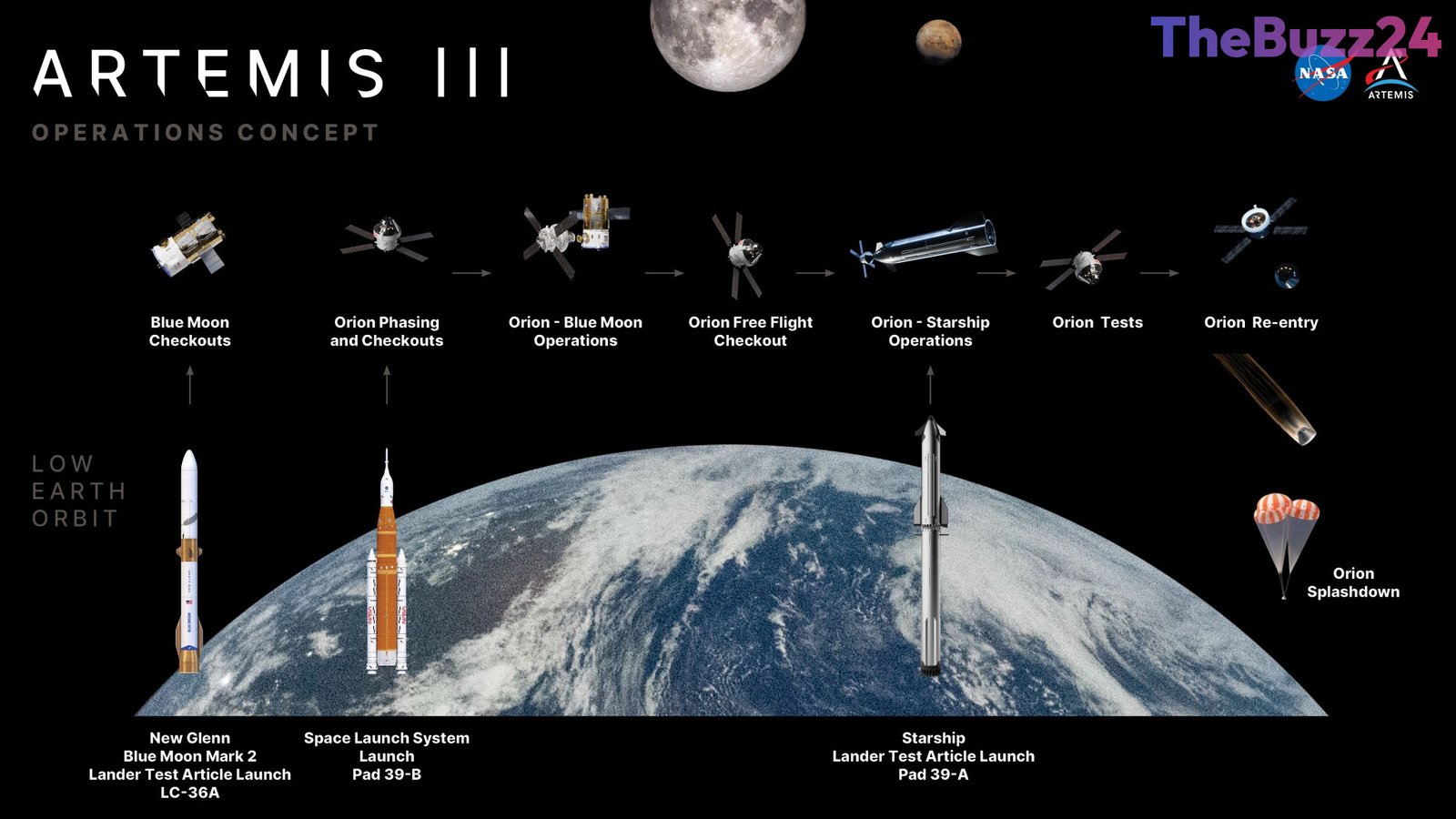
The ambitious campaign will require launching three distinct spacecraft on three separate heavy-lift rockets over a short duration—a first-of-its-kind endeavor for flight controllers and engineering teams. The itinerary begins with the deployment of a Blue Origin lunar lander test article into a circular low Earth orbit. Shortly thereafter, the Orion spacecraft, powered by the Space Launch System, will launch from Florida to rendezvous and dock with the Blue Moon test vehicle, allowing the crew to enter the cabin and evaluate life-support systems, avionics, and controls firsthand.
Following the completion of the Blue Origin evaluations, Orion will undock and prepare for a second, separate rendezvous sequence with a Starship test article launched by SpaceX. While astronauts will not board the Starship vehicle during this phase, the exercise is designed to test different docking geometries, communication architectures, and integrated software performance between Orion and a vastly different commercial architecture.
The remaining days of the orbital flight will be utilized for a variety of supplementary test objectives, including the assessment of crew survival suits, thermal measurements, cellular biology experiments, and autonomous health-assessment studies. Ultimately, the mission aims to significantly reduce technical risk, validate hardware functionality, and forge robust operational coordination before humanity takes its next historic steps near the lunar South Pole.
Key Takeaways
- The 2027 test mission will send four crew members into low Earth orbit to evaluate landing systems built by Blue Origin and SpaceX.
- The flight marks a historic first by launching three separate spacecraft on three different rockets for joint orbital operations.
- Data gathered during the 14-day mission will help reduce risks and validate hardware ahead of future crewed lunar landings.
Editor’s Analysis & Impact
This upcoming test flight represents a crucial transitional phase in modern space exploration, shifting the paradigm from government-exclusive operations to deep collaboration with private aerospace contractors. By testing contrasting commercial lander architectures in the safety of low Earth orbit, flight planners can identify integration bottlenecks, software glitches, and procedural hurdles before lives are put on the line near the lunar South Pole. The success of this multi-launch strategy will not only dictate the timeline for crewed moon landings but also establish a scalable blueprint for future interplanetary logistics, commercial space stations, and eventual crewed missions to Mars.
Frequently Asked Questions
Q: What is the primary objective of the upcoming mission?
A: The mission is designed to test rendezvous, docking, habitation, and operational procedures with commercial lunar landers in low Earth orbit to reduce risk before landing astronauts on the Moon.
Q: Which commercial partners are involved in the lander tests?
A: Blue Origin and SpaceX are providing the human landing system test articles for the orbital demonstrations.
Q: Will astronauts enter both commercial landers during the flight?
A: Astronauts will enter and evaluate Blue Origin's lander test article during a multi-day docked phase, but they will not enter the SpaceX Starship test article during its separate docking demonstration.
AI Disclosure: This article is based on verified data and official reports. Our Team and AI have cross-referenced every financial detail with primary sources to ensure total accuracy.
More from this Category