NASA’s NEO Surveyor Telescope Readies for Launch with Advanced Sunshield
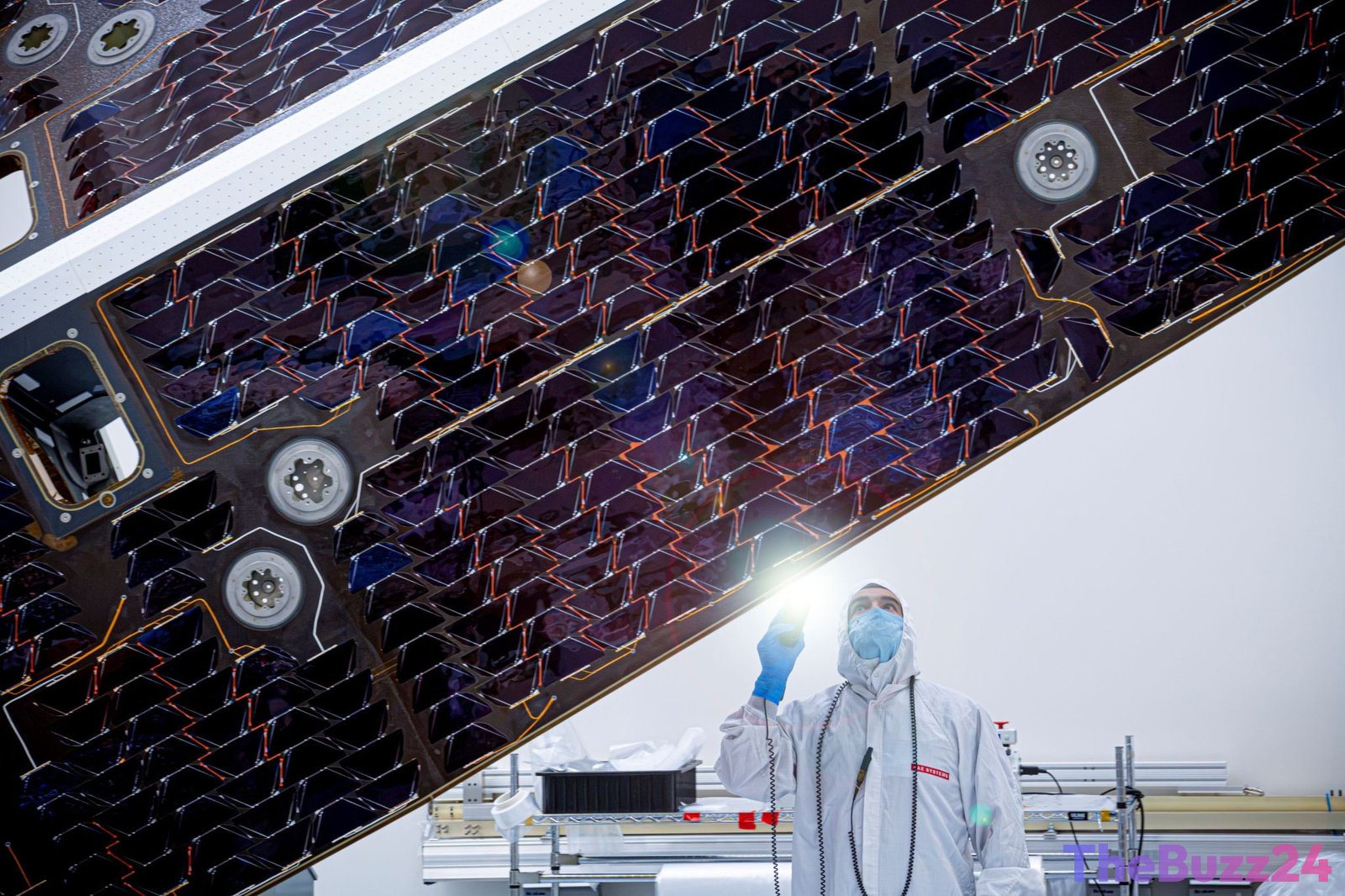
NASA’s ambitious Near-Earth Object (NEO) Surveyor mission is making significant progress, with its crucial sunshade component now undergoing inspection. This innovative sunshield, standing an impressive 20 feet tall and measuring 8 feet wide at its base, is designed to maintain the frigid operating temperatures required for the infrared space telescope. Its primary function is to shield the sensitive instruments from the Sun’s intense heat, enabling the telescope to effectively scan the skies for potentially hazardous asteroids and comets.
The NEO Surveyor spacecraft is engineered to detect celestial objects that are particularly challenging to find using traditional ground-based optical telescopes. This includes asteroids and comets that orbit in close proximity to the Sun, a region of the sky that is often obscured from Earth-bound observatories. By operating in infrared, the telescope can peer through dust and gas, and its specialized sunshield ensures it can function optimally even when observing areas near our star.
This advanced sunshade not only protects the telescope but also plays a vital role in powering the spacecraft. The successful development and testing of this critical component mark a substantial step forward in NASA’s ongoing efforts to identify and track objects that could pose a threat to Earth. The mission’s success hinges on its ability to operate reliably in the harsh environment of space, and the sunshade is central to achieving that goal.
Key Takeaways
- NASA's NEO Surveyor mission features a large, 20-foot-tall sunshade essential for its infrared telescope's operation.
- The sunshade will keep the telescope cool and enable it to detect asteroids and comets, including those near the Sun.
- The NEO Surveyor aims to identify hard-to-find near-Earth objects that are difficult for ground-based telescopes to observe.
Editor’s Analysis & Impact
The development of the NEO Surveyor’s sunshade represents a critical advancement in planetary defense technology. By enabling infrared observation near the Sun, the mission addresses a significant gap in current asteroid detection capabilities. The success of this mission could dramatically improve our understanding of the near-Earth object population, providing crucial data for potential future mitigation strategies. The integration of power generation with thermal protection in the sunshade design highlights innovative engineering solutions for long-duration space missions. This project underscores the growing global emphasis on space-based observation for scientific discovery and planetary safety.
Frequently Asked Questions
Q: What is the primary purpose of the NEO Surveyor's sunshade?
A: The sunshade's main purpose is to keep the infrared telescope cool, allowing it to detect near-Earth asteroids and comets without being overwhelmed by the Sun's heat. It also provides power to the spacecraft.
Q: Why is observing near the Sun important for asteroid detection?
A: Many asteroids and comets have orbits that bring them close to the Sun, making them difficult or impossible to detect with ground-based optical telescopes. The NEO Surveyor's infrared capabilities and sunshield allow it to observe these challenging regions.
Q: What kind of objects will NEO Surveyor search for?
A: NEO Surveyor will search for near-Earth objects (NEOs), which include asteroids and comets that orbit the Sun and come within a certain distance of Earth's orbit. The mission specifically targets those that are harder to find.
AI Disclosure: This article is based on verified data and official reports. Our Team and AI have cross-referenced every financial detail with primary sources to ensure total accuracy.
More from this Category