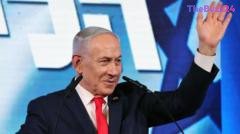
Israel’s Election Stalemate: Netanyahu’s Bloc Leads, Coalition Formation Uncertain Amidst High Turnout
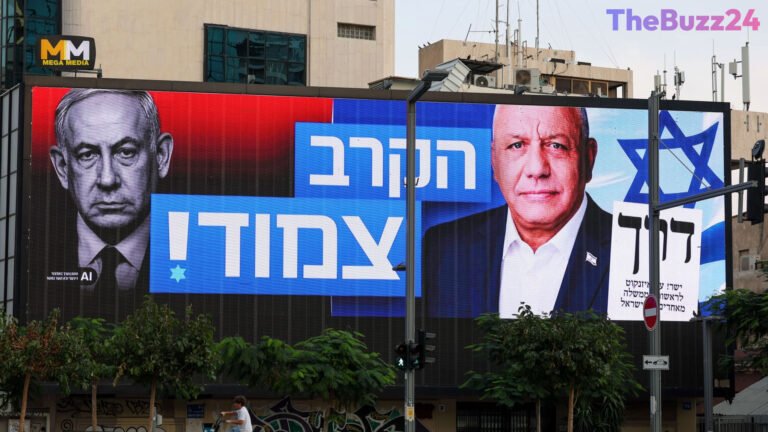
Partial results from Israel’s recent general election indicate that veteran Prime Minister Benjamin Netanyahu’s bloc holds a lead, though it falls short of securing an outright majority in the 120-seat Knesset. With approximately 85% of ballots tallied, Netanyahu’s Likud party, alongside its far-right and ultra-Orthodox Jewish allies, is projected to win 53 seats. In contrast, the bloc led by former military chief Gadi Eisenkot, comprising his Yashar party and other Jewish opposition factions, is set for 48 seats. The high voter turnout, reaching 77.7%, marked the country’s highest in over two decades, reflecting the profound significance Israelis attached to this election.
The path to forming a stable governing coalition appears fraught with challenges for both leaders. A critical factor in the political calculus is the unprecedented performance of Arab-led parties, which are on track to secure 19 seats. This strong showing positions them as potential kingmakers; however, nearly all Jewish parties have publicly committed to not collaborating with them. This reluctance to engage with Arab factions complicates any efforts to bridge the gap to a 61-seat majority, potentially leading to prolonged negotiations or even another election if a government cannot be formed.
The election, the first since the deadly Hamas-led attacks on October 7, 2023, and the subsequent regional conflicts, was widely seen as one of the most consequential in Israel’s history. Key campaign issues revolved around accountability for security failures, the conduct of ongoing wars, the contentious issue of conscripting ultra-Orthodox Jewish men into the military, judicial reforms, and Israel’s international standing. President Isaac Herzog is expected to initiate consultations with all political factions once final results are confirmed, a process that could span weeks as he seeks to identify the leader most capable of forming a government and avoiding further political instability.
Both Netanyahu and Eisenkot have asserted their right to lead the next government, with Netanyahu advocating for a “strong right-wing national government” and Eisenkot emphasizing the public’s desire for “change.” Initial exit polls had presented a more varied picture, but as votes were counted, Netanyahu’s bloc performed better than some early projections. Despite the lead, the current projection of 53 seats is significantly fewer than the 68 seats his bloc commanded in the previous Knesset, underscoring the shifting political landscape and the deep divisions within Israeli society.
Key Takeaways
- Benjamin Netanyahu's bloc is leading in Israel's general election but falls short of the 61-seat majority needed to form a government.
- Arab-led parties achieved an unprecedented 19 seats, positioning them as potential 'kingmakers,' though most Jewish parties have rejected forming a coalition with them.
- The election, held after the October 7th attacks, saw the highest voter turnout in over two decades and focused on critical issues like security, conscription, and judicial reform, highlighting deep societal divisions.
Editor’s Analysis & Impact
The Israeli election results signal a period of significant political uncertainty, with neither major bloc securing a clear path to power. This instability could impact investor confidence and the national economy, particularly if coalition negotiations are protracted or lead to another election. The strong showing of Arab-led parties, despite their potential exclusion from a governing coalition, underscores a growing demand for political representation and could force a re-evaluation of traditional alliances. The outcome will profoundly shape Israel’s future domestic and foreign policies, especially concerning regional conflicts, religious-secular relations, and judicial reforms. The challenge of forming a stable government amidst such deep divisions highlights a critical juncture for Israel’s identity and its standing on the global stage, potentially influencing its diplomatic relations and internal social cohesion.
Frequently Asked Questions
Q: What are the main challenges in forming a government after this election?
A: The primary challenge stems from neither Benjamin Netanyahu's nor Gadi Eisenkot's bloc securing an outright majority of 61 seats. This necessitates complex coalition negotiations, further complicated by the significant gains of Arab-led parties, who could be kingmakers but face strong opposition from most Jewish parties regarding potential partnerships.
Q: Why was this election considered particularly significant for Israel?
A: This election was the first since the October 7th attacks and the subsequent conflicts, making security failures and regional policy central issues. It also addressed contentious topics like ultra-Orthodox conscription into the military and judicial reforms, with the outcome poised to determine Israel's future political and social trajectory amidst deep national divisions.
Q: What role do Arab-led parties play in the current Israeli political landscape?
A: Arab-led parties achieved an unprecedented number of seats, positioning them as potential 'kingmakers' in coalition formation. Their increased turnout signals a desire for greater political influence, though their ability to join a governing coalition is hampered by strong opposition from most Jewish parties, who have largely pledged not to partner with them.
AI Disclosure: This article is based on verified data and official reports. Our Team and AI have cross-referenced every financial detail with primary sources to ensure total accuracy.
More from this Category