Unraveling the Mystery of Mars’ Massive 1,500-Kilometer Elongated Cloud
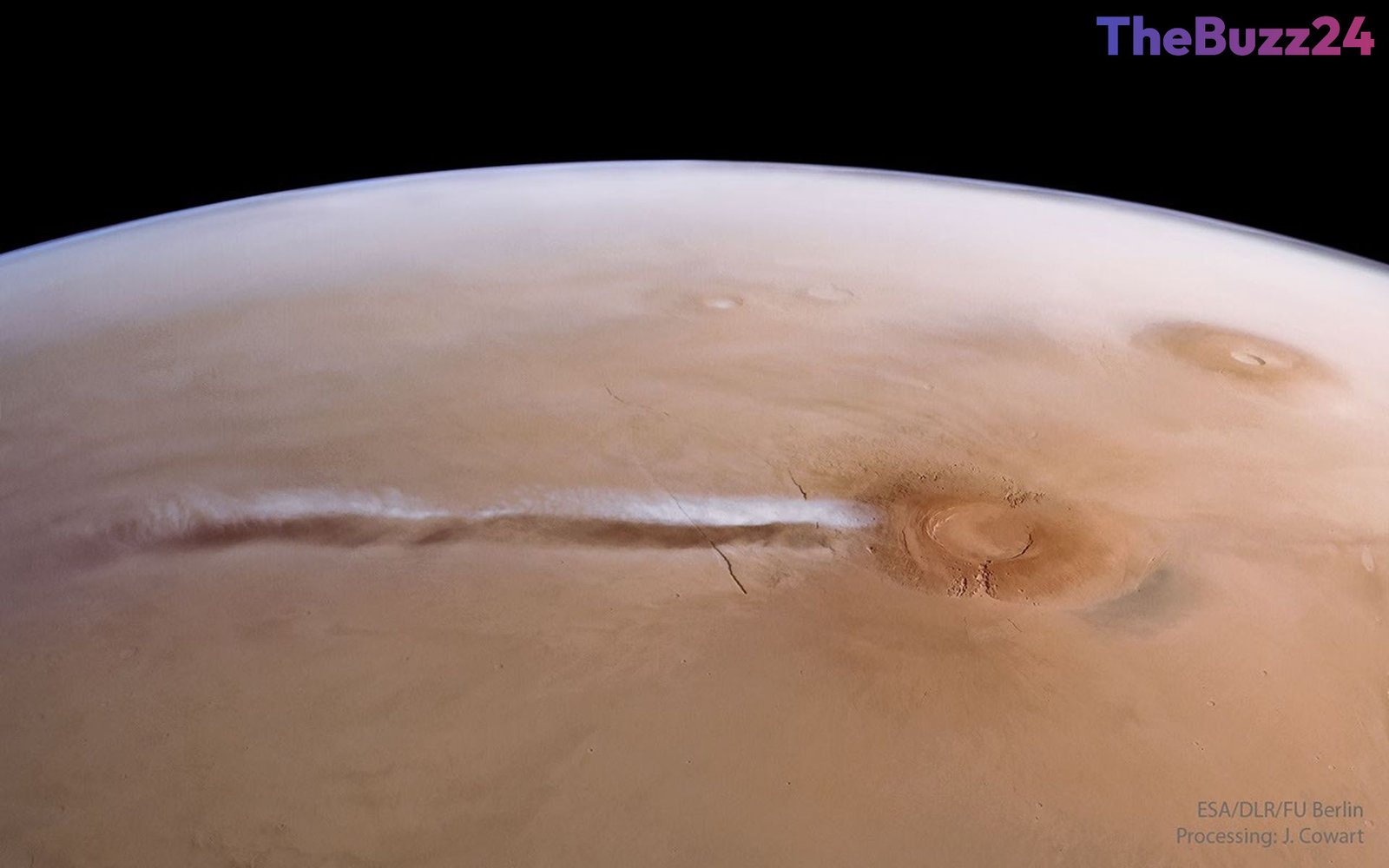
Astronomers and planetary scientists continue to study a fascinating atmospheric phenomenon on Mars known as the Arsia Mons Elongated Cloud, or AMEC. First documented by the Viking Orbiter 2 spacecraft in 1977, this remarkable weather event has recently been captured in high-resolution detail by the Mars Express robotic spacecraft.
The colossal water-ice cloud materializes exclusively during the Martian spring and summer seasons and only manifests in the early morning hours. Unlike typical cloud formation processes on Earth and Mars, which rely on water vapor condensing around airborne dust particles, scientists believe dust plays little to no role in generating the AMEC due to the extreme thinness of the high-altitude Martian atmosphere.
Once the cloud forms near the towering Arsia Mons volcano, strong atmospheric winds stretch the vapor downstream, producing an enormous tail that can span an incredible 1,500 kilometers in length. Researchers are actively analyzing data from these seasonal formations to gain deeper insights into planetary atmospheres, which could ultimately improve our comprehensive meteorological models for both Mars and Earth.
Key Takeaways
- The Arsia Mons Elongated Cloud (AMEC) on Mars stretches an impressive 1,500 kilometers long.
- This unique water-ice formation occurs exclusively during spring and summer mornings.
- Unlike typical clouds, scientists believe dust is not involved in forming the AMEC due to the thin Martian atmosphere.
Editor’s Analysis & Impact
The continued study of Martian weather patterns, such as the Arsia Mons Elongated Cloud, represents a critical step forward in planetary science. As robotic missions gather increasingly detailed data on atmospheric dynamics, researchers gain a comparative framework that heavily benefits terrestrial meteorology. Understanding how unique cloud structures form under the thin atmosphere and distinct gravitational pull of Mars broadens our comprehension of fluid dynamics on a planetary scale. Looking ahead, these insights will prove invaluable for future crewed missions to the Red Planet, where accurate weather forecasting and atmospheric modeling will be essential for surface operations and safety. Furthermore, studying alternative planetary climates expands our theoretical boundaries, offering a more robust perspective on climate systems across the solar system.
Frequently Asked Questions
Q: What is the Arsia Mons Elongated Cloud?
A: It is a massive water-ice cloud that forms near the Arsia Mons volcano on Mars during specific seasons and morning hours, stretching up to 1,500 kilometers long.
Q: When was this Martian cloud first discovered?
A: The phenomenon was first recorded by the Viking Orbiter 2 spacecraft in 1977 and has since been studied in greater detail by the Mars Express spacecraft.
Q: How do these clouds form without dust?
A: While Earth clouds and typical Martian clouds usually require dust particles for water crystals to condense around, the AMEC forms through alternative atmospheric mechanisms that bypass the need for dust in the thin Martian air.
AI Disclosure: This article is based on verified data and official reports. Our Team and AI have cross-referenced every financial detail with primary sources to ensure total accuracy.
More from this Category