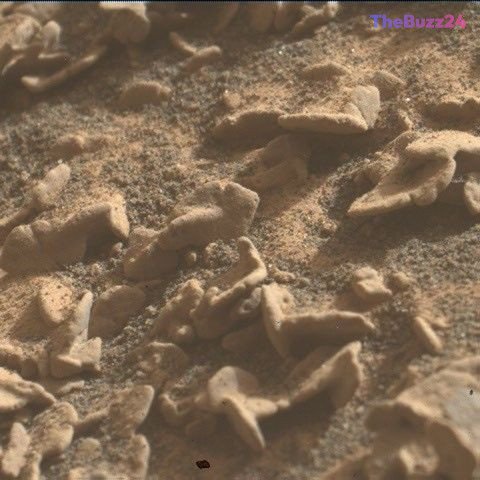
Curiosity Rover Investigates Mysterious Crystal Formations on Mars
The Curiosity rover has successfully concluded its latest drilling campaign at the ‘Nazca’ site on Mars, marking a significant milestone in the ongoing exploration of the Red Planet. During this mission phase, which spanned Sols 5063 through 5069, the rover focused on analyzing unique bedrock features characterized by distinct, chip-shaped crystal formations. These geological structures have become a primary point of interest for researchers seeking to understand the mineralogical history of the region.
Throughout the week, the rover’s robotic arm utilized the Mars Hand Lens Imager (MAHLI) to capture high-resolution imagery of these crystal forms. Simultaneously, the Sample Analysis at Mars (SAM) instrument processed drill samples to determine their chemical composition. The mission team also employed the ChemCam instrument to conduct depth profiles on various targets, including the ‘Colca’ and ‘Bermejo’ crystal formations, providing deeper insights into the subsurface properties of the Martian terrain.
Beyond geological sampling, the rover maintained a rigorous schedule of environmental monitoring. This included conducting dust devil surveys, capturing atmospheric zenith movies, and documenting a solar eclipse event caused by the Martian moon, Phobos. Following the completion of the Nazca drill site analysis, the rover executed a series of maneuvers to depart the area, continuing its southerly trek toward new exploration targets along the ridge systems.
As Curiosity moves forward, it continues to document the landscape using its Remote Micro-Imager (RMI) to create detailed mosaics of distant rock clusters and ridges. These ongoing efforts are essential for mapping the geological diversity of the area and identifying future sites that may hold clues regarding the environmental history of Mars.
Key Takeaways
- Curiosity completed its 49th drill hole at the 'Nazca' site, focusing on unique chip-shaped crystal formations.
- The mission included extensive chemical analysis using the SAM and ChemCam instruments to characterize Martian bedrock.
- The rover successfully captured observations of a solar eclipse by the moon Phobos before continuing its journey southward.
Editor’s Analysis & Impact
The continued operational success of the Curiosity rover provides invaluable longitudinal data regarding Martian geology. By focusing on specific crystal formations, the mission is effectively narrowing down the search for past aqueous environments that could have supported prebiotic chemistry. The integration of high-resolution imaging with deep-crustal chemical analysis represents a sophisticated approach to planetary science that minimizes risk while maximizing data yield. Looking forward, the rover’s transition to new ridge systems suggests a strategic shift toward exploring more complex stratigraphic layers. This ongoing exploration is critical not only for understanding Mars’ past climate but also for refining the landing and operational protocols for future human-led or sample-return missions. The ability to maintain such high-level scientific output years into the mission underscores the robustness of current robotic exploration technology.
Frequently Asked Questions
Q: What was the primary objective of the Curiosity rover at the Nazca site?
A: The primary objective was to drill into the bedrock and analyze unique, chip-shaped crystal formations to better understand the geological composition of the area.
Q: How does the rover capture images of the Martian surface?
A: The rover uses several instruments, including the Mars Hand Lens Imager (MAHLI) for close-up shots and the Remote Micro-Imager (RMI) for long-distance mosaics of the surrounding terrain.
AI Disclosure: This article is based on verified data and official reports. Our Team and AI have cross-referenced every financial detail with primary sources to ensure total accuracy.
More from this Category